
Skip to content

"Moroni's America" – The North American Setting for the Book of Mormon

The Book of Mormon in North America

Search
  • Home
  • Geography
    • Jonathan Neville on the Radio
    • Overview of Geography and Church History
    • The Mormons and the Mounds
    • Divine Documents
    • Cumorah’s Cave
    • Basic Questions
  • Research
    • Original Sources
    • New Research
    • Reviews of Old Research
      • BMAF
      • Book of Mormon Central
      • BYU Religious Studies Center
      • BYU Studies
      • Church History Library
      • FairMormon
      • FARMS
      • Joseph Smith Papers
      • Meridian Magazine
      • Neal A. Maxwell institute-BYU
      • The Interpreter
  • Testimony
  • Moroni’s America Blog
  • Neville Blogs
  • Fun Stuff
  • Maps
  • Store
  • Links
  • About
  • Videos

"Moroni's America" – The North American Setting for the Book of Mormon

The Book of Mormon in North America

Close menu
  • Home
  • Geography
    • Jonathan Neville on the Radio
    • Overview of Geography and Church History
    • The Mormons and the Mounds
    • Divine Documents
    • Cumorah’s Cave
    • Basic Questions
  • Research
    • Original Sources
    • New Research
    • Reviews of Old Research
      • BMAF
      • Book of Mormon Central
      • BYU Religious Studies Center
      • BYU Studies
      • Church History Library
      • FairMormon
      • FARMS
      • Joseph Smith Papers
      • Meridian Magazine
      • Neal A. Maxwell institute-BYU
      • The Interpreter
  • Testimony
  • Moroni’s America Blog
  • Neville Blogs
  • Fun Stuff
  • Maps
  • Store
  • Links
  • About
  • Videos

"Moroni's America" – The North American Setting for the Book of Mormon

The Book of Mormon in North America

Search Toggle menu

Author: Jonathan Neville

November 28, 2019Uncategorized

M2C relies on fictional version of Church history

For our Thanksgiving enjoyment, Meridian Magazine, aka M2C magazine, published another delightfully fictitious version of “Church History” lately. We looked at the first one here.

http://www.bookofmormoncentralamerica.com/2019/11/meridian-m2c-magazine-and-loserthink.html

Let’s take a look at this second article now.

Here’s the link: https://latterdaysaintmag.com/obtain-knowledge-of-countries-and-kingdoms/

Most readers of Meridian M2C Magazine are unaware of the magazine’s editorial policy to promote M2C and mislead readers about the teachings of the prophets about the New York Cumorah.

Long-time readers of this blog can readily spot the errors, of course, but it’s always helpful to have a peer review.

Had the editors asked us for a peer review, this is what we would have offered. To do the peer review, we have to provide the full article (sans photos), which also shows we’re not taking anything out of context, as the anonymous trolls sometimes claim we’re doing. Original in blue, comments in red.

Plus, there’s always the possibility that the editors of Meridian M2C Magazine will revise their editorial policy to accurately inform, rather than mislead, their readers. Hope springs eternal…
_____

CHURCH HISTORY

“Obtain knowledge of countries and kingdoms.”
By V. Garth Norman · November 26, 2019

Why is this misquote in quotation marks? The actual quotation is “obtain a knowledge of history, and of countries, and of kingdoms” 
(Doctrine and Covenants 93:53)


Ancient Migrations from Central America to North and South America

Many discoveries of antiquities throughout the Americas relating to the Middle East bring to mind a Biblical statement in Deuteronomy 28:64: “And the Lord shall scatter thee [Israelites] among all people, from the one end of the earth even unto the other.” This helps us realize that there were more than three migrations (Jaredite, Mulekite, Lehite) by ancient people from the Middle East to the Americas. Also, ancient Central American people traveled outside their principle cities and concourses, such as in the first century BC at the time of Hagoth’s shipping, as well as migrations on land to regions north and south (Alma 63: 4-9; Helaman 3: 3-14), taking with them the Maya Calendar and cubit measuring rods to measure art and architecture throughout the Americas (Norman: 2018 [4] 2015 [19]). [4] Ancient Migrations from Central America to all Americas.

This is a rehash of an article Meridian M2C Magazine published in 2010, also written by Brother Norman. It’s found on the web page of the parent corporation of Book of Mormon Central, here:
http://www.bmaf.org/articles/measuring_mesoamerica_cubit__norman

This is a great example of bias confirmation because the “cubit” measurements are based on measurements from particular points, chosen because they are the right lengths. But there are always other points that could be measured that don’t fit the cubit narrative.

Ironically, John Lloyd Stephens himself, who had also studied ancient Egypt, concluded that the Mesoamerican culture had no connections to ancient Egypt. But Brother Norman doesn’t mention that. Wikipedia explains it this way: “As a result of their explorations, Stephens and Catherwood argued convincingly that the Mayans built the ancient Central American cities in contrast to the theory that ethnic groups from European or Asian civilizations had built them.” 

John Lloyd Stephens and the Prophet Joseph Smith

A pioneering explorer in Central America was John Lloyd Stephens, born in 1805, the same year the prophet Joseph Smith, Jr. was born. Stephens was born in New Jersey, just southeast of New York, Joseph Smith was born in Vermont, just northeast east of New York. 

This is no kind of meaningful connection between these two men who never met.

Both were tutored in New York, Stephens at Columbia College in New York, Joseph Smith in Palmyra, New York where he was taught by his Heavenly Father and Savior, Jesus Christ, and numerous visitations from resurrected beings. 

Stephens graduated from Columbia at age 17 and became a lawyer in New York City. Joseph’s educational experience was a little different from that.

Joseph studied the Bible diligently, and had scribes write as he translated words from gold plates of ancient American people—known as the Book of Mormon. Joseph wondered who the people were that he learned of in this Testament of Jesus Christ. 

The idea that Joseph “wondered who the people were” contradicts the previous paragraph and Joseph’s own explanations. 

Joseph didn’t wonder who the people were–he learned about them directly from Moroni and other divine messengers. His mother explained that he told his family about these ancient inhabitants even before he translated the plates. In the Wentworth letter, Joseph wrote, “I was also informed concerning the aboriginal inhabitants of this country and shown who they were, and from whence they came; a brief sketch of their origin, progress, civilization, laws, governments, of their righteousness and iniquity, and the blessings of God being finally withdrawn from them as a people, was [also] made known unto me.”

Steadily he became an avid reader of history, politics, novels, and poets as well as studying foreign languages, primarily Hebrew and German. 

There is historical evidence that Joseph studied foreign languages, but not that he became an “avid reader” of novels and poets. Notice the lack of a footnote to support such an idea. 

During 1839-1842, as the Saints were establishing the city of Nauvoo, the Prophet Joseph Smith led his people in business, church administration, temple building, and as newspaper editor. [11] 

Joseph’s brother, Don Carlos, started and edited the Times and Seasons until his death in 1841. In 1842, Joseph became the nominal editor for a few months. His other activities precluded him from doing any actual editing; Wilford Woodruff noted that in 1842, Joseph barely had time to sign his name to important documents prepared for him.

John Lloyd Stephens practiced law until in 1834, when he traveled abroad to explore Europe, the Middle East, and Mediterranean countries. He wrote his own publications, including Incidents of Travel in Egypt, Arabia, Petraea, and the Holy Land (1835) [3] which was extremely popular. He explored the lands of the Bible, whereas Joseph studied the Bible diligently! When Stephens returned to the USA, in 1839, as a newly appointed United States Diplomat to Central America, he and his artist colleague, Frederick Catherwood combined government duties with exploration of ‘nearly three thousand miles in the interior of Central, America, Chiapas, and Yucatan,” traveling to some 50 ruined cities, making comparisons of Old World and New World antiquities.

He saw in Central America “plausible religious motivation in the monumental art and architecture in ruins choked by jungle growth”. [4] He stated: “With an interest perhaps stronger than we had ever felt in wandering among the ruins of Egypt, we followed our guide, who . . . conducted us through the thick forest, among half-buried fragments, to fourteen monuments of the same character and appearance, some with more elegant designs, and some in workmanship equal to the finest monuments of the Egyptians” [5] Stephens wondered who the people were who built the pyramids and antiquities of Central America. That knowledge was even lost among the dwellers of the ruins. [6] Frederick Catherwood’s drawings and lithographs (see below) show, without question, the Maya to have been the authors of some of the most artistic and intellectual works of pre-Columbian America.

As we noted above, John Lloyd Stephens concluded that the Mesoamerican culture had no connections to ancient Egypt or any other Asian civilization. 

Just 11 years after the Book of Mormon was published in New York, Stephens published his personal writings in the accounts of his travels in Central America in two volumes in Incidents of Travel in Central America, Chiapas and Yucatan (1841 Harper & Brothers, New York). Through his explorations and writings, Stephens was recognized as the founder of American Archaeology.

This is an odd claim because Stephens himself was inspired by Alexander von Humboldt, who had traveled through the Americas and documented ancient ruins in Mesoamerica even before Stephens was born. The English translation of von Humboldt’s book, which contained drawings of ruins similar to Catherwood’s, was published in 1810 and widely available in New York, including in Palmyra. 

In 1839, in Nauvoo, Illinois, the leaders of the Church began publishing the Times and Seasons periodical (the same year that John Lloyd Stevens began his explorations in Mesoamerica). Its motto, “Truth will prevail,” expressed a goal to promote truth, and correct falsehoods, and was the main organ for publishing truths pertaining to the restored gospel to the Church members and the world. 

Among these truths were the 8 essays on Church history written by Oliver Cowdery, with the assistance of Joseph Smith, in 1834-5. Joseph gave the essays to his brother Don Carlos to publish in the Times and Seasons in 1840-41. Letter VII was published in the Times and Seasons in 1841, establishing “the fact, that here, between these hills, the entire power and national strength of both the Jaredites and Nephites were destroyed.” 

Of course, Oliver was describing the Hill Cumorah in western New York, but neither Brother Norman nor Meridian M2C Magazine doesn’t want its readers to know that. 

Letter VII was republished many times and was copied into Joseph’s own journal, which you can read here.

Many of the Prophets revelations, and his Book of Abraham translation, for instance, appeared in print for the first time in the Times and Seasons. 

This is an interesting point. Letter VII also appeared in the Times and Seasons, but unlike the other materials, it also appeared in the Messenger and Advocate, the Gospel Reflector, the Millennial Star, and the Prophet (two days after Joseph was martyred in Carthage). 

In the spring of 1842 (May 11), in consequence of too many errors appearing in print, the Prophet Joseph Smith took over the editorship and announced his personal responsibility for the contents of the paper. 

This is another reprint of the same error that appeared in Brother Norman’s first article on this topic, so we’ll repeat what we pointed out there.

Joseph’s name first appeared as editor, printer and publisher in the Feb. 15, 1842 issue. After Don Carlos died in September 1841, his former business partner took over the paper. Benjamin Winchester, who had started his own Mormon newspaper in Philadelphia but ran out of money, moved to Nauvoo in October 1841 to work for the paper. The paper began publishing Winchester’s articles anonymously. In January 1842, Winchester was rebuked and Joseph announced that the Quorum of the Twelve should take over the newspaper. 

The March 1, 1842, Times and Seasons (which contained the Wentworth letter) also contained this statement:

“TO SUBSCRIBERS.
This paper commences my editorial career, I alone stand for it, and shall do for all papers having my signature henceforward. I am not responsible for the publication, or arrangement of the former paper; the matter did not come under my supervision. JOSEPH SMITH.”

This statement, combined with the boilerplate, is the rationale for attributing to Joseph Smith everything that appeared in the newspaper between March 1 and October 1, 1842.

Historians have assumed that “my signature” referred to the boilerplate at the end of each paper, which stated the paper was “Printed, published and edited by Joseph Smith, Jr.” Of course, no one claims that Joseph actually set type, operated the printing press, cleaned the equipment, etc. He was listed as printer in name only.

Likewise, there is no evidence that Joseph ever actually edited the paper. No journal entries, no observations by others, etc. But there is evidence that he did not know what was in the paper until he read it after it was printed. This evidence indicates that Joseph was merely the nominal editor, just as he was merely the nominal printer. 

Plus, there were errors in the paper that, if he was actually editing the paper, Joseph should have recognized and corrected. One error appears in Joseph’s own history, which states that it was Nephi, not Moroni, who appeared to Joseph Smith in 1823.

There is also evidence that William Smith, Joseph’s brother, who was editing the Wasp newspaper in Nauvoo that was printed on the same printing press as the Times and Seasons, was actually editing both papers, probably with the assistance of W.W. Phelps.

During the next six months he endeavored to raise the paper’s standard of excellence (May-Nov. 1842). One of the distinctive features of Joseph’s six-month editorial career was the attention given to antiquities as they might relate to the Book of Mormon. 

Such antiquities were discussed before and after Joseph’s nominal editorship, both in the Times and Seasons and in other Church and private periodicals and books. Letter VII is the only authoritative publication about Book of Mormon geography, however; it was written by the Assistant President of the Church, with the assistance of the President and approval of the First and Second counselors in the First Presidency, and approved by every member of the Twelve who ever addressed the topic.

In the November 15, 1842 edition, he announced that Elder John Taylor should be the Editor to maintain the high quality of excellence that had developed.  [11]

Stephens’ Incidents of Travel (1841) taken to the Prophet Joseph Smith

Bishop John Bernhisel, in New York, had Wilford Woodruff, who was on his way home to Nauvoo from his mission in England, take copies of Stephens’ 1841 Volumes I & II to Joseph Smith in Nauvoo. 

This is accurate and explains why Woodruff wrote the thank-you note to Bernhisel.

After reading about and seeing the exquisite drawings by Frederick Catherwood of the magnificent ruins of Central American pyramids and stone monuments with hieroglyphic writings on them, Joseph had a new “vision” opened to him of the remains of large civilizations that fit the descriptions of the people in the Book of Mormon who had come to the Americas anciently from the Middle East.

This is fictional conjecture. Apart from the thank-you note, there is no evidence that Joseph every saw or read these books, and especially no evidence that he had a vision on the matter. 

The Prophet Joseph recorded in his personal journal the importance of these discoveries for the Book of Mormon.[12] 

This is demonstrably false, as we saw in the peer review of the previous article.

In the Nauvoo Times and Seasons Editorial of Oct. 1, 1842, titled “Zarahemla”, Joseph compared the ruins of Quirigua, Guatemala from Stephens’ writings, and stated: “The city of Zarahemla, burnt at the crucifixion of the Savior and rebuilt afterwards, stood upon this land.”[13] A year later, John Taylor wrote a similar editorial expounding the importance of Stephens’ books in the Times and Seasons. [14] Taylor also marveled that these magnificent ruins came to light so soon after the Book of Mormon was published in 1830, when there was no knowledge of American Archaeology and Geography to sustain it.

American Archaeology places the beginning of this science with Stephens’ discoveries. It can also be viewed as the birth of Book of Mormon Archaeology. 

Of course, in the previous peer review we saw that “the birth of Book of Mormon Archaeology” occurred when Joseph got the plates, when he and Oliver visited the depository of Nephite records inside the Hill Cumorah in New York, and during Zion’s camp when Joseph’s companions actually dug up Zelph’s skeleton and artifacts. 

The lives of John Lloyd Stephens and Joseph Smith, who never met, paralleled each other in many ways. Consider the following:

Prophet Joseph Smith, Jr.
Explorer John Lloyd Stephens
1.Born 1805 in Vermont (by NY)
1.Born 1805 in New Jersey (by NY)
2.Bible Name-Joseph
2.Bible Name-John
3.Learned & Published in Palmyra, NY.

3.Student: Cambridge College, NY. Published in NY.

4.Studied the Bible (& edited it). Studied History, learned Hebrew & German, and other languages.
4.Explored Bible Lands, Middle East, Europe & published books about them.

5.Translated the Book of Mormon, Another Testament of Jesus Christ, published in N.Y. in 1830, and organized the Church of Jesus Christ of Latter-day Saints, 1830.
5.Explored Central America and saw antiquities of high civilizations with pyramids and stones with hieroglyphic writings; published  about Central America in 1841, N.Y.

6.1842: Read Stephens’ books of Central American discoveries & related them to Book of Mormon lands in Journals & 1842 Times & Seasons articles.
6.1841 Published: Incidents of Travel in Central America, Chiapas and Yucatan (NY) taken in 1842 to Joseph Smith in Nauvoo.
7. Early death: Joseph Smith martyred at age 39, (1844) in Carthage, Illinois.
7. Early death: John Lloyd Stephens died at age 46 (1852) in N.Y. from diseases contracted in his Central American jungle travel.  


The irrelevance of these “parallels” is typical of the M2C “correspondences” we read in all the M2C literature.

Latter Day Prophets visit Central America

On August 24, 2019, President Russell M. Nelson arrived in Guatemala City to speak to the Latter-day Saints in “The Land of Eternal Spring.” Upon arrival he said “his thoughts were with the ancient civilizations whose ruins still define this nation.  The lands of Central America and South America are studded with ruins—remnants—of ancient civilizations. . . .One wonders what life must have been like among those people. . . .Add to that the message on the title page of the Book of Mormon, that it is ‘written to the Lamanites, who are a remnant of the house of Israel,’ [and] we . . . learn more about those ancient inhabitants.”[15] 

Aside from the punctuation errors here (you can see the original article here: https://www.thechurchnews.com/leaders-and-ministry/2019-08-24/latam-president-russell-m-nelson-guatemala-158124), this statement says nothing about the location of Book of Mormon events. 

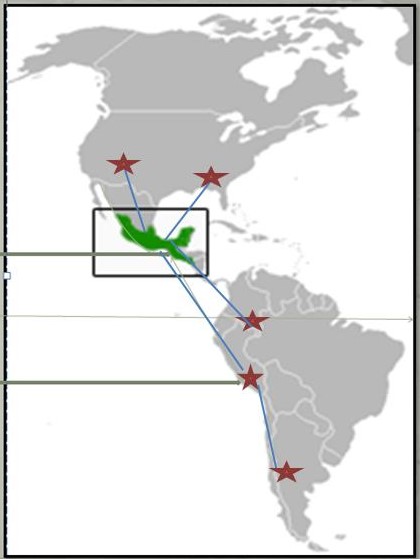
The beginning of this article includes a map that shows purported migrations from Central America to North and South America. Of course, in reality people migrated both ways. DNA shows that the native people in Latin America have ancient origins in East Asia; they didn’t originate in Central America and spread out from there. 

Moroni told Joseph Smith that the Book of Mormon related the history of the ancient inhabitants of “this country,” a statement that Joseph reaffirmed in the Wentworth letter. It is perfectly consistent with the Book of Mormon that after Lehi landed in North America, his descendants migrated throughout the hemisphere and intermarried with the existing Asian inhabitants.

Speaking of temple dedications, though, the first temple dedicated in this dispensation was in Ohio. D&C 109 specifically speaks about the “remnants of Jacob” being converted. This reference to the American Indians is corroborated by passages in the Book of Mormon and the D&C. And the next temple dedicatory prayer to mention the Lamanites was in Cardston, Alberta.  

When President Gordon B. Hinckley dedicated the Guatemala City Temple in December, 1984, he observed that “three fourths of the people in attendance were descendants of father Lehi.” [16]

Again, this says nothing about the location of Book of Mormon events. 

Apostle Dieter F. Uchtdorf dedicated the Quetzaltenango, Guatemala Temple on Dec. 11, 2011. In the dedicatory prayer he stated: “Thou kind and gracious Father, our hearts are filled with gratitude for Thy remembrance of the sons and daughters of Lehi. Thou hast heard their cries and seen their tears. Thou hast accepted their righteous sacrifices.” [17]

Again, this says nothing about the location of Book of Mormon events.

Explorer Stephens, Seaman Maury, Smithsonian Institute’s Matthew Stirling

Exciting archaeological discoveries are continually coming forth that bear witness to the world of the authenticity of the Book of Mormon. Stephens’ 1841 (11 years after the Book of Mormon publication) publications opened the door to the vast antiquities of Central America where Joseph Smith directed us to search and study. 

The anonymous author of that editorial did not exclude the antiquities in North America. In fact, the only specific antiquities that Joseph Smith personally identified were those in the “plains of the Nephites” in Ohio, Indiana, and Illinois.

In 1847 (17 years after the Book of Mormon publication), seaman Lieutenant Matthew Fontaine Maury studied and began publishing “wind and current charts” of the Atlantic, Pacific and Indian Oceans. In 1855, Maury’s The Physical Geography of the Sea became the first standard oceanography text showing ocean currents that propelled ancient and modern vessels on “natural paths” across the seas. [18]

One hundred years after Stephens’ publications on Central America, the Smithsonian Institute’s Matthew Stirling (Director of the Bureau of American Ethology, and associate of the National Geographic Society) visited the ancient site of Izapa, Southern Mexico in 1941, where he photographed the “Tree of Life” monument from the right side. [19] In the 1960’s the New World Archaeological Foundation (NWAF) began archaeological excavations at the Izapa Temple Center. 

Even most M2C scholars agree that the Izapa stone has nothing to do with the Book of Mormon.

Many other American institutions began serious archaeology reconnaissance throughout Central America discovering ancient cities, pyramids, and monuments. Today, LiDar imaging from airplanes shows even greater antiquities (covered in jungle growth) in Central America: massive cities, roads, fortifications, animal corals, and pyramids in Guatemala and Mexico—to be shared in future articles.

Those Church members who still believe the teachings of the prophets about the New York Cumorah are interested in the Mesoamerican discoveries, but they recognize that the more we learn about ancient Mayan culture, the less that culture has anything to do with the Book of Mormon.

At the same time, the more we discover about the ancient inhabitants of North America, especially the eastern U.S., the more we see how well the Book of Mormon describes those ancient societies. 

Notes
[1] John Lloyd Stephens, Incidents of Travel in Central America, Chiapas and Yucatan. Volume 1. (1969    Reprint by Dover Publications, New York, of 1841 Edition by Harper & Brothers, New York). P. iv                (Hereinafter referred to as JLS-1.)
[2] Rachel Norman Williams – 2003 Drawing of the Prophet Joseph Smith.
[3] John Lloyd Stephens. Incidents of Travel in Egypt, Arabia, Petraea, and the Holy Land. New York.
[4] V. Garth Norman, Cubit Connection in Ancient World Migrations. (2018, Arconbooks, www.amazon.com) p. 86, 106.
[5]  Ibid. P. 86, 106.
[6] Unfortunately, because of the many wars, and massive movements within Central America, most written records of the ancient inhabitants were destroyed. Yet stone pyramids and stone   monuments with hieroglyphic writing on them, art and architecture remain today.
[7] JLS-1. P. 11.
[8] John Lloyd Stephens, Incidents of Travel in Central America, Chiapas and Yucatan. Volume 2. (1969    Reprint by Dover Publications, New York, of 1841 Edition by Harper & Brothers, New York). P. iv (Hereinafter referred to as JLS-2) P. 420.
[9] JLS-1. P. 140.
[10] JLS-2. P. 435 
[11] History of the Church of Jesus Christ of Latter Day Saints. Deseret Book, SLC. No. 9 Vol. III, p. 710.
[12] Dean C. Jessee, The Personal Writings of Joseph Smith, revised edition, (Salt Lake City, Utah:             Deseret Book, 2002), 533.
[13] Times and Seasons. Joseph Smith, Jr.—Editor.  Oct. 1, 1842, Nauvoo, Illinois. P. 1.
[14] Times and Seasons. John Taylor—Editor. Oct. 1, 1843, Nauvoo, Illinois. P. 1.
]15] Deseret News, Church News Saturday, September 1, 2019. P. 3-5.
[16] Sheri L. Dew, Go Forward With Faith: The Biography of Gordon B. Hinckley. (Deseret Book, Salt Lake             City, Utah, 1996) P. 419.
[17] https://www.churchofjesuschrist.org/temples/details/quetzaltenango-guatemala-temple/  prayer/2011-12-11 
[18] The Physical Geography of the Sea by Matthew Fontaine Maury. 1855  in Glyph Notes: A Book of      Mormon Report, Sept. 2019: 6.
[19] V. Garth Norman Izapa Sacred Space, Sculpture Calendar Codex. BYU Press, Provo, Ut. 2015, p.x.

Source: About Central America

November 27, 2019Uncategorized

Gratitude for the prophets

This Thanksgiving, we ought to remember the prophets who have brought about and preserved the Restoration of the gospel, beginning with Joseph Smith and Oliver Cowdery.

Together, Joseph and Oliver received the Aaronic and Melchizedek Priesthood and the associated keys in the Kirtland temple.

Together they wrote the first history of the Church, the eight essays that were published as letters in 1834-5. (This includes Letter VII, of course.)

Together they testified that Joseph translated the plates with the Urim and Thummim, thereby producing the Book of Mormon.

Together they testified of its divine authenticity, including the site of the Hill Cumorah of Mormon 6:6, right in western New York. 

All of their faithful contemporaries and successors have reaffirmed their testimony about these topics.

They all deserve our respect and gratitude, as well as our trust.

Happy Thanksgiving! 

Source: Letter VII

November 27, 2019Uncategorized

Divine authenticity: Comstock on Education

Below is an excerpt from a wonderful book, published in 1810, sold in Palmyra in 1819 as “Comstock on Education.”

The excerpt explains how religion fails when it is taught as a superstition, attended by bigotry, instead of as a rational, evidence-based truth that embraces examination. Some might find it astonishing to realize that this was written over 200 years ago. It reads as if it could have been written yesterday. It is congruent with the Church’s emphasis on family-centered, Church supported gospel learning, and it has application to M2C and other issues.*

One key passage: “Strive to comprehend the evidence for the divine authenticity of the sacred scriptures yourselves.”

As you read this, recall that for Joseph Smith and Oliver Cowdery, and their contemporaries and successors, the New York Cumorah was a key component of the divine authenticity of the Book of Mormon.

https://archive.org/details/essaysondutypar00comsgoog/page/n56
_____

Respecting the unfaithfulness of parents preparing the way for the reign of infidelity, and the 
importance of religiously educating children as a barrier against it. 

One of the most deplorable consequences attending a neglect of parental duty, is the prevalence of infidelity. The professed friends of religion have contributed, indirectly, to raise up a formidable enemy against it [i.e., against religion]. It is evident that the unfaithfulness of parents, in the government and religious education of their children, has prepared the way for the reign of this pernicious evil. 

Fifty years ago, there was perhaps fifty times the attention paid to the government and religious education of children in this country, in proportion to the number of inhabitants, that there has been for some years past. At that period there was scarcely an infidel to be found. If there were any who denied the divinity of Jesus Christ and the sacred scriptures, they were obliged to be silent ; for such characters were held in universal abhorrence. But now infidelity triumphs over shame, appears entirely without a mask, and often enters our temples, dedicated to the worship of that God and Saviour, whom it does not hesitate publicly to blaspheme without a blush….

But the popular cry is, that period was the reign of superstition and religious bigotry. And that superstition and bigotry served as blinders to their eyes, and prevented people from acting rationally. They disposed people to take things for granted on their parents’ testimony, and place such an implicit confidence in their veracity, as forbid inquiry. But the present is the reign of reason, they say, a time for rational inquiry. These blinders are removed, and the human mind is rising above these prejudices, and people now see how much they have been imposed upon by their ancestors. 

And here it must be observed, that we have no objection against having religion come to the light. We believe it will bear the most critical investigation. And notwithstanding it has been to some a stumbling block, and to others foolishness, yet to every honest, unbiassed [sic] heart, to every one that believes, it is to their abundant satisfaction, the wisdom and the power of God. It does not stand in any need of such supports as superstition and bigotry, and we pointedly disavow them as necessary in the least to support religion. But they have often, Judas-like, betrayed it into the hands of its enemies. 

That there is a period, in which it is proper and necessary for children, on account of the weakness of their own mental powers, to place confidence in the judgment and opinion of parents, must be admitted. But that they should to old age, continue to be children, without making any inquiry after the reason on which, those opinions were founded, is an abuse of their rational powers. 

That this was too much the case with people formerly, we are disposed to grant. And with regard to the impropriety of it, we are pleased to see people’s eyes opened, and their prejudices removed. Error is error, let it be found when or where it may, and we wish to have it detected. 

But there is that weakness, or imperfection, attached to human nature, that leads mankind, when they have discovered errors on one extreme, not to rest satisfied with correcting the error, and stopping at a medium, but like the vibration of a pendulum, rush into the opposite extreme. 

This has ever been the case. And although it has been observed by the wise and prudent, and the observation has been common, yet people in general have never been disposed to improve in this respect, by the failings of others. 

There is a medium between a superstitious, bigoted attachment to religion, and a bold, presumptuous renunciation of it. 

That medium, we conceive to be, a rational attachment to religion, founded on a conviction of its troth, reality and importance, produced by the most convincing, satisfactory evidence.

This rational attachment to religion, we profess; and we do earnestly recommend it to mankind. We believe it is the only source of true, solid enjoyment for them. 

But it is not surprising, that people who have never studied the evidences of Christianity, nor felt its enlightening influence on their hearts; who are disposed to think freely, when they come to see the influence which superstition and bigotry have had on their own, and the minds of others, and see what a restraint they have laid upon their rational powers; should be offended, and turn from religion with a degree of disgust.

It is just like depraved human nature. This has led many in this day, profanely to say, what is the Almighty that we should serve him ? and what profit should we have if we should pray unto him? It is vain to serve God.

But it is observable in this case, that religion is not so much the object of disgust, as the manner in which people adhere to it, and are influenced by it.

But it is denied that a superstitious bigoted attachment is a rational one, or that religion in such cases has its genuine influence. 

When the great Jehovah made the rational soul of man, he designed it should be happy in the enjoyment of himself, without laying restraint upon his rational powers. And when man had sinned, and fallen under the curse, and God entered into a covenant of grace for his redemption from sin, he ordained that religion, and what is implied in it, should be the only thing that should make men happy, without laying the least restraint upon the free, unbiassed exercise of reason. And this religion certainly does, whilst it forbids, and even mocks at that false reasoning, and vain philosophy, which is used as a shelter for vice, 

The scriptures inform us, that the carnal mind is enmity against God. That the natural man receiveth not the things of the Spirit of God, that he cannot know them, because they are spiritually discerned. We grant that there is something in religion, as it respects the heart, that appears mysterious, or unaccountable to natural men. But it appears so, not because it is irrational, but because their understandings are darkened, through the moral blindness of their hearts. 

And here we observe, that it is not uncommon for very loose, wicked men, when taking a view of their own characters, to despair of ever enjoying the blessings which religion promises its friends. In this situation, human nature has been disposed to fly to some shelter, to screen it from those curses which it denounces upon its enemies. And this has commonly been, to renounce religion, and deny its divine authenticity. And they take occasion from every unfavourable circumstance, connected with religion, to justify themselves for doing it. 

But with respect to superstition, and what is commonly called religious bigotry, it is evident that they are not the natural, legitimate offspring of religion. They have their origin in the weakness and depravity of human nature. And we grant that religion has been the occasion of the depravity of the human heart discovering itself, or operating in these particular ways. 

But this we conceive affords no ground, or colour of objection against religion. And we farther grant, that on these accounts religion has often been made a tool of state, and has been improved by the aspiring arid ambitious, to obtain the most abominable purposes ; yet we conceive this affords no ground of objection against it. As well might people be prejudiced against money, because it was improved by a Judas to betray his Lord, as to object against religion on these accounts. 

And it is further observable, that superstition and bigotry are not the natural, or necessary fruits of a religious education. These evils do not necessarily follow, as unavoidable consequences upon the religious education of children. We grant, however, that they follow, as consequences of a certain improper method of religious instruction. 

When parents religiously educate their children, under the influence of superstition or bigotry, these consequences commonly follow. These evils produce their own likeness. When children are taught their creed, or what they ought to believe, and what they ought to do, and their mouths are shut against any inquiry, and they are taught that it is criminal to make inquiry, because it may imply 
doubt, and this, enforced by awful considerations suggested to the imagination; it commonly makes such an impression as leads children to think they must never inquire, that to inquire will be sinful ; and in this opinion they grow to manhood. In this manner children have taken things for granted, on their father’s testimony. This is the principal fountain from whence these evils flow. 

This, as our Saviour said of the phairisees, is taking away the key of knowledge. This method of instruction is to be deplored. We have reason to believe that it has carried, and is carrying thousands of stupid mortals blinded to destruction….

These neglects of parents, and their slothfulness in the religious education of their children, have contributed to aid the cause of infidelity in our country. An affecting, lamentable consideration ! Yes, parents, your unfaithfulness to your children has contributed, indirectly, to raise up enemies against religion, and to strengthen their cause….

It is a fact, parents, and one that ought to alarm you, that the discerning among the enemies of religion are highly gratified with your inattention to your children. They know how subject the minds of children and youth are to the influence of education. And they have been mortified to see, that where a faithful attention has been paid to their religious education, their own sentiments have generally been held in abhorrence. 

And this very consideration has led the enemies of religion to educate young men with their sentiments, and send them out into the world as teachers of schools, and instructors of children and youth, to disseminate their own pernicious opinions, in order to prevent the religious education of children, and counteract its influence. These enemies of religion see, and they are pleased ts see, that where parents neglect their duty to their children, they indirectly aid their cause. A garden neglected will soon be full of noxious weeds ; so the youthful mind, that is not instructed in the principles of the Christian religion, nor impressed with its truths, falls an easy prey to those false reasonings, and foul sentiments, which, like unclean spirits from the mouth of the dragon, or the bottomless pit, are destroying the souls of men, and hurrying them down to their own native regions. 

Friends of Zion, these considerations are truly alarming. This subject is truly interesting, it demands your serious, prayerful attention. It demands your vigorous exertions. The enemies of Christianity, you see, are bold and enterprising. They have raised their stance and are officiously busy to enlist people unto it….

Study, therefore, to know your duty in all its branches… educate your children rightly, point out to them forbidden paths, show them their danger, and train them up in the way they should go. 

And be particular, as their minds expand, to impress them with the consideration, that religion is a rational thing, and that it lays no restraints upon their rational powers. Instruct them in the great doctrines of the Christian religion. Strive to understand them yourselves, and whatever you inculcate, as matter of faith, as soon as your children are able to make the inquiry, let them know you have reason for believing it ; and that if they are not able now to comprehend it, express your hope that they will be able, when their understandings are more enlarged. Strive to comprehend the evidence for the divine authenticity of the sacred scriptures yourselves, and as soon as your children are able, help them to understand it. Teach them their duty, and make it as plain as possible, and help them as far as you can, to see the propriety and reasonableness of it….

And by doing this you may erect a hedge around your vineyard, which it will be difficult for your enemies to break over. God in his providence, is calling upon you to be more faithful in this branch of your duty. And we press it upon you as the most prudent measure, to stop a dreadful torrent, and the contaminating influence of those pernicious sentiments, which threaten to overwhelm our country. 

But in recommending the religious education of children, we do not expect the approbation of that class of men, who avow infidelity, in opposition to the sacred scriptures. We expect to incur their displeasure. And you may expect it and their opposition too. But this, Christians, we must beat. 

_____

*This has obvious application to the ongoing censorship being practiced by Book of Mormon Central and other M2C organizations.

Source: Book of Mormon Wars

November 22, 2019Uncategorized

Singapore, and then more M2C sophistry

We’ve been away for a few days because we went to Singapore. I wrote about one specific event during the trip in another blog, here:

https://presidentnelsonspeaks.blogspot.com/2019/11/a-gracious-and-loving-prophet-president.html

_____

I would much rather focus on President Nelson’s message in Singapore than write about M2C, but I’ll discuss those teachings in the other blog in the next few days.

In this blog, we offer an alternative to M2C (the Mesoamerican/two-Cumorahs theory of the Book of Mormon). We also alert readers to the tactics and methodology of M2C intellectuals so they can make informed decisions and help others do likewise. In our view, there is abundant evidence for the divine authenticity of the Book of Mormon, but not in Mesoamerica.

I emphasize, as always, that we’re all free to believe whatever we want. We can be faithful Latter-day Saints regardless of what we believe about Book of Mormon historicity, geography, the teachings of the prophets, etc.

However, there are many people who think M2C is the quasi-official position of the Church. It’s easy to see why. M2C intellectuals continue to enforce censorship of competing ideas. Their peers in the Church History Department have de-correlated the New York Cumorah to accommodate M2C, as we’ve seen in the Saints book, Volume 1, as well as the Joseph Smith and Brigham Young lesson manuals, the CES manuals, etc.

We have groups such as Book of Mormon Central, the Interpreter, FairMormon, etc. that are spending millions of dollars to promote M2C while simultaneously censoring and repudiating the teachings of the prophets about the New York Cumorah.

This leaves many people with the mistaken impression that you have to accept M2C to believe the Book of Mormon is a real history. Because M2C is implausible to many members of the Church (and even less plausible to nonmembers), M2C can cause people to become confused and disturbed in their faith.

When we understand the M2C techniques, we can better help those who seek alternatives to M2C so they can retain and strengthen their faith.
_____

Today’s topic was prompted by another reader inquiry. It involves yet another Interpreter article, this one an excerpt from a book.

The author is a well-known M2C proponent, as you will see. I like much of his work, but his obsession with M2C undermines his objectivity and even credibility, IMO.

For example, in this chapter, the author writes, “Books have been written to examine the geography and history described in the Book of Mormon. This isn’t one of those books.” But as a dedicated M2C advocate, he inserts M2C anyway. In fact, starting on page 39 he delves into one of the “correspondences” that, IMO, are pure bias confirmation; i.e., “it is important to note that this method of recording annalistic history was part of the cultures of Mesoamerica, which I consider the most plausible location of the Book of Mormon events. Perhaps the change to the way time was recorded was influenced by the introduction of the long count among the Maya.” He spends a few pages comparing Mayan annals to the Book of Mormon text.

My reaction to such “correspondences” is to consider whether they have any relevance or are merely examples of Loserthink bias confirmation and pattern recognition.

Image result for ancient annalsAnnals are ubiquitous on human history. The history of China includes “The Basic Annals” dating to around 2853 B.C. Ancient Roman and Christian annals were well known by the time Joseph translated the Book of Mormon, as were the Chaldean annals, the Phoenician annals, and others. Josephus discussed the annals of the Tyrians.

It may be more difficult to find an ancient civilization that did not keep annals than to find one that did. The Nephites and the Mayans were no exception, but that doesn’t make the Nephites Mayans.

But you’re free to take these correspondences as facts if you want to.
_____

Getting back to the reader’s inquiry… It involves footnote 5, which you can read here:

https://journal.interpreterfoundation.org/labor-diligently-to-write-the-ancient-making-of-a-modern-scripture-1/#sdfootnote5sym

First, here’s the paragraph from the article that establishes M2C:

Mormon’s writing career was bracketed by plates buried in a hill. The same plates Mormon removed from the hill Shim at the beginning of his writing career (Mormon 1:3, 4:23), he interred in the hill Cumorah at the end (Mormon 6:6). In the intervening years, Mormon’s relationship to those plates shifted from recorder of events to interpreter of events. Mormon buried the Nephite archive in the hill Cumorah to preserve it, but he gave Moroni a more important set of plates to preserve. Those were later buried in a hill. 5 (emphasis added)

This is a clever way to frame the issue. He contrasts “the hill Cumorah” with “a hill.”

Readers here know that M2C is the acronym for the “Mesoamerican/two-Cumorahs” theory. M2C intellectuals and their followers claim that the “hill in New York” where Joseph found the plates has nothing to do with the Cumorah of Mormon 6:6.

Instead, these M2C intellectuals claim that
(i) the “real Hill Cumorah” is in southern Mexico and
(ii) all the prophets who taught about the New York Cumorah misled the Church with their false personal opinions.

The author is clever because the paragraph does not overtly declare M2C. We have to read the footnote for that.

Here’s the footnote:

5. Mormon tells us that he buried plates in Cumorah but that they were not those on which the Book of Mormon was written. Perhaps he returned to Cumorah, but that is speculation. All the text tells us for certain is that the Book of Mormon plates were not buried in Cumorah, although others were. (emphasis added)

This is a patently false claim. It’s true that the text does not tell us where Moroni hid up (buried) the abridged plates, but it never says the abridged plates were not buried in Cumorah.

Orson Pratt explained there were two departments in the hill Cumorah in New York, one for the depository and one for the abridgment. Nothing in the text contradicts that scenario. Letter VII establishes it as a fact.

The footnote then quotes Mormon 6:6.

And it came to pass that when we had gathered in all our people in one to the land of Cumorah, behold I, Mormon, began to be old; and knowing it to be the last struggle of my people, and having been commanded of the Lord that I should not suffer the records which had been handed down by our fathers, which were sacred, to fall into the hands of the Lamanites, (for the Lamanites would destroy them) therefore I made this record out of the plates of Nephi, and hid up in the hill Cumorah all the records which had been entrusted to me by the hand of the Lord, save it were these few plates which I gave unto my son Moroni.” (Mormon 6:6)

Mormon never states or implies that he ever left Cumorah. He gathered his people there for the “last struggle.” After describing the final battle, he explained that he hid up in the hill Cumorah all these records. He never says he left the area before he died.

Perhaps the footnote meant to say it was Moroni who returned to Cumorah, but if so, that’s not a matter of speculation because Moroni himself identified the “hill in New York” as Cumorah and we know from Letter VII that the hill where Joseph found the plates was also the setting for the final battles and the depository of Nephite records.

Nowhere in the text does Moroni say where he buried the abridgment, but he never says he did not bury them in Cumorah. In Mormon 8:4, Moroni says “I will write and hide up the records in the earth, and whither I go it mattereth not.”

The Introduction explains it this way:

After Mormon completed his writings, he delivered the account to his son Moroni, who added a few words of his own and hid up the plates in the Hill Cumorah. On September 21, 1823, the same Moroni, then a glorified, resurrected being, appeared to the Prophet Joseph Smith and instructed him relative to the ancient record and its destined translation into the English language.
(Introduction, 4)

Although inconsistent with M2C, the Introduction is consistent with the historical record. Joseph learned the name Cumorah from Moroni before he even obtained the plates. Letter VII establishes the location of the Hill Cumorah of Mormon 6:6 as a fact.
Readers are susceptible to M2C if they are unaware of the historical accounts, the teachings of the prophets, and the abundant corroborative evidence from archaeology, anthropology, geology, geography, etc.
_____
Of course, we are all free to believe whatever we want. 
We just need to make sure we’re making informed decisions, which means we can’t simply read and accept whatever the M2C intellectuals write–even when they slip it into a footnote in a book on a supposedly unrelated topic.

Source: About Central America

November 18, 2019Uncategorized

"Neutrality" and the de-correlation of Cumorah

A reader posed this question about “neutrality,” as many people do. I’m offering my response here because it involves the ongoing effort to de-correlate the New York Cumorah to accommodate M2C.*

Question: Have you ever received a good answer to why the church is “neutral” now when, as you claim, the prophets earlier where not neutral?

Answer: The question relates to the anonymous “Gospel Topics Essay on Book of Mormon Geography.” To understand the essay, we need to review the background and context.

Church leaders have always made a distinction between (i) the New York Cumorah, which is a fact taught since before Joseph even got the plates, and (ii) the location of other events, which we don’t know for sure.

The current version of the Gospel Topics Essay on Book of Mormon Geography blurs that distinction. Let’s look at the long-held position first, then assess what “neutrality” means.

Both of the long-held positions make sense. Joseph and Oliver personally visited Mormon’s depository of Nephite records inside the Hill Cumorah in New York. Moroni himself called the hill Cumorah, as we know from Lucy Mack Smith’s history and Parley P. Pratt’s autobiography.

Oliver Cowdery memorialized this fact in Letter VII. You can read that in the Joseph Smith Papers here:

http://www.josephsmithpapers.org/paper-summary/history-1834-1836/90

Recall that at the time, Oliver was the Assistant President of the Church. Joseph Smith, President, and Sidney Rigdon, First Counselor, both approved Oliver’s letters and Frederick G. Williams, Second Counselor, copied them into Joseph’s own history as part of Joseph’s life story. These letters therefore originated with the First Presidency and have been reaffirmed by all members of the First Presidency and Quorum of the Twelve who have ever publicly addressed the issue, including members of the First Presidency speaking in General Conference.

As for other Book of Mormon locations in Lehi’s promised land, Church leaders have always said we don’t know for sure where they are. There are thousands of sites throughout North America that fit Book of Mormon timelines and geography, but it’s impossible to tell which specific ones line up with the named sites in the Book of Mormon.

One well-known example was explained by Joseph Smith during Zion’s Camp. Joseph referred to Illinois, Indiana and Ohio as the “plains of the Nephites,” alluding to Alma 52:20, 62:18, 19, and possibly Ether 13:28, 29 and 14:15, 16. But he did link any specific site to any specific passage in the text.

You can read this in the Joseph Smith Papers at the bottom of the page here:

https://www.josephsmithpapers.org/paper-summary/letter-to-emma-smith-4-june-1834/2

We saw in the first version of the Gospel Topics Essay on Book of Mormon Geography that the authors of the essay made some obvious mistakes. Soon after it was released I pointed some out and suggested some revisions, which I posted here.

The essay was quickly revised. The new version was posted without notice and without comment about the changes (which has happened with other Gospel Topics Essays as well). The revised version did correct some errors, but in some ways it made things worse.

And, the current version still avoids mentioning Cumorah. By implication, the essay lumps Cumorah in with the uncertainty about other sites. Consequently, it misleads members of the Church about what the prophets have taught abut the New York Cumorah.

I discussed the changes in this post:

http://www.bookofmormoncentralamerica.com/2019/02/great-news-revised-gospel-topics-essay.html

The authors of the anonymous essay squandered an opportunity to educate Church members about the issue, solely because they wanted to accommodate M2C.

Most, but not all, of the members of the committee who wrote the essay believe M2C, so they think the prophets were wrong about the New York Cumorah. The essay was submitted to the Brethren for approval, but the committee apparently refused to even offer for consideration a version of the essay that contained the teachings of the prophets about Cumorah.

This is standard organizational behavior. When employees want a particular outcome, they guide the boss by giving the boss only what they want him/her to consider. If the boss wants alternatives, the employees provide the worst alternatives they can think of so their preferred outcome appears to the boss as the best choice.
_____

The “neutrality” position makes sense regarding specifics about Book of Mormon geography other than Cumorah. As we saw above, there are thousands of sites that match up with the relative few sites named and described in the Book of Mormon. At present, it is impossible to choose among them to identify specific sites.

However, what does it mean to be “neutral” about the teachings of the prophets about the New York Cumorah?

Are we supposed to be “neutral” about whether Oliver told the truth about the visit of John the Baptist (Letter I)?

Are we supposed to be “neutral” about whether Oliver told the truth about Moroni’s visit (Letter IV)?

Are we supposed to be “neutral” about whether Oliver told the truth about Moroni’s stone box (Letter VIII)?

Are we supposed to be “neutral” about whether Oliver told the truth about the translation of the plates (Letter I)?

You get the drift…

Certain LDS intellectuals have long argued that we actually should be “neutral” on two key points:

1. Whether Joseph even translated the Book of Mormon (they teach the long-discredited “peep stone” narrative); and

2. Whether the Hill Cumorah is really in New York (they teach that Cumorah is in southern Mexico and that all the prophets and apostles who taught the New York Cumorah actually misled the Church).

Advocating “neutrality” about the teachings of the prophets causes people to become confused and disturbed in their faith, as Joseph Fielding Smith warned long ago.
_____

The current version of the Gospel Topics Essay on Book of Mormon Geography is part of an effort to de-correlate the New York Cumorah as if it had never been taught. That was a key factor in the Saints book, Volume 1, which created a false historical narrative to accommodate M2C. We discussed that here, for example:

https://saintsreview.blogspot.com/2018/10/the-historians-explain-censorship-in.html

Does anyone think the de-correlation effort can succeed when anyone can read these teachings in the Joseph Smith papers, in General Conference reports, and in books such as Articles of Faith and A Marvelous Work and a Wonder?

Eventually, the Cumorah issue will have to be addressed.
_____

I’m confident that Church leaders will reaffirm the teachings of their predecessors. That seems inevitable because the New York Cumorah is so well established and also corroborated by relevant archaeology, anthropology, geology, geography, etc.

However, for decades now the intellectuals have been teachings that the prophets are wrong about Cumorah. They have persuaded many LDS to follow them instead of the prophets. Now Book of Mormon Central is spending millions of dollars to promote M2C on the Internet and around the world. They’ve even weaved it into the scriptures through ScripturePlus.

M2C is nonsensical to many Church members. Even those who don’t know what the prophets have taught about the New York Cumorah find M2C difficult to believe.

But thanks to the efforts of the M2C intellectuals, there are many Church members who believe M2C. They live within the M2C bubble. They don’t know any different, and they have no idea what the prophets have taught.

It seems that M2C will have to implode completely before the M2C hoax becomes apparent to those who live within the M2C bubble.
_____

*M2C is the “Mesoamerican/two-Cumorahs” theory of Book of Mormon geography. M2C claims the prophets were wrong when they taught that Cumorah is in New York. Instead, M2C teaches that the hill in New York has nothing to do with the Book of Mormon, except that Moroni hauled the plates from Mesoamerica to New York so Joseph could find them.

M2C is a separate issue from where Book of Mormon events (other than Cumorah/Ramah) took place. People can believe the teachings of the prophets about the New York Cumorah and still believe other Book of Mormon events took place in Central, South, or North America.

Source: About Central America

November 15, 2019Uncategorized

The Jailers of your Mental M2C Prison – Loserthink

The M2C intellectuals justify their position because they are “experts” in ancient Mayan culture and languages, they are “experts” in studying the scriptures, and they are “experts” in Church history. They assert this “expertise” to justify their repudiation of the teachings of the prophets.

M2C jailers of your mental prison

The book Loserthink has an important section on “Listening to the Experts” summarized here:

We live in a world in which it is dangerous to ignore the advice of experts, but it is almost as dangerous to follow their advice. The trick is to know when the experts are the solution and when they are the jailers of your mental prison.

There are plenty of “experts” in Church history and Book of Mormon historicity. Some are inside the Church; others are outside the Church.

Critics of the Church and the Book of Mormon also rely on Loserthink tactics. They are jailers of the mental prisons of their followers.

Mormon Stories and CES Letter, two of the best-known critics, employ most of the Loserthink  strategies discussed in the book. We’ll look more at their work in upcoming posts, but today we’ll focus on M2C.

How can you determine whether these experts are the solution or the jailers of your mental prison?
_____

You can consider the tactics they use and their objectives. Are they supporting or repudiating the teachings of the prophets on these topics?

Tactic 1. The M2C jailers of mental prisons use patterns or analogies as arguments and rationales for M2C. The M2C intellectuals use the term “correspondences” to describe the patterns they cite to make people believe ancient Mayan culture has something to do with the Book of Mormon.

The book of
“correspondences”

The argument goes like this:

The Nephites were farmers.
The Mayans were farmers.
Therefore the Nephites were Mayans.

When explained that way, the futility of a theory based on “correspondences” is apparent. Yet the entire M2C theory consists of little more than such “correspondences.”

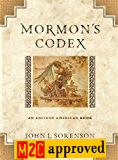
Chapter 6 in Mormon’s Codex, for example, is titled “About Correspondences” and argues that “The text of the Book of Mormon can be compared with the findings of Mesoamerican scholarship at several levels… In this volume, correspondences vary between two levels of persuasiveness. Some correspondences are so specific that there seems to be no explanation for their occurrence in both the Book of Mormon and data from archaeology or anthropology other than that some literal historical sharing must have occurred. Other correspondences are somewhat less striking, yet given the context provided by the strongest correspondences, it seems very likely that those that are less focused also are best explained as the result of direct historical connection rather than by a mental interventionism.”

I give Brother Sorenson great credit and respect for addressing the issue of correspondences because the entire M2C theory depends on such comparisons and patterns. But just because he addressed the issue doesn’t mean these correspondences are meaningful–or that they are so meaningful as to justify repudiating the teachings of the prophets because of them.

These correspondences can be persuasive because, as Loserthink explains, “humans use pattern recognition to understand their world. Humans are very bad at pattern recognition. And they don’t know it. We can’t tell the difference between valid patterns that might predict something useful and something that simply reminds us of something else but means nothing.”

The psychological power of pattern recognition, or finding “correspondences,” enables our M2C intellectuals to frame M2C as obvious and conclusive. In fact, they think these “correspondences” are so decisive that the teachings of the prophets, by comparison, are “manifestly absurd” (to use the description Brother Sorenson uses in Mormon’s Codex).

Loserthink explains how the jailers use this tactic: “if your [theory] is based on pattern alone, you are probably in a mental prison. And your jailers are the people who try to dupe you with patterns that mean nothing.“

That the “correspondences” cited by M2C intellectuals mean nothing is evident from the reality that experts in ancient Mayan studies who are not inside the M2C bubble see no connection between the Mayans and the Book of Mormon.
_____

Tactic 2. Another section of Loserthink, titled “Fake News Filter,” explains the problem of people being stuck in silos. “It is one thing to disagree with an opposing viewpoint, but it is a far bigger problem if you have never heard of it.”

Book of Mormon Central, FairMormon, the Interpreter, Meridian Magazine–all these M2C publications share a common editorial policy of censoring information and commentary that contradicts M2C. In a word, they resort to censorship.

The logo includes a Mayan glyph, foreclosing the possibility that the Book of Mormon could have taken place anywhere else.

This logo represents a closed-minded organization that insists the prophets are wrong. They justify censorship because they claim that, as experts, they have the answers. Further inquiry, discussion, and debate is unwelcome.

Consequently, there are many members of the Church who have never heard that there is an alternative to M2C. Many of them have never heard that the prophets have consistently taught that the Hill Cumorah of Mormon 6:6 is in New York.

Ignorance is one of the most powerful jailers of mental prisons possible.

As long as these organizations continue to censor ideas and information that contradicts M2C, including the teachings of the prophets, they will continue to function as jailers of mental prisons.
_____

Source: About Central America

November 14, 2019Uncategorized

Meridian (M2C) Magazine and Loserthink

Examples of Loserthink continue to proliferate. A fine one appeared in Meridian (M2C) Magazine, which is operated by adamant promoters of M2C. No one should be surprised that they would publish this article the way it is.

Here’s a link to the article:
https://latterdaysaintmag.com/nauvoo-times-and-seasons-searching-for-book-of-mormon-lands/

Today we’ll do a “peer review” of the article, meaning that had the editors sent it to me ahead of publication, these are the notes I would have sent back. To do this, I have to show the entire article lest my critics, including the anonymous trolls, accuse me of “cherry picking,” not telling the whole story, etc.

In reality, there’s nothing I want more than for people to read what the M2C scholars teach. This article is a fine example. Inevitably, these scholars resort to Loserthink to try to convince members of the Church that the prophets are wrong. This article employs many of the standard M2C tactics, as we’ll see.

At the outset, I re-emphasize that I think the M2C scholars are fine people, great scholars, faithful LDS, genuine, smart, thoughtful, etc. The author of this article fits those descriptions. Brother Norman a great guy whom I respect and like personally.

None of those qualities has anything to do with Loserthink, however. None of my observations about M2C ideology and tactics are personal; we all want to focus on the issues, not the personalities involved.

This article contains a series of assumptions and factual errors presented as facts to support M2C.

We’re not surprised that Meridian Magazine would publish it as is because the article supports the editors’ M2C agenda.
_____

There is a lot of detail in this article. One of the common Loserthink tactics is the “confusopoly,” a term Scott Adams coined “to describe an industry in which price competition is eliminated by making products and services so confusing that customers cannot tell what they are getting for their money.”

M2C scholars use the confusopoly concept by making their arguments so confusing that readers give up and just accept the conclusion that the prophets are wrong about the New York Cumorah.

To unpack the article, I’ve had to delve into the detail. This may be more detail than most people want to read, so I’ll summarize it here first.

Several anonymous articles in the 1842 Times and Seasons made a link between the Book of Mormon and archaeological findings in North and Central America. Joseph Smith was listed in the boilerplate of the newspaper as the editor of the Times and Seasons from Feb 15-Oct 1, 1842.

Many people, especially M2C proponents, think this means Joseph was personally responsible for everything published in the newspaper during those months, including anonymous articles. That leads M2C proponents to claim Joseph Smith believed the Book of Mormon took place in Central America. They then say the New York Cumorah is too far from Central America, so Joseph and Oliver and their contemporaries and successors misled the Church by teaching that Cumorah was in New York.

While the idea that Joseph actually wrote or edited the anonymous articles was a long-held assumption, it doesn’t hold up to scrutiny for many reasons that I’ve discussed in detail in three of my books.

Basically, there is no evidence that Joseph actually edited anything in 1842 other than the Wentworth letter, which he signed separately in the newspaper.

The boilerplate at the end of each issue of the 1842 Times and Seasons from Feb 15-Oct 1 did say Joseph edited the paper, but it also listed Joseph as printer and publisher. No one claims Joseph operated the printing press, set type, etc. because he was merely the nominal printer; i.e., “in name only.” The evidence, IMO, shows that he was merely the nominal editor, too.

Brother Norman’s article claims it is a fact that Joseph wrote the anonymous articles, but at best he can only speculate about that.

He also claims Joseph actually wrote specific journal entries, but these, in reality, are fake compositions created after Joseph died. 

I think the anonymous articles are as fake as the composed journal entries, but you can reach your own conclusions after you assess the evidence.

IMO, it is completely irresponsible for Meridian (M2C) Magazine to publish an article such as this without at least checking (and correcting) the factual errors, and without offering its readers an alternative interpretation of the facts. This is the type of advocacy journalism that causes divisions and perpetuates ignorance among members of the Church.
_____

Original material in blue, my comments in red. 

CHURCH HISTORY

Nauvoo “Times and Seasons”: Searching for Book of Mormon Lands

By V. Garth Norman · November 12, 2019

Annually, October 1, is the anniversary of a little known event in early Church history that I believe, in consequence of significant research progress into 2019, now deserves recognition for identifying a region of major Book of Mormon lands and for initiating Book of Mormon archaeological historic research.
Readers will immediately realize both claims in this sentence are false. The sentence should be rewritten.
(i) The claim that the October 1 article identified “a region of major Book of Mormon lands” is false. At best, it speculated about a possible setting for BofM events.
(ii) The claim that the October 1 (1842) article “initiated” BofM archaeological research is false because Joseph Smith and others personally engaged in BofM archaeological research as early as 1834. During Zion’s camp they dug up the bones of Zelph in Illinois. Joseph wrote to Emma about this research: “The whole of our journey, in the midst of so large a company of social honest men and sincere men, wandering over the plains of the Nephites, recounting occasionaly the history of the Book of Mormon, roving over the mounds of that once beloved people of the Lord, picking up their skulls & their bones, as a proof of its divine authenticity.”  
https://www.josephsmithpapers.org/paper-summary/letter-to-emma-smith-4-june-1834/2
In a Times and Seasons editorial, October 1, 1842, the Prophet Joseph Smith 
This is mere speculation. The editorial is anonymous and there is no evidence that Joseph wrote, edited, or even saw the article before it was published. Some speculate that Joseph wrote the article, but such speculation should not be stated as a fact. Readers should be informed that the author is merely speculating here.
The assumption that Joseph wrote the article arose from a comment published in the March 1, 1842, issue, discussed below.
after progressive study 
There is no evidence that Joseph studied these books, apart from a brief reference in a November 1841 thank-you note that Joseph may or may not have dictated but didn’t sign. It’s just as likely he never even saw that letter, for reasons I’ve discussed at length elsewhere. 
announced a discovery that the Book of Mormon “land southward” is located in Central America (Mesoamerica), which would be from the Isthmus of Tehuantepec as the narrow neck of land, south to Panama or at least Costa Rica, which as the Prophet pointed out, fits the description in Alma 22: 32 as the land that is “nearly surrounded by water.” [1] 
The article says nothing about the Isthmus of Tehuantepec; it merely refers to the land “north of the Isthmus of Darien.” Again, the article is anonymous; one can speculate that Joseph wrote it, but it misleads readers to simply declare that he did. 
The speculative and irrational nature of the article is evident from these passages: “the ruins of Zarahemla have been found where the Nephites left them… We are not going to declare positively that the ruins of Quirgua are those of Zarahemla [but] we are of opinion, that it would require more proof than the Jews could bring to prove the disciples stole the body of Jesus from the tomb, to prove that the ruins of the city in question, are not one of those referred to in the Book of Mormon.”
Joseph’s information resulted from studying an exciting book by explorer John Lloyd Stevens, Incidents of Travel in Central America, Chiapas and Yucatan, 1841, that for the first time was bringing major exposure to the outside world of magnificent ancient Maya ruins hidden in the jungles of Central America. 
While the Stevens book was sensational because of its detailed illustrations, the existence of Mayan ruins was well known even before the Book of Mormon was published. Alexander von Humboldt had explored Central America and had visited President Thomas Jefferson to discuss his expedition. His book had been translated into English and was on sale in the Palmyra print shop as early as 1818. This is the print shop young Joseph visited weekly to get the newspaper for his father. 
In his book, von Humboldt discussed ancient ruins in Central America, accompanied by illustrations, and identified Panama as a “neck of land.” This reflects a common understanding of the time; i.e., Panama was the “neck of land” between South America and North America. Naturally some people applied this to the language in the Book of Mormon. 
And keep in mind, Joseph knew that in the Book of Mormon “the history of ancient America is unfolded” [2]  Can you sense his enthusiasm and flag waving to research it out?
These sentences mislead readers as well. Here is the full quotation of from the original Wentworth letter:
In this important and interesting book the history of ancient America is unfolded, from its first settlement by a colony that came from the Tower of Babel at the confusion of languages to the beginning of the fifth century of the Christian era. We are informed by these records that America in ancient times has been inhabited by two distinct races of people. The first were called Jaredites and came directly from the Tower of Babel. The second race came directly from the city of Jerusalem about six hundred years before Christ. They were principally Israelites of the descendants of Joseph. The Jaredites were destroyed about the time that the Israelites came from Jerusalem, who succeeded them in the inheritance of the country. The principal nation of the second race fell in battle towards the close of the fourth century. The remnant are the Indians that now inhabit this country.
This passage is an edited version of Orson Pratt’s missionary pamphlet. When he wrote the Wentworth letter (published March 1, 1844), Joseph omitted Orson Pratt’s extensive commentary that focused on Central and South America. He replaced it with the simple, clear declaration that “The remnant are the Indians that now inhabit this country.” 
Some M2C scholars claim that the phrase “this country” refers to all of western hemisphere, but Joseph was writing from Nauvoo, Illinois, to an editor in Chicago, Illinois. He could have used the term “country” to refer to the American nation or the area where they both lived (in Illinois), but after expressly deleting Orson Pratt’s speculation about Central America, Joseph surely did not intend the term to refer to Central America.
John Lloyd Stephens and the Birth of American Archaeology
In 1830, American archaeology was unknown. John Lloyd Stephens, a New York Attorney, became an explorer when he traveled to Europe in 1834, then to the Middle East, returning to NY in 1836. He wrote several books about his travels on the other side of the Atlantic that became best sellers in America. In 1839, President Martin Van Buren commissioned Stephens to be a Special Ambassador to Central America. So Stephens, accompanied by artist and architect Frederick Catherwood traveled to British Honduras (now Belize) where they first came across Maya ruins at Copan.                       
John L.Stephens [3]    
A big fan of Stephens was Wilford Woodruff, who brought the books from New York to Nauvoo and read them along the way. He wrote a letter to Dr. Bernhisel, who had given him the books to give to Joseph as a gift. For this and other reasons, the most likely explanation for the November 1841 thank-you note is that Woodruff wrote it.                                        
Note that this map does not even show the Isthmus of Darien, the only specific feature the Times and Seasons article mentions.
In 1841, Stephens’ published four books about his travels and explorations including Incidents of Travel in Central America, Chiapas and Yucatan. Stephens’ books on Central America with impressive drawings of spectacular temple buildings and monuments by artist Frederick Catherwood exposed, to the outside world for the first time,  extensive lost ancient civilizations in the jungles of Central America (southern Mexico, Yucatan, and Guatemala), and north of the Isthmus of Darien [Panama] which once embraced hundreds of miles of territory from north to south.                                            Map of Mesoamerica [4]
Drawings by Catherwood of Maya ruins of Uxmal (L) and Palenque (R) explored by Stephens [5]
TIMES AND SEASONS EDITORIALS, 1842
Joseph Smith
Joseph Smith Jr. at 14 years old was considered “uneducated”. 
While it’s true that Joseph had little formal education, his peers noted that as a schoolboy, he was an effective speaker and knew the scriptures. He spent several early years laid up and unable to work because of the leg surgery. There is good reason to believe he was well-read as a young boy. This desire for knowledge did not start after he translated the Book of Mormon.
Steadily he became an avid reader of history, politics, novels, and poets as well as studying foreign languages, primarily Hebrew and German.  During 1839-1842 as the Saints were establishing the city of Nauvoo, the Prophet Joseph Smith led his people in business, church administration, and temple building. [6] In 1839, the leaders of the Church 
[Actually, it was Joseph’s brother Don Carlos and a business partner, neither of whom were leaders of the Church, who started the paper]
began publishing the Times and Seasons periodical (the same year that John Lloyd Stevens began his explorations in Mesoamerica). Its motto, “Truth will prevail,” expressed a goal to promote truth, and correct falsehoods, and was the main organ for publishing truths pertaining to the restored gospel to the Church members and the world. Many of the Prophets revelations, and his Book of Abraham translation, for instance, appeared in print for the first time in the Times and Seasons. In the spring of 1842 (May 11), in consequence of too many errors appearing in print, the Prophet Joseph Smith took over the editorship and announced his personal responsibility for the contents of the paper. [7]   
Actually, Joseph’s name first appeared as editor, printer and publisher in the Feb. 15, 1842 issue. After Don Carlos died in September 1841, his former business partner took over the paper. Benjamin Winchester, who had started his own Mormon newspaper in Philadelphia but ran out of money, moved to Nauvoo in October 1841 to work for the paper. The paper began publishing Winchester’s articles anonymously. In January 1842, Winchester was rebuked and Joseph announced that the Quorum of the Twelve should take over the newspaper. 
The March 1, 1842, Times and Seasons (which contained the Wentworth letter) also contained this statement:
TO SUBSCRIBERS.
This paper commences my editorial career, I alone stand for it, and shall do for all papers having my signature henceforward. I am not responsible for the publication, or arrangement of the former paper; the matter did not come under my supervision. JOSEPH SMITH.
This statement, combined with the boilerplate, is the rationale for attributing to Joseph Smith everything that appeared in the newspaper between March 1 and October 1, 1842.
Historians have assumed that “my signature” referred to the boilerplate at the end of each paper, which stated the paper was “Printed, published and edited by Joseph Smith, Jr.” Of course, no one claims that Joseph actually set type, operated the printing press, cleaned the equipment, etc. He was listed as printer in name only.
Likewise, there is no evidence that Joseph ever actually edited the paper. No journal entries, no observations by others, etc. But there is evidence that he did not know what was in the paper until he read it after it was printed. This evidence indicates that Joseph was merely the nominal editor, just as he was merely the nominal printer. 
Plus, there were errors in the paper that, if he was actually editing the paper, Joseph should have recognized and corrected. One error appears in Joseph’s own history, which states that it was Nephi, not Moroni, who appeared to Joseph Smith in 1823.
There is also evidence that William Smith, Joseph’s brother, who was editing the Wasp newspaper in Nauvoo that was printed on the same printing press as the Times and Seasons, was actually editing both papers, probably with the assistance of W.W. Phelps.
Drawing of Joseph Smith [8]  
During the next six months he endeavored to raise the paper’s standard of excellence (May-Nov. 1842). 
It’s unclear what “standard of excellence” means here or how it could be quantified. Some issues of the Times and Seasons contained the same articles as William Smith’s Wasp; others consisted largely of reprints from other newspapers.
One of the distinctive features of Joseph’s six month editorial career was the attention given to antiquities as they might relate to the Book of Mormon. 
This was not distinctive; it was a common topic during Joseph’s lifetime. Every Mormon newspaper had discussed this topic of antiquities, including the Evening and the Morning Star, the Millennial Star, the Gospel Reflector, the Prophet, and the Messenger and Advocate.
Oliver Cowdery’s eight essays on Church history, originally published in the Messenger and Advocate in 1834-5, were republished in the Gospel Reflector, the Prophet, the Millennial Star, and the Times and Seasons (as well as the Improvement Era). One of his essays, titled Letter VII, specifically addressed the historicity issue by explaining it was a fact that the hill in New York where Joseph found the plates was the very Hill Cumorah of Mormon 6:6, the scene of the final battles of the Nephites and Jaredites and the location of the depository of Nephite records Mormon abridged.
Other books, such as Parley P. Pratt’s Voice of Warning, cited the same evidence and quoted some of the same sources found in the anonymous Times and Seasons articles. When the Apostles went to England in 1839-1840, they cited antiquities as evidence of the Book of Mormon.
In the November 15, 1842 edition, he announced that Elder John Taylor should be the Editor to maintain the high quality of excellence that had developed. [9]
Shortly after Stephens’ 1841 Incidents of Travel in Central America, Chiapas and Yucatan (Vol. I and II) on Mesoamerica hit the book market (illustration at right), Joseph received them as a gift and commented in his personal Journal History about their importance to the Book of Mormon. 
There is no citation here and I’ve never heard of such a journal entry. I suspect the author has confused this claim with the November letter to Dr. Bernhisel, but because I can’t tell for sure, I can’t comment further.
On June 25, 1842, Joseph recorded in his Journal that Stephens and Catherwood had succeeded in collecting in the interior of Middle America “a large amount of relics of the Nephites, or the ancient inhabitants of America treated of in the Book of Mormon,” which relics had recently landed in New York. [10] 
Footnote 10 refers to History of the Church, a compilation that was begun after Joseph died in 1844. The compilers changed original records to first person to make it appear as if Joseph had written the material. They also inserted newspaper accounts and other material as if Joseph had written it. 
In 1842, Joseph didn’t record anything in his journal. His journal was maintained by scribes.  The original entry for June 25, 1842, had nothing to do with relics; it reads:
Saturday 25 Transacted Business with Bro. [Edward] Hunter. Mr Babbit [Almon Babbitt]. & set for the drawing of his profile. for Lithographing on city chart.
You can read it here: https://www.josephsmithpapers.org/paper-summary/journal-december-1841-december-1842/30
The journal entry in History of the Church, cited in this article, was taken from a newspaper article about the Stephens books that described these relics from Central America, such as the article that appeared in the June 18, 1842, edition of the Wasp (the Nauvoo newspaper edited by William Smith).  You can see it in the second column from the left, about half way down, under “Central America,” at this site:
https://archive.org/details/TheWasp18421843_201703/page/n39
Brother Norman wants his readers to believe that a fake journal entry, taken from a newspaper report and added years after Joseph’s death, was actually personally recorded by Joseph Smith.
While the relics were judged to be of the “Nephites,” that was of course unknown, but illustrates Joseph’s frame of reference at that early date. The ruins of ancient Maya civilizations were completely shrouded in mystery, yet he held the key in the Book of Mormon to unlocking the lost history of ancient America civilizations.
Since the journal entry is a fake, Brother Norman’s conclusions don’t follow. Besides, if we accept that Joseph held the key to unlocking the lost history, we should look at what Joseph said and did when using that key. He endorsed the New York Cumorah several times and when he wrote the Wentworth letter, he specifically edited out Orson Pratt’s Central American speculation. 
In the September 15th 1842 issue of the Times and Seasons, an extract from John Lloyd Stephens on the antiquities at Palenque, Mexico was published with editorial comments. The scripture about the narrow neck of land geography in Alma 22:32 was cited, implying reference to the Isthmus of Tehuantepec which is not far from Palenque. 
Rather than “implying reference to the Isthmus of Tehuantepec,” these articles specifically cited the Isthmus of Panama, which was widely described as a “neck of land” even before Joseph translated the Book of Mormon. 
The next issue two weeks later (October 1, 1842) [1] followed up with specific details that show studied progress to try and locate Book of Mormon lands and ruins. That front page editorial is particularly significant as the Prophet’s last and most specific statement on geography while he was the official editor, so it deserves our attention.    
Again, this claim merely states as a fact that Joseph wrote the anonymous editorial. The same Oct. 1 issue, however, contains a letter from Joseph Smith to the Church, dated September 6, 1842, that he signed and sent to the actual editor of the paper for publication. During this time frame, Joseph was hiding from the Missouri authorities. None of his contemporaries stated or implied that Joseph was doing any editing work; certainly he was not studying the Stephens books or anything related to Central America.  
The next section of this article rehashes the first sections, insisting that Joseph wrote the anonymous articles. 
This section is an outstanding example of the Loserthink tactic of mind reading. Mind reading is awesome even when someone is reading the mind of a living person, but reading the mind of Joseph Smith, whose personal writings are sparse and for whom we have few verbatim records apart from the Book of Mormon and some of the revelations in the D&C, is exceptional awesomeness.
Map of Mesoamerica showing antiquities + Palenque –       [11]
OCTOBER 1, 1842 TIMES AND SEASONS EDITORIAL
The October 1, 1842, editorial titled “Zarahemla” precedes an extract from Stephens on the site of Quirigua in Guatemala. The opening statement expresses his active interest in exploring possible locations of Book of Mormon lands: “Since our ‘Extract’ was published from Mr. Stephens’ ‘Incidents of Travel,’ & c. [preceding September 15 issue], we have found another important fact relating to the truth of the Book of Mormon. . . .The city of Zarahemla, burnt at the crucifixion of the Savior, and rebuilt afterwards, stood upon this land as will be seen from the following words in the book of Alma.” [1]
The editorial then quotes Alma chapter 22: 32 about the land located southward of the narrow neck of land being nearly surrounded by water. The second page of Stephens’ book contains a map of Central America charting his explorations from Costa Rica northward to Tabasco on the Gulf of Mexico near the Isthmus of Tehuantepec as the “narrow neck of land,” and into Yucatan. [1]                                                                                                 
The editorial continues: “It is certainly a good thing for the excellency and veracity of the divine authenticity of the Book of Mormon, that the ruins of Zarahemla [land not city] have been found where the Nephites left them.” [1]
This proactive search for antiquities related to the Book of Mormon reflects the Prophet’s absolute knowledge of the divine authenticity of Book of Mormon history, which placed the burden of proof on the skeptic to prove that the lands and ruins in question are not related to the Book of Mormon. Joseph viewed the antiquities as a witness for the divine authenticity of the Book of Mormon.
Map by Catherwood of Central America [12]
Joseph also stated: “It will not be a bad plan to compare Mr. Stephen’s ruined cities with those in the Book of Mormon; light cleaves to light, and facts are supported by facts. The truth injures no one. . . .” [1] Joseph Smith had the courage to press forward in Book of Mormon archaeology/history research, “to assist the Saints in establishing the Book of Mormon as a revelation from God,” which was his last statement before the Oct. 1, 1842 extract.
The Prophet, as he was concluding his editorial career, seems to assume the Saints would continue to seek knowledge from researching antiquities to add material witness of the authenticity of the Book of Mormon. At least, that is how I read it. As such, I propose Joseph’s initial study and comments of Stephens’ writings in the Times and Seasons in 1842, was the beginning of Book of Mormon archaeology, and may have even been the first invitation to pursue archaeological investigations of Stevens’ ruins in Middle America.
As we saw previously, the actual “beginning of Book of Mormon archaeology” took place in 1834, when Joseph and his fellow travelers dug up the bones of Zelph and other Hopewell-era burials throughout the Midwestern United States–the area Joseph called the “plains of the Nephites.” Modern excavations of this site and others in the area have confirmed what Joseph taught about Zelph, including the dating and trade networks. 
Anyone interested in Book of Mormon archaeology ought to start where Joseph started. 
NAUVOO MUSEUM DEVELOPMENT
The Book of Mormon exploration challenges were not idle words. Seven months later President Smith’s clerk delivered from his office a proclamation to the Times and Seasons, dated May 15, 1843, titled “To the Saints Among All Nations,” announcing that according to “divine direction,  . . . it appears to be the duty of the members of the Church of Jesus Christ of Latter Day Saints, to bring to Nauvoo, their precious things, such as antiquities, . . . petrifactions [fossils] as well as inscriptions and hieroglyphics, for the purpose of establishing a Museum of the great things of God, and the inventions of men, at Nauvoo.” [13]
This Museum development would obviously have included collections that explore possible Book of Mormon antiquities, but due to limited knowledge, it would have been very circumstantial. Broad interest included all nations and peoples past and present. What this says to me is that knowledge from the past in any specific area of interest, including Book of Mormon studies, should be inclusive not exclusive. In other words, it can best grow and be understood and accepted, not in isolation, but in proportion to knowledge expanding in neighboring areas from the past to the present. Knowledge of Book of Mormon history and culture is now beginning to be understood and appreciated within Mesoamerican civilization. As we are able to discover more accurately where and how it fits, research is also reaching outward to explore migration relationships of Mesoamerican-Book of Mormon peoples to neighboring ancient cultures in North and South America.
On May 6, 1842, a man from New York City presented Joseph with a 20-foot-long scroll of “hieroglyphics” purporting to show the travels of Lehi from Jerusalem to South America. Joseph and his scribes apparently thought so little of it that the item didn’t even merit a mention in his journal. That’s understandable, given what Joseph wrote in the Wentworth letter about the Indians in this country (and not in Central and South America).
I cite this incident to show that Joseph did not embrace everything brought to him. He never once formally linked the Book of Mormon to anything in Central or South America. Everything he formally said, wrote or endorsed instead corroborated the New York Cumorah (e.g., D&C 128:20) and the identity of the remnant of the Lamanites in the northeastern U.S. (and the western areas to which they had been removed by the Federal government). 
It’s true that, as Brother Norman has brought to our attention, anonymous articles and speculations did exist during Joseph’s lifetime.  Some of these referred to Lamanites and ruins in South and Central America. Certain authors, including the Pratt brothers, William Smith, and Benjamin Winchester, made specific connections.
But when given the chance to endorse these ideas in the Wentworth letter, Joseph instead deleted them and specified that the remnant are the Indians “in this country.”
Conclusion
Just as Stephens’ exploration of ancient Maya ruins was the beginning of American archaeology, from the perspective of the early Saints, Stevens opened the door to exploring Book of Mormon lands. Some of the Classic Maya ruins that Stevens explored and Catherwood drew are post period Book of Mormon. However, in recent years Mayan archaeological research exploration is revealing that many Maya ruins overlay earlier Book of Mormon period ancient civilizations that were settled in Nephite-Mulekite times, as well as earlier Jaredite times as described in the Book of Mormon.
John Taylor, as editor of the Times and Seasons in 1843, expressed the view that the Lord may have designed the coming forth of the Book of Mormon before any knowledge of related ruined cities was known, so that the world could produce a material witness. And it seemed miraculous to him that Stephens’ discoveries of ancient Maya ruins came so soon, about 10 years after the publication of the Book of Mormon.
I pay tribute to the Prophet Joseph Smith and his associates for the vision they gained so early about where to explore, and for their conviction that it is important and worthy of our dedication and sacrifices to pursue archaeological, geographical, and historical research of lands of the Book of Mormon.
This is all fine, except it misses the obvious point that scholars should pursue these sciences where Joseph started to pursue them–in the Midwestern and Northeastern United States.
            [1]       
[2] Times and Seasons, Nauvoo, Illinois, March 1, 1842: Wentworth Letter.
[3] John Lloyd Stephens, Incidents of Travel in Central America, Chiapas and Yucatan. Volume 1                         1969 Dover Publications NY (Reprint of 1841 Edition by Harper & Bro. NY.).  P. iv                  
[4]  www.hankeringforhistory.com
[5]  John Lloyd Stephens, Incidents of Travel in Central America, Chiapas and Yucatan. Volume II.           1969 Dover Publications, NY, (Reprint of 1841 Edition by Harper & Bro., NY). P.434,308.
[6]  Alex D. Smith, (Volume  9 Editor of The Joseph Smith Papers – Documents) Lecture on Joseph         Smith at Nauvoo (1841-1842) at Assembly Hall on Temple Square, Sept. 26, 2019.
[7]  History of the Church of Jesus Christ of Latter Day Saints. Deseret Book, SLC. No. 9 Vol. III, p. 710.
[8]  Drawing of Joseph Smith by Rachel Norman Williams 2002.
[9]  History of the Church of Jesus Christ of Latter Day Saints. Deseret Book, SLC. No. 5. P. 193.
[10]  History of the Church of Jesus Christ of Latter Day Saints. Deseret Book, SLC. No. 5. P. 44.
[11]  www.peimag.com
[12]  John Lloyd Stephens, Incidents of Travel in Central America, Chiapas and Yucatan. Volume 1                      1969 Dover Publications, NY. (Reprint of 1841 Edition by Harper and Bro. NY),  P. 11
[13]  Times and Seasons, Nauvoo, Illinois, May 15, 1843. John Taylor Editor. 

Source: About Central America

November 12, 2019Uncategorized

Loserthink and M2C – part 2

The subtitle of Scott Adams’ book* is “How Untrained Brains Are Ruining America.” That seems far more negative than the book itself, however. A more accurate subtitle might be “How Untrained Brains Are Postponing the Golden Age.”

(You need to read the book to see how Scott describes the Golden Age. It’s one of the best parts of the book and should be especially interesting to Latter-day Saints who still aspire to establishing Zion.)

Loserthink is ubiquitous among humans, but there are special applications for particular groups. I discuss this briefly in a chapter in my upcoming book. The chapter is titled “Loserthink for Latter-day Saints.”

Loserthink is postponing progress in many areas. If members of the Church can learn to identify Loserthink and apply it, we’ll all be able to think more clearly, make informed decisions, and focus on the things that matter most.
_____

Loserthink is not limited to M2C, but the way M2C intellectuals promote and enforce M2C is a prime example of Loserthink.

A good example is the section in the book titled “Compared to Nothing.”

Scott writes, “People also make the mistake of not comparing proposed plans to the next best alternative. Sometimes the best plan has big problems, but not as big as the next best plan. If you are not explicitly comparing your preferred plan to the next best alternative, you are not involved in rational thinking. But it might feel as if you are.”

The accompanying illustration is a Sunday cartoon from about a year ago that shows the CEO taking credit for success because he picked the best plan from among the choices provided by the employees. Of course, the employees manipulated the CEO by offering the plan they wanted, giving as options only the worst plans they could think of, which caused the CEO to pick the plan the employees wanted.

One of my more popular and controversial blog posts addressed this cartoon.

http://www.bookofmormoncentralamerica.com/2018/12/employees-make-decisions.html

The Loserthink element is believing something is the best alternative when you haven’t really compared it with anything. 

That’s a key strategy of the M2C intellectuals.

The corollary, as shown in the cartoon, is keeping critical information away from decision makers.
_____

If you read the material on Book of Mormon Central’s web page, you’ll notice that they promote M2C without any mention of alternative views about Book of Mormon geography.

This is by design.

Some years ago we proposed working with them to develop a comparison matrix that would allow members of the Church (and friends) to compare M2C with other ideas. Some in the organization were enthusiastic, but ultimately the leaders vetoed the idea.

This is classic Loserthink.

Many members of the Church accept M2C because they assume the intellectuals have actually done a comparison of all the alternatives, but that’s not the case.

Loserthink fantasy map

You can ask your CES or BYU teacher if he/she has ever compared the alternative ideas. They’ll admit they haven’t, and they’ll say the geography doesn’t matter anyway. (Of course, maybe it doesn’t matter to them, but that has nothing to do with whether it matters to other people–like the vast majority of people in the world.)

If pressed, they’ll say someone else has done the comparison and concluded that M2C is the best approach.

That’s how we ended up with the fantasy maps from CES and BYU. It’s pretty amazing, actually.

The teachers might cite the work of John Sorenson, such as Mormon’s Codex, or the work of another M2C promoter. As we’ve discussed on this blog, that book is based on a mistaken premise that it doesn’t explain and consists of a series of cascading assumptions and “correspondences” that require people to repudiate the teachings of the prophets and essentially rewrite key parts of the Book of Mormon to make it fit in Mesoamerica.

What you’ll never see from Book of Mormon Central is a comparison chart.

That’s because M2C is based on the Loserthink principle of comparison to nothing.

By now, readers here know why. The M2C scholars know that, in most cases, once members of the Church learn what the prophets have actually taught, they usually chose the prophets over the M2C scholars.

Of course, everyone is free to chose the scholars instead of the prophets. We don’t mind if people make an informed decision to follow the scholars and repudiate the prophets.

But when there is no basis for comparison, it is Loserthink to chose the scholars by default.
_____

I created some comparison charts a few years ago and invited others, including the M2C scholars, to make comments or corrections if I misstated anything.

You can see the results in this post:

http://www.bookofmormoncentralamerica.com/2017/09/comparison-chart-and-decision-tree.html

I continue to welcome comments and suggestions for improvement. I’ll probably make some myself soon.
_____

*Apparently the title page on the print version says “How Untrained Brains are Ruining the World,” which is a better subtitle because America has no monopoly on untrained brains.

Source: About Central America

November 11, 2019Uncategorized

The Perfect Storm – Part 4

Believing the intellectuals instead of the prophets has become popular lately, but ironically, the intellectuals are far less credible than the prophets on these topics. We’re seeing the natural consequences of people preferring the intellectuals over the prophets.

Below is an email that went out a while ago. It involves an event to take place in Salt Lake City on November 17, 2019.

Many people living in Utah are familiar with this group and its activities, but many are not. Those living outside of Utah may be less familiar with this, but in my experience, nearly every member of the Church, everywhere in the world, knows people who have left the Church for various reasons.

In very few cases does anyone leave the Church while retaining a testimony of the truthfulness of the Book of Mormon.

I include this event as part of the “Perfect Storm” series because the combination of M2C and the peep stone narrative are undercutting the basic premise for the Restoration.

That is, the Restoration is based on the premise that Joseph Smith and Oliver Cowdery told the truth about the translation of the Book of Mormon and related events. They were the sole witnesses to the translation, the restoration of the Priesthood, and the restoration of Priesthood keys in the Kirtland temple.

Modern LDS scholars who promote M2C and the peep stone narrative are teaching members of the Church to disbelieve Joseph and Oliver on key points they emphasized over and over.

This inevitably leads to an erosion of faith.

Our M2C scholars insist that Joseph and Oliver (and their successors) misled the Church about the New York Cumorah. Instead, these scholars claim the “real” Cumorah is somewhere in Mexico, with all the baggage that brings.

The revisionist historians claim that Joseph didn’t really translate the plates, but instead merely read words that appeared on a peep stone he put in a hat. They are teaching this throughout the Church. Of course, that contradicts everything Joseph and Oliver ever said on the subject and questions the point of Mormon abridging the Nephite records in the first place; i.e., if Joseph didn’t really translate the plates, why did everyone go to so much trouble to create and preserve them?

Joseph and Oliver specifically addressed both issues when they wrote the eight historical essays we’ve discussed here many times, including Letter VII. They cited facts to establish their teachings, but now these intellectuals want members of the Church to reject those facts and their teachings.

Many members of the Church reject what the M2C scholars and revisionist historians teach, but Book of Mormon Central is spending millions of dollars to promote both ideas. 

Now, Book of Mormon Central is promoting M2C through a scripture app designed to entice Church members away from Gospel Library.

We hope these intellectuals will reconsider their message, but based on past experience, we think that’s unlikely. Instead, they will continue to promote M2C and the peep stone narrative, enforcing their beliefs by censoring and repudiating the teachings of the prophets on these topics.

As a result, we’ll see more and more people confused and disturbed in their faith, exactly as Joseph Fielding Smith warned.

The upcoming event is a prime example of what happens when people lose their faith in the prophets.

We empathize with those who have lost their faith and wish them all the best. But we hope any who have lost their faith because (i) they realize that Mayans have nothing to do with the Book of Mormon, or (ii) they can’t believe the peep stone narrative, will reconsider.

People would be better to repudiate the teachings of the M2C intellectuals and the revisionist historians (and their followers) than to repudiate the teachings of the prophets.
_____

We realize there are many reasons why people obtain or lose faith, but these two issues are core to faith in the restoration. That’s why Joseph and Oliver addressed them in the first place and why Joseph had these essays republished so often.

It’s one thing to believe what Joseph and Oliver taught about the physical reality of the Book of Mormon, citing the New York Cumorah as a fact; it’s another thing altogether to reject their testimony and claim we don’t know anything about where the Book of Mormon events took place.

It’s one thing to believe that, as Joseph and Oliver always testified, Joseph actually translated ancient records after years of training and that he was able to accomplish a literal translation of the Title Page. It’s another thing altogether to reject their testimony and claim that Joseph merely read words that appeared on a peep stone he put in a hat, a sort of supernatural teleprompter.

Some people have faith to believe in M2C and the peep stone, and that’s great. But for others, it’s a step too far, not only because of the inherent implausibility, but because it means that Joseph and Oliver (and their successors) misled the Church for decades.

Now that our intellectuals have undermined the credibility of Joseph and Oliver on these topics, it is more difficult for many people to believe what they taught on other topics. And once that faith is eroded…

Well, the upcoming conference is a good example of the result.

———- Forwarded message ———
From: John Dehlin <thrivebeyondmormonism@gmail.com>
Date: [redacted]
Subject: I need your help
To: [redacted]


Dear Friend,

On November 17th, 2019 in Salt Lake City we will be holding an event called THRIVEDAY 2019.

The purpose of THRIVEDAY is to promote healing, growth, and community for post-Mormons.

We have assembled an incredible list of speakers, which includes:

  • Daniel Wayne Sermon – Lead guitarist for Imagine Dragons.
  • Amber Scorah – Author of “Leaving the Witness” – a memoir about leaving the Jehovah’s Witness movement as a missionary.
  • Stephenie Sorensen Larsen – Founder & Executive Director of ENCIRCLE.
  • Natasha Helfer Parker – Marriage and Family Therapist and Sex Therapist.  Author of “Check Your Baggage: Unpack the Messages Getting in the Way of your Sex Life“
  • Christian Moore – Author of the Resilience Breakthrough.
  • John Hamer – Mormon historian, mapmaker, Community of Christ Seventy and Pastor.
  • Hans Mattsson – Former LDS Area Authority from Sweden.  Author of “Truth Seeking: The Story of a High-Ranking Mormon Leader Seeking Sincere Answers.”
  • Sarah Newcomb – Founder of Lamanite Truth.
  • Mindy Gledhill – Award-winning musician.  Latest album: Rabbit Hole.
  • John Dehlin – Psychology Ph.D., Host of Mormon Stories Podcast and The Gift of the Mormon Faith Crisis Podcast,
  • And many more…..

Our collective goal is for THRIVEDAY is for it to be a 100% positive, healing, and uplifting event.

You can register for THRIVEDAY 2019 here.    We have priced the event so that all can afford to attend.

Also, for those interested in spending more time with author Amber Scorah, we will be holding a separate book signing with Amber on Saturday night, 11/16 at 7pm.  Registration and details for Amber’s book signing can be found here.

Please consider joining us for these two events.  And please forward this email on to anyone who you think might want to attend.  We hope to see you there.

Sincerely,

John P. Dehlin

The end

Source: About Central America

November 7, 2019Uncategorized

Dr. Houston and the M2C hoax

In a previous post, I mentioned the bizarre headline announcing the visit of Dr. Stephen Houston to BYU (bizarre because of the way it was worded). Dr. Houston spoke about some archaeological discoveries in Central America.

I wasn’t able to attend, but I’ve heard from some attendees. I also have some screen shots of the presentation, which are basically the same images from previous accounts of the LIDAR work done in Guatemala recently. He gave a similar presentation at the Library of Congress, which you can see here:

https://www.youtube.com/watch?v=qxveog3liyM

Professor Houston, a former BYU professor who now teaches at Brown University, is not LDS. I’m told that at his recent presentation at BYU, he said, “It’s really hard to see how the Book of Mormon relates to Mesoamerica–especially for archaeologists.”

By now, I think it’s becoming apparent that it is really hard for anyone outside the delusional M2C bubble to see how the Book of Mormon relates to Mesoamerica.

Probably that’s because M2C is a hoax, based on a mistake in interpreting Church history. The M2C hoax persists only because our M2C scholars and their followers continue to censor, suppress, and repudiate the teachings of the prophets about the New York Cumorah.

Which is fine, so long as everyone involved understands what’s going on here.
_____

I’ve previously discussed the disconnect between non-M2C Mesoamerican scholars and M2C scholars who “can’t unsee” Mesoamerica when they read the Book of Mormon. This post is an example:

http://www.bookofmormoncentralamerica.com/2018/04/m2c-exposed-on-facebook.html

M2C is an outstanding example of bias confirmation. No matter what discoveries archaeologists make in Mesoamerica, our LDS M2C intellectuals will suddenly “find” something in the text that fits.

Dr. John Sorenson was one of the best at doing this, so it’s appropriate that this lecture was named for him. 

For example, the largest enumerated army in the entire Book of Mormon was a Lamanite army that had 42,000 men. But now that LIDAR has discovered millions of Mayans, our M2C scholars claim the Book of Mormon wars involved massive armies.

Mesoamerica features volcanoes. The Book of Mormon does not. Naturally, our M2C scholars “find” volcanoes in the text, just as they “find” tapirs, mountainous terrain, etc.

If you’re not inside the M2C bubble, the M2C hoax is obvious. If you’re still inside the bubble–if you still follow the M2C intellectuals instead of the prophets–you might want to step outside the bubble for an hour or so and look around.

You’ll be surprised to discover that actual archaeology, anthropology, geology, geography, etc., support the teachings of the prophets–something you’ll never learn as long as you’re inside the M2C bubble.

We thank Dr. Houston for his presentation and comments.

Maybe a few more presentations such as this will finally pop the M2C bubble and liberate members of the Church to believe the teachings of the prophets once again.

Source: Book of Mormon Wars

Posts pagination

< 1 … 80 81 82 … 177 >

Click Image to Purchase

getPart

Menu

  • Contact Us
  • About Moroni’s America
  • Terms and Conditions
  • Privacy Policy
  • Expo Details
  • EVENTS
  • View moronisamerica’s profile on Facebook
  • RSS - Posts
  • RSS - Comments

Join Our Blog

logo main
© 2026 "Moroni's America" - The North American Setting for the Book of Mormon. Proudly powered by Sydney
 

Loading Comments...