The Mothers of Invention of a snowless setting

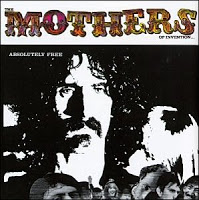
In yesterday’s post, I didn’t explain something I thought was obvious. The Mothers of Invention alludes to the well-known proverb, “Necessity is the mother of invention.”

The LDS scholars and educators who are Mesoamerican advocates have found it necessary to invent all kinds of rhetorical tricks to explain how and why
(i) Joseph Smith and Oliver Cowdery were actually ignorant speculators who were wrong about Cumorah and misled the Church for 100 years;
(ii) there are actually two Cumorahs; and
(iii) the text actually describes a Mesoamerican setting.

Yesterday I discussed the canard that the river Sidon “must flow north.”

Today I will discuss snow.
_______________________

Mesoamerican advocates have trained their followers well. If you engage in a conversation about Book of Mormon geography with people afflicted with Mesomania, within minutes they will say something such as, “If the Book of Mormon took place in North America, it would have mentioned snow.”

The argument is so irrational that we’re surprised it has endured, but I heard it again last week from a well-educated, experienced, long-time BYU-affiliated person who was perfectly serious.

The basic idea is explained throughout the publications of the citation cartel, so if you’re involved with this issue, you’ve surely seen or heard it.

Here’s one of the best explanations, this one from Jeff Lindsay, a persistent Mesoamerican advocate:

“If the Book of Mormon were based on elements from Joseph’s environment, and if he was describing a people who lived or at least fought major battles in the New York area (around the puny hill where the plates where buried, which many Mormons incorrectly and implausibly associated with the Hill Cumorah of the text), then we would expect the snow and cold of winter to play a key factor.”

http://mormanity.blogspot.com/2006/07/snow-in-jerusalem.html

This passage is a beaut on several levels.

First, the passage exemplifies the series of cascading assumptions that typify Mesoamerican “logic.”

Second, by rejecting the New York Cumorah and claiming that “many Mormons” are incorrect, the passage dismisses Joseph and Oliver as ignorant speculators who deceived the Church–but instead of mentioning them by name, he slyly includes them in the amorphous group “many Mormons.” (Note: few Mesoamerican advocates will openly admit they think this about Joseph and Oliver, but a few have. Whether they openly admit it or not, every Mesoamerican advocate rejects Joseph and Oliver. Every time you see a map (like the ones at BYU Studies I linked to yesterday) or see a display like the one in the North Visitors Center on Temple Square, or read an article promoting the Mesoamerican setting, or even look at the artwork in most chapels and the Arnold Friberg paintings set in Central America that are in missionary editions of the Book of Mormon, you are seeing an implicit repudiation of Joseph and Oliver. So it’s not shocking to us that Jeff Lindsay would write this. It’s typical.)

Third, we see this rejection of Joseph and Oliver framed as a proof of the authenticity of the Book of Mormon!

That’s my favorite element of the no-snow argument, actually. The “scholars and educators” are actually making the argument that if Joseph wrote the Book of Mormon, he would have mentioned snow as an integral part of the narrative. What they don’t mention is that “View of the Hebrews” also doesn’t mention snow (except when the immigrants came across the Bering Strait). Their argument actually bolsters the anti-Mormon claims.
____________________

Here is the genesis of the Mesomania about snow.

1 Nephi 11:8 describes the fruit on the tree of life by writing “the whiteness thereof did exceed the whiteness of the driven snow.”

This is the only mention of the term “snow” in the Book of Mormon (not counting the 116 pages). Presumably Nephi wrote this passage in the Old World, not the New World, and then, presumably, no one mentioned snow in the New World. Therefore, according to the citation cartel, the New World events of the Book of Mormon had to take place in a setting that lacked snow.

I know, you’re having trouble keeping a straight face reading their argument, but there’s more.

The “no snow” argument is really the inverse of the argument these same “scholars and educators” make about volcanoes. The text never mentions volcanoes, so these “scholars and educators” conclude the Book of Mormon had to take place in a setting that featured volcanoes.

Which is the same argument that the Book of Mormon had to take place in an area that featured tapirs and jungles and massive stone temples, none of which are ever mentioned or described in the text.

According to Mesomania logic, it is less likely that a feature of a geographical setting (i.e., snow) is actually found in that setting when it is mentioned in the text than when a feature (i.e., volcanoes) is not mentioned at all!

That’s only the beginning of this Alice-in-Wonderland logic invented by necessity.
______________

FairMormon has a fun approach. Supposedly, people question the credibility of Nephi 11:8. Look at the answer. (You can see why I never refer serious people to FairMormon).

“Contrary to popular belief, snow is not unheard of in Israel and Jerusalem

“In 1 Nephi 11:8, Nephi says Lehi describes the Tree of Life by saying “the whiteness thereof did exceed the whiteness of the driven snow.” Since Nephi and Lehi were desert folk from Jerusalem, and then likely lived in tropical Central America, why would they have used “snow” as a description?
Contrary to popular belief, snow is not unheard of in Israel and Jerusalem.”

Anyone who reads the Bible knows snow is not unheard of in Israel and Jerusalem because the Bible mentions it several times, both as a metaphor and as an actual occurrence. E.g., Proverbs 26:1 “As snow in summer, and as rain in harvest, so honour is not seemly for a fool.”

FairMormon starts with a straw man argument–in the real world, there is no “popular belief” that snow is unheard of in Israel–and then gets even more ridiculous.

FairMormon, a charter member of the citation cartel that publishes articles anonymously just like Benjamin Winchester, proceeds to claim Nephi and Lehi “likely lived in tropical Central America.” Then they ask the rhetorical question, “why would they have used ‘snow’ as a description?”

The answer, according to FairMormon, is that “many Old Testament scriptures” “also use the term ‘snow’.” Their answer kills their own straw man, of course, a point they are oblivious to. But worse, they also don’t seem to realize they missed a key point.

The Old Testament writers used “snow” as a metaphor because their readers and listeners knew what snow was!

If I wanted people to know something was really, really white and pure, would I write that it was as white as xhinecoscg? Not if my readers don’t know what xhinecoscg is.

The very point that FairMormon cites as a reason why Biblical writers used “snow” as a metaphor–because it was known to the audience–refutes their claim that Lehi and Nephi lived in “tropical Central America.” Does it make any sense for Nephi to use as a metaphor a term that his people would not understand?

I know, it is unbelievable that the “scholars and educators” would make an argument such as this, but when necessity is the mother of invention, sometimes your invention is not going to make any sense.
______________________

As long as we’re looking at FairMormon, notice that they overlook another key point.

The phrase “driven snow” appears nowhere in the Bible.

The anonymous FairMormon author(s) clam that because many Old Testament scriptures use the term “snow,” “it is not surprising that Lehi and Nephi (who knew Israelite scripture well) would use the term.”

Except Lehi and Nephi did not use the Biblical term!

“Driven snow” is not “snow.” The Bible uses “leprous as snow,” “cold of snow,” “melted snow,” “snow like wool,” “whiter than snow,” and “white as snow” (the only use in the New Testament, used three times), but it never uses “driven snow.” I don’t see any passages in the Bible that allude to snow being driven or even blown. There are a couple of references to snow falling, but nothing like driven snow.

According to the Oxford dictionary, “driven snow” means “snow piled into drifts or made smooth by the wind, taken as a type of purity.” Apparently Shakespeare coined the phrase “white as driven snow,” although it is such an obvious metaphor that it surely preceded him. Driven snow is what you see in England, where you get lots of snow piled into drifts.

I’ve been in a snowstorm in the Middle East. It falls, but doesn’t accumulate enough to be blown into drifts. As far as I can determine, the deepest known snowfall on record (other than in the mountains) in Israel was less than 2 feet in February 1950. Obviously, the weather could have been different in Nephi’s day. Maybe it snowed 5 feet deep on the Arabian peninsula and blew all over the place.

But I doubt that.

And even if it did, how would Nephi’s descendants in the New World know what “snow” was when they were living in the Mayan tropical paradise? Let’s assume the absurd and pretend they saw white snow during a freak storm on one of the mountains in Central America. Even then, unless they were living in those mountain tops, how would they know what “driven snow” was?

Remember, they couldn’t get that phrase from the scriptures.

I could go on, but you get the picture.

Our LDS “scholars and educators” who promote the Mesoamerican theory want us to believe that Nephi’s people didn’t know what snow was, let alone driven snow, because they lived in “tropical Central America.”

They want us to believe that Nephi used a metaphor his own people could not understand.

They want us to believe that although Nephi knew about driven snow well enough to use it as a metaphor (a metaphor he did not borrow from the scriptures), he could not have lived in a place where snow was driven; i.e., North America.

At the same time, they want us to believe that Nephi lived in a place characterized by natural features he forgot to mention, including volcanoes, jungles, jade, tapirs, massive stone pyramids–and, let’s not forget, millions of Mayans.
_____________________

The citation cartel has come up with plenty of additional fun explanations. The examples I’ve cited above are the tip of the iceberg–the tip of the snowbank. Hopefully my brief analysis gives you an idea of what to look for.

Perhaps the most bizarre of all these articles is one posted by the parent organization of Book of Mormon Central America, here:
http://www.bmaf.org/articles/whiteness_driven_snow__stoddard

There’s another awesome one here:
http://www.bmaf.org/node/364

The next time someone tries to persuade you that Joseph and Oliver were ignorant speculators who deceived the Church because the Book of Mormon doesn’t mention “snow” frequently enough, you should have a decent response by now.

But there’s one more I have to mention.
______________________

The Fair blog at LDS Living has an all-time classic here. I’ll put my interlinear notes in red:

Weather in relation to Book of Mormon geography
byFAIR Blog
Opinions & Features

Comments [footnotes omitted]
Snow [actually, “driven snow”] is only mentioned once in The Book of Mormon, and that is only when the Lehites were still in the Old World. [We don’t know when Nephi wrote this. Nephi wasn’t describing physical snow anyway; he was using “driven snow” as a metaphor, writing some time after the event (i.e., it’s just as likely he wrote chapter 11 in the New World as in the Old World). He wrote to his children (2 Ne. 26:1), so using “driven snow” as a metaphor while living in tropical Central America would be confusing at best, a contradiction to his insistence on writing in plainness (2 Nephi 32:7)] 

This is very indicative of where The Book of Mormon took place. [I agree; it had to take place in an area that featured “driven snow,” especially since this is not a Biblical term.]

If they lived in an area that was cold, such as the area around the Great Lakes, surely the bitter winters known in that area would have been mentioned. [Lots of fallacies here, but I’ll just mention the obvious three. First, Nephi did mention driven snow. Second, Book of Mormon authors rarely mentioned weather, and when Mormon did (Alma 46:40), he mentioned “some seasons,” not just the two in Central America (rainy and dry). Third, this argument, if applied consistently, precludes Central America as a possible setting because the text never once mentions volcanoes, jungles, jade, tapirs, or even Mayans. But one thing we’ve learned from the citation cartel over the years: they don’t apply their arguments consistently.]

Other than the one reference , there is no mention of snow at all where the primary events of The Book of Mormon took place. [“Other than the one reference” is a classic dodge, isn’t it? If there were two references, the argument would be, “other than the two references.” This line of reasoning has no coherent limit. And the one mention is still one more than any mention of Mesoamerican features.]

John Lund states “The pilgrims of Plymouth, Massachusetts in 1620 often referenced the cold and the snow. If the major events of The Book of Mormon all happened around the New York Hill Cumorah, one would expect to hear about snow.”

[This is almost poetic, the ability to pack so many logical fallacies into two sentences. The pilgrims landed in winter and nearly starved. Lehi landed in the spring with plenty of time to plant crops and with abundant wildlife to eat in the meantime. Not even the text suggests that the major events of the Book of Mormon happened around Cumorah; only the final battles did. This is another fine example of a straw man fallacy (creating the straw man claim that the major events took place around Cumorah, then attacking that straw man on the ground that the text doesn’t mention snow). The poetry comes in adding “all” to major events. Needless to say, many of major events took place in and around Jerusalem, so this straw man fails on that account already. For that matter, why didn’t Nephi describe snow falling when he was confronting Laban, since snow is so common in Jerusalem now, according to these “scholars and educators.”]

However, the cold is not what we hear about. Instead, we hear phrases like “heat of the day”[This is a fun rhetorical trick. “Phrases like” implies there are other similar phrases, but there aren’t any! Plus, anyone who has been in the Midwestern U.S. or even western New York in the summer knows what “heat of the day” means. Besides, it’s easy to have a battle in the “heat of the day” even in cold weather. For example, in The Late War, we have this sequence (on p.49): “And when the battle waxed hot, and they began to rush upon one another with great violence, the small band of Columbia fought desperately, and the slaughter was dreadful; and the pure snow of heaven was sprinkled and stained with the blood of men!”], without any indication of a cold climate one would expect to see if The Book of Mormon took place in the North Eastern United States. [This reprise of the straw man expands the fake setting a little beyond the immediate proximity, but it’s no less misleading because of the straw man assertion that the Book of Mormon took place in the North Eastern U.S. Only the final battles took place at Cumorah.] 

The Lehites came from the Middle East, travelled years through the vast Saudi Arabian deserts, and then we only hear about the heat of the new land. [I missed the part in the text where Nephi relates his encounter with all this heat in the Middle East and Saudi Arabia. Why was it okay for him to forget to mention the weather in the Old World, but he was supposed to describe it in detail in the New World?]

If it were a new, colder climate, it would most certainly be mentioned. [The “most certainly” argument is a lot of fun, especially when FairMormon doesn’t know what was on the 116 pages and Nephi specifically focused not on history (or climate) but on prophecies and promises (which Mesomania also treats with great sophistry). A generation removed from Nephi, people had no “Old World” to compare with, yet they still presumably understood Nephi’s “driven snow” metaphor because Nephi wrote in plainness. And look at how Mesomania really uses the “most certainly” argument. If there were volcanoes, jungles, jade, jaguars, tapirs, massive stone pyramids, and, especially, millions of Mayans, these “most certainly” would not be mentioned, according to Mesomania. Do these Mesoamerican promoting “scholars and educators” really expect us to buy this argument? The answer, of course, is yes. They do expect us to fall for these arguments. And thousands of their students have gone through BYU accepting these logical fallacies, which they have continued to prop up as Institute and Seminary and Sunday School teachers ever since.]

The rest of this awesome article is found on Fairmormon here. It’s more of the same nonsense, IMO.

Source: Book of Mormon Wars

The mothers of invention of the Mesoamerican theory

I’m continuing to hear some old objections to the North American setting for the Book of Mormon, so apparently I need to comment on them again as I have time. I’ll frame these posts as looking at the mothers of invention of the Meosamerican theory.
______________

[Skip this section if you don’t want to read about the reference to the Mothers of Invention.

[When I was growing up, the Mothers of Invention was my choice of rock band for teenage rebellion. I was reminded of this recently on a Delta flight. The music list included “Brown Shoes Don’t Make It” from the “Absolutely Free” album. The Mothers’ records are so awful that my mom actually broke my vinyl album in half so I would stop listening to it. Maybe some day we’ll be able to do the same with the Mesoamerican theory that has caused so much trouble.

[The album I thought was the most clever was “We’re Only in it for the Money.” I have heard this complaint from both sides of the Book of Mormon geography issue; i.e., I’ve heard that Mesoamerican advocates promote their theory with books, tours and conferences, while “Heartlanders” do the same. In my view, neither side is in this for the money. Advocates on both sides are promoting their beliefs because they love the Book of Mormon and want to share its message with the world (and encourage LDS people to study it more). That said, there are costs involved with any educational pursuit. I have spent far, far more money on Mesoamerican books and conferences than on North American books and conferences, and certainly LDS people in general have done the same. Mormon’s Codex alone costs $59.99 at Deseret Book. Along these lines, I have to say, I hope I never again here a BYU-affiliated (i.e., tithe-payer subsidized) scholar/educator complain about other people selling books and tours. It’s bad enough that tithing money has been used in the past to support the Mesoamerican theory.]
______________

One of my favorite objections to the North American setting is the old meme that “The River Sidon flows north.”

The mother of invention of the north-flowing river was Orson Pratt’s hemispheric model, not a careful analysis of the text. Joseph Smith specifically rejected Pratt’s ideas in the Wentworth letter, but that hasn’t stopped anyone from promoting the progeny of Pratt’s ideas anyway.

Here’s my conclusion for those who don’t want to wade through the explanation:

The notion that there is a north-flowing river from the land of Nephi to the land of Zarahemla is correct, but it’s not the Sidon River. Translated into the modern world, the Sidon is the Mississippi, and the river flowing from the land of Zarahemla up in elevation and south to the land of Nephi is the Tennessee River.
______________

Here’s how the idea of a Mesoamerican north-flowing river Sidon started. In the 1920s, some RLDS and LDS scholars convinced themselves that the Book of Mormon took place in a limited area of Central America. This meant the “real” Cumorah could not be in New York, which led to the bizarre “two Cumorahs” theory.

This theory also presented the problem that the only two significant rivers in the area of Mesoamerica flow north. Therefore, these scholars concluded, the river Sidon must flow north. To justify their theory, they imposed an interpretation on the text that has become their default standard. It’s an example of the “ruling theory” that I mentioned in my last post.

If you went to the link I provided in that post, you saw this explanation of the result of the “ruling theory” approach:

“Our premature explanation can become a tentative theory and then a ruling theory, and our research becomes focused on proving that ruling theory. The result is a blindness to evidence that disproves the ruling theory or supports an alternate explanation. Only if the original tentative hypothesis was by chance correct does our research lead to any meaningful contribution to knowledge.”

You find this happening throughout the writings of the LDS scholars and educators who promote the Mesoamerican setting.
______________________

The latest example is Book of Mormon Central (BOMC) (https://bookofmormoncentral.org/), which is merely a front for Mesoamerican advocacy groups. It started as a front for “ancientamericafoundation.org,” a long-time promoter of the Mesoamerican dogma, but BMAF is now a front for Book of Mormon Archaeological Forum, Inc. (http://bmaf.org/), which is essentially a club for Mesoamerican advocates. (“The legal organization behind Book of Mormon Central is the Book of Mormon Archaeological Forum, Inc., a 501 (c) 3 non-profit public charity chartered in the state of Utah in 1983.”) See my post about BMAF from last year:
http://bookofmormonwars.blogspot.com/2016/02/bmaf-conference.html.

You can have all kinds of fun going through the BOMC archives learning about Sidon flowing north. (Mostly, you’ll read about the comical debates about whether the Usumacinta or the Grijalva is the “real Sidon.”) That’s why I call BOMC Book of Mormon Central America. (I stopped calling it that for a while because they promised me they’d be neutral, but instead, they’ve doubled down on the Mesoamerican stuff, so there’s no reason not to refer to them as Book of Mormon Central America. In fact, referring to them as Book of Mormon Central, as if they were neutral, would be more misleading.)
______________________

Another of my favorites is BYU Studies. This mostly excellent journal is, sadly, deeply infected with Mesomania. Right on the main page, they have a link to “Book of Mormon Charts,” here: https://byustudies.byu.edu/book-of-mormon-charts. This includes a list of “Ten Essential Features of Book of Mormon Geography.” You have to see this to believe it.

Go to this link: https://byustudies.byu.edu/charts/13-149-ten-essential-features-book-mormon-geography. Most of these “essential features” are illusory and based on circular reasoning and confirmation bias (i.e., designed to “prove” the false Mesoamerican theory), but look at number 5.

“5. The river Sidon flowed northward through Zarahemla.”

The maps and explanations included in the “Book of Mormon Charts” depend on this assumption. Actually, all the Mesoamerican theories depend on this assumption.

But it’s an assumption that doesn’t make sense when we read the text carefully.
______________________

Here’s an excerpt from my book Moroni’s America that addresses this specific issue.

Flowing North or South?
A common objection to the North American setting relies on the theory that the River Sidon flows north like the major rivers in Central America<!–[if supportFields]> XE "Central America" <![endif]–><!–[if supportFields]><![endif]–>. Because the Mississippi flows south, goes the argument, North America cannot be the setting.[i]

To address this issue, I refer to an analysis by one of the most thoughtful and careful advocates of the Mesoamerican theory.[ii]He summarizes the history of the issue and identifies his proposed location in Mesoamerica<!–[if supportFields]>XE "Mesoamerica" <![endif]–><!–[if supportFields]><![endif]–>.
“The northerly flow of the Sidon has been well-understood by Book of Mormon students for over a century. In his notes to the 1879 edition of the Book of Mormon, Orson Pratt<!–[if supportFields]> XE "Pratt, Orson" <![endif]–><!–[if supportFields]><![endif]–> said the river flowed northward, [Note: this isn’t true. Pratt’s footnote to Alma 2:15 reads “supposed to be Magdalena.” but he says nothing about it flowing northward. The Magdalena river does flow northward (it is in Colombia), but Pratt did not choose it because of the direction of its flow. Pratt assumed South America was the “land southward” so he “supposed” the Magdalena was Sidon because he thought it was near the narrow neck of land.] an observation that persisted in the indices to the 1920 edition prepared under the direction of James E. Talmage and the 1980 edition prepared under the direction of Bruce R. McConkie. In his magnum opus published in 1899 (A Complete Concordance of the Book of Mormon), George Reynolds correlated the Sidon with the north-flowing Magdalena in modern Colombia. In his 1917 work Geography of Mexico and Central America<!–[if supportFields]> XE "Central America" <![endif]–><!–[if supportFields]><![endif]–> from 2234 BC to 421 AD Louis Edward Hills correlated the Sidon with the north-flowing Usumacinta. The New World Archaeological Foundation’s first season of field work in 1953 was near Huimanguillo, Tabasco west of the north-flowing Grijalva. Daniel H. Ludlow’s internal reconstruction of Book of Mormon geography, distributed throughout the Church Educational System for decades, shows the Sidon flowing north to the sea. John E. Clark’s article “Book of Mormon Geography” in the 1992 semi-official Encyclopedia of Mormonism includes the north-flowing Sidon as one of the few tenets of Book of Mormon geography unambiguously attested in the text. We established previously that the Usumacinta River is the viable candidate for The Book of Mormon’s river Sidon… As we would expect, the Usumacinta flows generally from south to north.”
_________________________
Despite that impressive history, the author, who is a Mesoamerican advocate, doesn’t seem to realize that the “north-flowing” Sidon dogma originated with the hemispheric model, which Mesoamerican advocates reject. It was Orson Pratt’s hemispheric idea, which Joseph Smith specifically rejected in the Wentworth letter, that led Pratt to name the Magdalena River because it was the only major river located near Pratt’s idea of the narrow neck of land. 
Fortunately, the most recent editions of the Book of Mormon deleted the description of Sidon as a north-flowing river. The text simply does not say that the river flows north.
The argument for a north-flowing Sidon is well presented in the following seven answers to the initial question.[iii] I offer my own analysis (designated JN1, JN2, etc.) after the answers provided by the original author (A1, A2, etc.)
_________________________
Q. How do we know the river Sidon flowed south to north?
A1. Near the land of Zarahemla<!–[if supportFields]> XE "Zarahemla" <![endif]–><!–[if supportFields]><![endif]–>, the hill Amnihu Alma 2:15, 17 and the valley of Gideon Alma 6:7 were both east of the river Sidon. Near the city of Zarahemla, the river Sidon had a west bank Alma 2:34. These data points all imply a general north/south orientation for the river in that part of its course.
JN1: I agree.
A2. Beyond (south of) the land of Manti, a south wilderness Alma 16:6, 7 lay east of the river Sidon. This implies a general north/south orientation for the river in that part of its course.
JN2: I agree, except for the parenthetical (south of). The text doesn’t say south of Manti, it says beyond Manti. Beyond the land of Manti can be on the east side of the river, with the wilderness still designated as south in relation to Zarahemla<!–[if supportFields]> XE "Zarahemla" <![endif]–><!–[if supportFields]><![endif]–> and other sites to the north.
A3. Upstream from (south of) the land of Manti Alma 43:32, Captain Moroni<!–[if supportFields]>XE "Moroni" <![endif]–><!–[if supportFields]><![endif]–> placed part of the Nephite army west of the river Sidon Alma 43:27 and another part east of the river Sidon Alma 43:53. These data points imply a general north/south orientation for the river in that part of its course.
JN3: The first part of this answer—upstream from—simply assumes the conclusion. The text never says which way the river is flowing. Moroni<!–[if supportFields]> XE "Moroni" <![endif]–><!–[if supportFields]><![endif]–> concealed part of his army in the valley that was on the west of the river Sidon and part into the valley on the east “and so down into the borders of the land Manti.” The text doesn’t say whether Moroni started out north or south of Manti, but Manti was on or near the border<!–[if supportFields]> XE "border" <![endif]–><!–[if supportFields]><![endif]–>. It wouldn’t make sense to have Moroni crossing the border into Lamanite territory and fortifying northward; instead, he would be fortifying the Nephite side of the border, from the north toward the south. That he went “down into the borders” shows the river flowed from the north to the south.
A4. One verse in the text has been interpreted to mean that the river Sidon flowed from east to west in part of its course. Alma 22:27 is ambiguous. It could mean that the river Sidon flowed from east to west at that point. Given the repetitive nature of Mormon’s phrasing, though, it is more likely that all the east to west references in Alma 22:27-29 refer to the narrow strip of wilderness<!–[if supportFields]>XE "narrow strip of wilderness" <![endif]–><!–[if supportFields]><![endif]–> that separated Nephite lands on the north from Lamanite lands on the south. The text mentions several geographic entities or human activities either east or west of the river Sidon. The text never mentions entities or activities directly north or south of the Sidon. All of these data points reinforce the notion that the Sidon flowed in a general north/south direction over most of its length.
JN4: I agree with this, and add that my chiastic analysis explains it in more detail. Nothing here speaks to the direction of flow, however.
A5. The land of Manti was south of the land of Zarahemla<!–[if supportFields]>XE "Zarahemla" <![endif]–><!–[if supportFields]><![endif]–> Alma 17:1. The land of Manti was also near the head of the river Sidon Alma 43:22. From the head of the river Sidon, one went down in elevation to Zarahemla Alma 56:25. These data points indicate that the river Sidon flowed generally northward from Manti to Zarahemla.
JN5: I agree with the first two sentences, but the third one is not what the text says, and the fourth is a faulty inference. Alma 56:25 says the Lamanites had a choice to “march down against the city of Zarahemla<!–[if supportFields]>XE "Zarahemla" <![endif]–><!–[if supportFields]><![endif]–>” or they could “cross the head of Sidon.” It doesn’t say they were atthe head of Sidon. Instead, in 56:29, it says the Lamanites, who had decided neither to march against Zarahemla nor to cross the head of Sidon, “began to sally forth,” a concept that is repeated in 3 Nephi 4:1 when the Gadianton robbers began to “sally forth” out of the mountains<!–[if supportFields]> XE "mountains" <![endif]–><!–[if supportFields]><![endif]–> and hills<!–[if supportFields]> XE "hills" <![endif]–><!–[if supportFields]><![endif]–>. The text indicates that the Lamanites in Alma 56 were in a highland area, from which they could either march against Zarahemla or cross the head of Sidon. The area around the head of Sidon in Missouri and Illinois has many high areas that the river flows through—from the north to the south—even though the elevations are higher in the south than in the north. It’s the elevation of the riverbed that determines flow, not the elevation of the surrounding areas, as I’ll show below.
A6. The greater land of Nephi was south of the greater land of Zarahemla<!–[if supportFields]>XE "Zarahemla" <![endif]–><!–[if supportFields]><![endif]–> Alma 50:7. An east/west dividing line separating the two lands ran by the head of the river Sidon Alma 50:11. To go from Zarahemla to Nephi, one went up in elevation Alma 2:24. Therefore, the river Sidon which bordered the land of Zarahemla Alma 2:15 flowed generally from south to north.
JN6: The error here is easy to see. The argument would make sense if all terrain followed the river, meaning it drops in elevation along with the flow of the river. However, that is true only of the riverbed itself, not the surrounding area. In Egypt, the Nile flows north through some wide valleys at low elevation before cutting through higher elevation mountains<!–[if supportFields]> XE "mountains" <![endif]–><!–[if supportFields]><![endif]–> to the north. Similarly, the Rhine River flows through a low elevation through central Germany before carving its way through the mountains between Bingen and Koblenz. In the U.S., the Mississippi River flows south, but on its way south it passes by higher elevations in Missouri on the west and in Tennessee and Alabama on the east. The banks of the Mississippi south of St. Louis rise over 650 feet above sea level. Montrose, Iowa—260 miles north of Arcadia—is at 531 feet. So even though the river is flowing south, it is flowing through terrain that is higher in elevation.
The other major error here is that the text never says the River Sidon leads up to the land of Nephi. While I agree people had to travel upstream—and south—to get to the land of Nephi, it wasn’t along the River Sidon that they did so. The text says only that the River Sidon flowed next to Zarahemla<!–[if supportFields]> XE "Zarahemla" <![endif]–><!–[if supportFields]><![endif]–>, not next to the city of Nephi. So how did people travel upstream to get to Nephi? They would travel from the head of Sidon up the Ohio River to the Tennessee River, and then up that river to Nephi. The Tennessee River flows north from the land of Nephi.
A7. The Mulekites made landfall in the land northward Alma 22:30, then founded their capital, Zarahemla<!–[if supportFields]> XE "Zarahemla" <![endif]–><!–[if supportFields]><![endif]–>, in the land southward Mormon 1:6 along the Sidon Mormon 1:10. As the Mulekites traveled south from the seacoast they went up in elevation Alma 22:31. This means the Sidon flowed downhill toward the north.
JN7: This is a common misunderstanding, based on an erroneous conflation of two different accounts that referred to two entirely different events. I explain this in more detail in the chapter on Omni, but for now I note that the account in Alma 22:30-31 was not referring to the people of Zarahemla<!–[if supportFields]>XE "Zarahemla" <![endif]–><!–[if supportFields]><![endif]–> who came from Jerusalem, but to the 43 scouts—people of Zarahemla—sent by King Limhi to find Zarahemla (Mosiah 8 and 22). This becomes evident when the text is carefully examined.
Mormon correctly described the land of Zarahemla<!–[if supportFields]> XE "Zarahemla" <![endif]–><!–[if supportFields]><![endif]–> as southward from where he was at the time. Throughout the text, the phrase “the land southward” is not a proper noun but a relative designation. Mormon’s use of the term in Mormon 1:6 does not equate to the land southward as defined in Alma 22.
Zarahemla<!–[if supportFields]> XE "Zarahemla" <![endif]–><!–[if supportFields]><![endif]–> waslocated along the river Sidon. However, the conclusion that the river flowed south does not follow. Even if someone traveled south and went up in elevation, a river in that area could still flow north or south. It is the elevation in the river bed that matters, not the elevation of surrounding terrain, as I’ve shown in the examples from Egypt, Germany, and North America.
Conclusion.
The text describes the River Sidon as having a north/south orientation, but it does not specify the direction of flow. One must infer direction of flow from other information about proximate locations, but these show the river flowing south, not north—just like the Mississippi River. Passages in the text that refer to going “up” to the land of Nephi and “down” to the land of Zarahemla<!–[if supportFields]>XE "Zarahemla" <![endif]–><!–[if supportFields]><![endif]–> are explained by the Tennessee River, which did flow downhill—and northward—through the Land of Nephi to the land of Zarahemla.
So the notion that there is a north-flowing river is correct, but it’s not the Sidon River. Translated into the modern world, the Sidon is the Mississippi, and the river flowing up and south to the land of Nephi is the Tennessee River.


[i] There are some small rivers in North America that flow north, which is the basis for some proposed geographies in limited areas such as western New York, but these models have other problems. Besides, a north-flowing river contradicts the text.
[ii] The discussion of the River Sidon in this section is a response to a blog entry titled “River Sidon South to North,” dated November 8, 2011, by Kirk Magleby. It is located online here: http://bit.ly/Moroni125. Brother Magleby is one of the founders of FARMS and is an outstanding scholar of the Book of Mormon. His posts on his blog are thoughtful and detailed. I think his focus on Mesoamerica<!–[if supportFields]> XE "Mesoamerica" <![endif]–><!–[if supportFields]><![endif]–> has affected his interpretations of the text, but his analysis of the various issues is superb.
[iii] Ibid. The original answers are designated by A1, A2, etc.

Source: Book of Mormon Wars

Multiple working hypotheses

There are three intellectual methods for scientific study that I like to apply to Church history and Book of Mormon geography issues (as well as science issues).

1. The method of the ruling theory.
2. The method of the working hypothesis.
3. The method of multiple working hypotheses.

The ruling theory method results from trusting an initial tentative explanation, blinding us to other possibilities. In my view, this is what has happened in Church history and Book of Mormon geography; i.e., people assumed Joseph Smith wrote anonymous articles linking the Book of Mormon to Central America and never really questioned that premise. This is how we’ve ended up with what I used to call the citation cartel of FARMS, Maxwell Institute, BYU Studies, the Interpreter, Book of Mormon Central, and all the rest of the Mesomania-inspired Groupthink about Church history and the Mesoamerican and two-Cumorahs theories. As the essay below points out, “The result is a blindness to evidence that disproves the ruling theory or supports an alternate explanation.”

The working hypothesis method starts out as a conception of a hypothesis to be tested, but soon devolves into a ruling theory to be proven. The essay points out “our desire to prove the working hypothesis, despite evidence to the contrary, can become as strong as the desire to prove the ruling theory.”

The multiple working hypotheses method requires the development of several explanatory hypotheses that may even contradict one another.

In my view, the multiple working hypotheses is the best method. It’s one I’ve followed as I went from being an advocate of the Mesoamerican theory to an advocate of the North American theory.

In fact, I think the only reason some people are sticking with the Mesoamerican theory is because they operate under the ruling theory method. That’s what leads to the group formerly known as the citation cartel.

I encourage anyone interested in these topics to read the publications mentioned above. After you read just one or two, you’ll see what I mean about the ruling theory method.
______________________

The concept of these three methods was set forth in T. C. Chamberlin’s “Method of Multiple Working Hypotheses.” You can see an excellent reworked summary of that paper at this site:
 http://www.gly.uga.edu/railsback/railsback_chamberlin.html

Source: Book of Mormon Wars

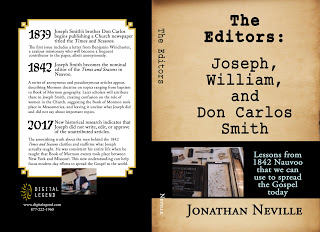
The Editors: Joseph, William and Don Carlos Smith

I’ve mentioned this book before on this blog. I actually wrote it a year ago but never released it because I was waiting for something. Not long ago, the Joseph Smith Papers released some new material that fit right in, so I finished the book and I’m going to introduce it Saturday at the conference.

I have it on Amazon now for my beta readers. Regular blog readers have asked me to let them know, so here it is. You can click on the image of the cover and it takes you right to the page on Amazon.

As of this writing, Amazon is still showing an old dummy cover. The actual cover is the one in this post.

This is a fairly detailed Church history book. I go through every reference to Joseph’s activities during 1842 while he was the nominal editor of the Times and Seasons.

Here are the main points for those who don’t want to read the detailed history and references.

– After his first editors, WW Phelps, Oliver Cowdery, and Warren Cowdery, left the Church, Joseph trusted only his brothers William and Don Carlos to be editors (until Don Carlos died and William caused too much trouble, but even then, Joseph allowed William to edit the newspaper in New York called The Prophet).
– William was the nominal and actual editor of the Wasp at the same time Joseph was the nominal but William was the actual editor of the Times and Seasons. W.W. Phelps contributed anonymously to both papers.
– Joseph never once connected the Book of Mormon to Central America.
– The famous “Bernhisel letter” was drafted by Wilford Woodruff; Joseph probably never even saw it.
– Joseph never read or cared about the Stephens and Catherwood books.
– Joseph adapted the Wentworth letter from Orson Pratt’s pamphlet and edited out Pratt’s hemispheric and Mesoamerican ideas. Phelps wrote much of the Wentworth letter, but Joseph wrote the key portions, including the corrections to Pratt’s work regarding the Book of Mormon geography.
– Don Carlos said Joseph gave him “essays on the glorious Priesthood” to publish in the Times and Seasons. The essays were actually Oliver Cowdery’s 8 letters (including Letter VII).
– W.W. Phelps played a key role at the Times and Seasons and probably wrote the introduction to the Book of Abraham that claims it was a translation of the papyrus.

Source: Book of Mormon Wars

How much should students defer to professors?

Although there are a lot of college students who read this blog, we’re all students in one way or another, so the question isn’t directed only at college students, although I’ll frame the discussion in terms of professors and students.

I think it’s pretty easy to recognize that we don’t defer to professors who try to persuade us to change our personal values. Or is it?

Let’s say a professor tells a student that marriage is outdated and pointless. Does that student defer to the professor, or think for herself/himself? What if the professor teaches that alcohol is good for health? Or that God doesn’t exist? At what point does the student learn for herself/himself?

When I was at the university, I was taught lots of things that turned out to be untrue. Some of the professors were teaching from ignorance; not personal ignorance, necessarily, but they were teaching what they were taught, which most people believed at the time.

It’s natural.

It doesn’t make much difference what field you are in, either. These problems arise in the arts, sciences, religion–just about any field is subject to change as we learn more about it.

One of the dangers of deference is Balkanization. People who defer to their professors become blind to (or oblivious of, or, worse, disdainful of) alternative viewpoints and inconvenient facts. People who defer to their professors tend to become intransigent and overconfident in their newly acquired expertise.

I see this all the time, in every field.

We see it play out on a daily basis in politics, where both sides are myopic and refuse to even understand alternative points of view, much less empathize with them. There is a lot of “us vs. them” going on as a result.

The obvious example related to this blog is how I was taught the Book of Mormon took place in Mesoamerica. “Everyone” knew it when I was at BYU. Now I see that idea was based on a series of false assumptions, but it was universally taught back then, and the legacy of that groupthink endures today among many people.

As a student, I didn’t have the background to understand the fallacy of the assumptions my teachers were relying on. I deferred to their expertise, basically.

Students need to realize that the purpose of a university education is not to please faculty by deferring to their expertise. Students need to learn for themselves, using professors as resources the way you would a textbook or a video. Learn what your professors know, but don’t stop there. Inevitably, unless you defer completely to their expertise, you will soon know more than your professors.

Some professors are more open-minded than others. You’ll discover this quickly if you inquire.

It’s up to each of us to learn for ourselves.
______________

A free book on this topic (not one I wrote) is here: http://www.bmartin.cc/pubs/91strip.html

Source: Book of Mormon Wars

Experts and assumptions

Much of what we “know” consists of information organized around assumptions we take for granted. This is natural; we can’t learn everything, so we have to defer to others: doctors, farmers, miners, manufacturers, journalists, scientists, etc.

But experts are people, too, and they have their own assumptions upon which they rely. A classic example I’ve written about is the assumption that Joseph Smith wrote anonymous articles in the Times and Seasons. These articles have shown up in Church manuals as teachings of Joseph Smith, even though it is now apparent he had nothing to do with them and even, in some cases, opposed them.

One fascinating aspect of this is that people on both sides of an issue may make the same assumptions–even when the assumptions are wrong. Hence, we have BYU-trained experts and staunch anti-Mormon activists debating over historical or doctrinal issues, based on mutual assumptions that, in many cases, are inaccurate. A classic example of this one is the debate over the Book of Abraham, which I’ve discussed elsewhere.

I came across this list of the 20 worst assumptions made by experts. Lots of analogies to what has been going on among LDS scholars and educators. I can’t vouch for the accuracy of the list because i haven’t checked it. The list was compiled by Paul Sloane who writes and speaks on innovation and lateral thinking. He is the author of The Leader’s Guide to Lateral Thinking Skills from which this list is taken.

THE 20 WORST ASSUMPTIONS MADE BY EXPERTS

The greater the expert the more wrong they can be; in their assumptions, their predictions or their negative reactions to new ideas. Here are some classic examples:
  1. Samuel Pepys (1633-1703), the celebrated English diarist, wrote the following comments on seeing plays by Shakespeare: Romeo and Juliet – ‘the worst play I ever saw in my life’, A Midsummer Night’s Dream – ‘the most insipid, ridiculous play’, Twelfth Night – ‘a silly play.’
  2. Dr. Dionysius Lardner (1793-1859), professor of natural history and astronomy at London University, warned that railway trains traveling at speed would asphyxiate their passengers through lack of air. He also stated that no steamship would be able to cross the Atlantic because it would need more coal than it could carry without sinking.
  3. Simon Newcomb (1835-1909), the leading US astronomer of his time and a professor of astronomy and mathematics, declared that flight by heavier-than-air objects was completely impossible. After the Wright brothers made their first flights he still claimed that airplanes were impractical and worthless.
  4. Ernst Werner von Siemens (1816-1892), the great German engineer who developed the telegraph industry and founded the company bearing his name, declared, ‘Electric light will never take the place of gas.’
  5. Charles Duell was Commissioner at the US Patents Office who in 1899 gave his opinion that, ‘Everything that can be invented has been invented.’
  6. Ernest Rutherford (1871-1937) was the eminent British physicist who pioneered nuclear physics, discovered the alpha particle and developed the nuclear theory of atomic structure. He refused to believe that nuclear energy could be harnessed and described ideas for nuclear power as ‘moonshine’.
  7. Lord Kelvin (1824-1907) was a distinguished British mathematician and physicist who developed the law of conservation of energy. The Kelvin scale of absolute temperature is named after him. He scoffed at the idea of radio and stated, ‘Radio has no future.’ He also said, ‘X-rays will prove to be a hoax.’
  8. H.G. Wells (1866-1946) the eminent British author and one of the first science fiction writers said in 1902, ‘I refuse to see any sort of submarine doing anything except suffocating its crew and floundering at sea.’
  9. General Douglas Haig (1861 -1928) the commander of the British Army in WWI said in 1914 of the machine gun, ‘Make no mistake, this weapon will change absolutely nothing.’
  10. In 1927, H.M Warner of Warner Brothers asked, ‘Who the hell wants to hear actors talk?’
  11. Irving Fisher was Professor of Economics at Yale University. In 1929 he pronounced, ‘Stocks have reached what looks like a permanently high plateau.’
  12. Dr Albert Einstein said in 1932, ‘There is not the slightest indication that nuclear energy will ever be obtainable.’
  13. Admiral William Leahy (1875-1959) told President Truman in 1945, ‘The atomic bomb will not go off and I speak as an expert in explosives.’
  14. Rex Lambert, Editor of The Listener, wrote in 1936, ‘Television won’t matter in your lifetime or mine.’
  15. John Langdon-Davies, fellow of the Royal Anthropological Institute opined in 1936, ‘By 1960 work will be limited to three hours a day.’
  16. Sir Richard Woolley was the British Astronomer-Royal who declared in 1956 that, ‘Space travel is utter bilge.’
  17. Don Rowe was the director of Decca Records who turned down the Beatles. He said to their promoter, Brian Epstein, ‘We don’t like your boys’ sound. Groups of guitarists are on the way out.’
  18. Frank Sinatra in 1957 stated, ‘Rock and Roll is phony. It’s sung, written and played by cretinous goons.’
  19. Ken Olson, CEO of DEC said in 1977, ‘There is no reason anyone would want a computer in their home.’
  20. Bill Gates stated in 1981, ‘640k ought to be enough for anybody.’
_________________

Here is a list I’ve thought of. You probably have some of your own to add. 

THE 10 WORST ASSUMPTIONS MADE BY lds EXPERTS

Here are some classic examples (without naming anyone) that I’ve seen in multiple publications by LDS scholars and educators. You can see the results of these assumptions on display on Temple Square and throughout Church media, manuals, etc. (although fortunately they are being gradually eliminated).
  1. Joseph Smith actually edited, printed, and published the Times and Seasons during 1842.
  2. Only Joseph Smith, John Taylor, and Wilford Woodruff contributed to the Times and Seasons during 1842.
  3. Joseph Smith wrote, or approved of, every anonymous article in the Times and Seasons during 1842 between March and November.
  4. When they referred to Cumorah being in New York, Joseph Smith and Oliver Cowdery were ignorant speculators who misled the Church.
  5. Joseph Smith changed his mind about Book of Mormon geography and gradually came to believe it took place in Central America.
  6. Joseph Smith expected scholars to figure out where the Book of Mormon took place.
  7. Central America is the only place in the world that matches the description in the text of the Book of Mormon.
  8. The river Sidon must flow north.
  9. Joseph mistranslated the plates because he didn’t name tapirs, jaguars, jade, or even volcanoes.
  10. When Lehi landed, he and his people were absorbed into a vast Mayan culture so no traces survived.

Source: Book of Mormon Wars

New Book – Before the World Finds Out

Okay, since a lot of readers want to know about new books, I’ll tell you about another new book that I’ve only sent to beta readers but which will be released later this week at the conference. It’s titled Before the World Finds Out. This one is a novel that gives an idea of how the new paradigms of Church history, Book of Mormon geography, and the Universal Model actually affect people.

The pre-release version is $6.99 through today for my beta readers, and now for my blog readers.

🙂

Click on the image above or search Amazon for

  • ISBN-10: 1540590097

Later this week it will be under a different ISBN with a price of $14.99.

Source: Book of Mormon Wars

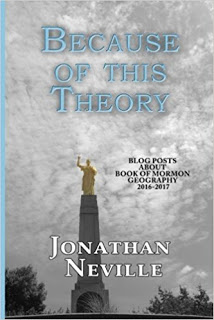
New book: Because of this Theory

For a long time people have been asking for a book version of this blog. I’ve explained that the entire blog is far too much to print; last time I checked, it was at about 1600 pages.

But I wanted a printed copy myself, as well as a Kindle version, so I started working on it.

Instead of printing the entire blog, I started with March 2017 and went backwards until I had about 100,000 words of good material, which took me back to August, 2016. I edited it somewhat, eliminated time-related posts, and put the whole thing in book format. I also added a few posts from other blogs when they were directly referenced here.

I titled it Because of this Theory, referencing Joseph Fielding Smith’s warning about the two-Cumorahs theory that, sadly, has been ignored by many LDS scholars and educators.

I like the way it turned out.

As of this writing, the book is at #6 on Amazon’s New Releases in Mormonism.
https://www.amazon.com/gp/new-releases/books/12430/ref=zg_bsnr_nav_b_3_16009761

For today and tomorrow (3-4 April, 2017), the introductory price for beta readers is $8.99. After that, it will be at the regular price of $19.99.

The Kindle version should be available soon, but I can’t predict when.

Source: Book of Mormon Wars

Joseph Smith endorsed Oliver Cowdery’s letters

From time to time I still hear objections to Letter VII based on the idea that Oliver wrote them by himself and Joseph didn’t endorse them. These objections are from Mesoamerican advocates, of course.
Here’s how the conversation typically goes.
Me – “Oliver said Joseph helped him write the letters.”
Meso – “Oliver did say that, but we don’t know how much Joseph assisted.”
Me – “Joseph had his scribes copy the letters into his own history.”
Meso – “Yes, but he wrote another history later, in 1838. If he approved of Oliver’s letters, he could have just used those.”
Me – “First, Joseph did rely on those letters. Second, he didn’t need to repeat the detail Oliver had written, such as when Joseph said Moroni quoted other scriptures he couldn’t relate at that time. Third, Joseph’s history covered topics in addition to what Oliver covered.”
Meso – “But still, Joseph never expressly endorsed Oliver’s letters.”
Me – “He expressly gave Benjamin Winchester permission to reprint them in the Gospel Reflector.”
etc.
__________________

Today I’m posting an additional detail from my book, The Editors: Joseph, William, and Don Carlos Smith, which will be released (finally) this week. I’ve never seen anyone write about this before and I think it’s significant.

In the last issue of the first volume of the Times and Seasons (October 1840), Don Carlos announced he was going to expand the paper by publishing it twice a month. (You can see this issue at this link: http://www.centerplace.org/history/ts/v1n12.htm.)

Here is his reason:


“We should be pleased to publish our paper weekly, as we have an abundance of matter for the instruction of the saints, as President Joseph Smith jr. is furnishing us with essays on the glorious subject of the priesthood, also giving us extracts of the new translation to lay before our readers, of the second volume,-but our circumstances will not permit us to publish oftener than twice a month.”

In the next issue, Don Carlos began the Times and Seasons with “Extract from the Prophecy of Enoch.” That fulfills the promise of “extracts of the new translation.”

But what about “essays on the glorious subject of the priesthood” that were promised?

Don Carlos does publish an essay “on the restoration of the Priesthood,” presumably also “furnished” by President Joseph Smith, Jr. But what is this essay?

It is Letter I of Oliver’s series of letters.

You can see it here: http://www.centerplace.org/history/ts/v2n01.htm

When you go to that page, search for “Priesthood” and you’ll see the term appears only in Oliver’s letter.

Don Carlos proceeded to publish all of Oliver’s letters in the following months, including Letter VII. In fact, the next issue of the Times and Seasons, November 15, 1840, starts off with Letter II. And again, this letter contains the only mention of the Priesthood in an article in that issue.

So here again, we have direct evidence that Joseph Smith formally and fully endorsed Oliver’s letters.

Source: Letter VII