

How to financially support the Mesoamerican and Two-Cumorahs theories

Questions have arisen about my post regarding Book of Mormon Central (BMC) and Book of Mormon Archaeological Forum, Inc. (BMAF). This post attempts to clarify the situation from my perspective. I welcome input/corrections by email.

I realize this may all sound a little confrontational, but I think it’s important for people to know what is going on here. Not many people know what BMAF is, but BMC has done a lot of work and spent a lot of money to promote its message.

As always, I emphasize that I respect the views of everyone involved. On a personal level, I like them and am happy to work with them in any way possible. But I also think members of the Church and investigators should know that there is a specific agenda involved here that is not exactly listed on the splash pages of these organizations.
________________

BMAF is a strident advocacy group for the Mesoamerican theory. They actively promote the two-Cumorahs theory and the idea that Joseph Smith and Oliver Cowdery were ignorant speculators who misled the Church about the New York Cumorah through Letter VII, etc.

BMC is merely a front for BMAF. People who donate money to BMC are donating money to promote the Mesoamerican and two-Cumorahs theory.

It really is as simple as that.
________________

I wouldn’t bother bringing this up except that BMC provides material to promote their Mesoamerican theory that is spread throughout LDS culture, such as through Mesomania Magazine, aka Meridian Magazine.

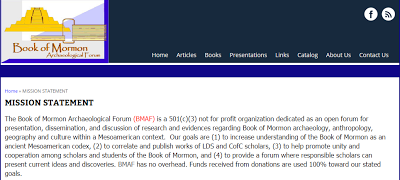
Here is the Mission Statement of BMAF, found here:

If you can’t read it, it says:

The Book of Mormon Archaeological Forum (BMAF) is a 501(c)(3) not for profit organization dedicated as an open forum for presentation, dissemination, and discussion of research and evidences regarding Book of Mormon archaeology, anthropology, geography and culture within a Mesoamerican context.  Our goals are (1) to increase understanding of the Book of Mormon as an ancient Mesoamerican codex, (2) to correlate and publish works of LDS and CofC scholars, (3) to help promote unity and cooperation among scholars and students of the Book of Mormon, and (4) to provide a forum where responsible scholars can present current ideas and discoveries. 

Of course, by “responsible scholars” they mean “scholars who promote a Mesoamerican setting” that supports the organization’s mission.
________________

I call BMAF a club for Mesoamerican activists, and if you read their materials, you see it clearly. They make no pretense about following the Church’s official position of neutrality.

I have no problem with that because they are open about it.

That’s not the case with BMC, though. They have pretended to follow the Church’s policy in the past. But in reality, they are merely a front for BMAF.

Here is the explanation of how BMC is a front for BMAF, found here:

If you can’t read it, it says:

The legal organization behind Book of Mormon Central is the Book of Mormon Archaeological Forum, Inc., a 501 (c) 3 non-profit public charity chartered in the state of Utah in 1983.

Now, look at what BMAF wants people to believe about its mission:

Our Mission Statement

Book of Mormon Central (BMC) exists to invite all people, especially the rising generation, to:
  1. Build faith in Jesus Christ
  2. Learn and cherish pure doctrine (1 Timothy 1:3-4)
  3. “Remember the new covenant, even the Book of Mormon” (D&C 84:57)
  4. Access scholarly evidence from BMC to answer hard questions about the Book of Mormon, including its origins—so that they “may know the truth of all things” (Moroni 10:5)

Those are laudable goals that I completely embrace, of course, but they forget to tell people about the mission of their corporate owner, BMAF, which I listed above.

We need to add #5 to the BMC mission statement:

5. Our goals are (1) to increase understanding of the Book of Mormon as an ancient Mesoamerican codex,

BMC’s pursuit of this unlisted goal has been apparent for a long time, based on the editorial slant of the BMC “Kno-Whys” and other material. It’s difficult for me to understand how they can build faith while promoting the Two-Cumorahs theory that undermines the credibility and reliability of Joseph Smith, David Whitmer, and Oliver Cowdery, but they have rationalized this in their own minds.
________________

As with BMAF, I would have no problem with it if they were more up front about it. By pretending to be neutral, BMC is not coming clean with their readers.

BMC adopted this statement in June 2016:

Book of Mormon Central Policy on Book of Mormon Geography – June 2016

Book of Mormon Central at this time is officially geography neutral. We seek deep understanding of the Book of Mormon text. We hope diligent students work together to achieve working consensus on the geographic correlation issue. Until that happens, our selection of exegetical material is guided by these principles:
  • In our hierarchy of evidence, the text itself is primary because it is closest to the divine.
  • If profound and compelling location-specific insights shed light on the text, we highlight these regardless of their geographic provenience.
  • We favor authors with credentials in their areas of interest.
  • We favor formally published works from reputable presses.
We welcome good work from any geographic persuasion that is responsive to these principles.

In reality, of course, these wonderful sentiments are a smokescreen over the goal of BMAF “to increase understanding of the Book of Mormon as an ancient Mesoamerican codex.” The content of BMC’s archive and the new material they produce is all designed to fulfill the BMAF goal.

In my opinion, it is tragic to have such a potentially valuable resource as BMC become nothing more than a souped-up version of BMAF

Source: Book of Mormon Wars

Relief Society at the United Nations

In case you missed them, these are great stories:

http://www.mormonnewsroom.org/article/new-mormon-relief-society-president-speaks-un?cid=HP_TH_13-4-2017_dPAD_fMNWS_xLIDyL2-2_

“Our small and simple efforts are enhanced and multiplied by our collaboration with hundreds of partners, both global and local, including all of my fellow panelists. I have been humbled by their presentations today. Islamic Relief’s “Day of Dignity” program has helped so many people raise their chins and look forward with determination to begin their new lives. Episcopal Migration Ministries’ emphasis on helping immigrants adjust to their new job markets has provided stability for individuals, families and future generations.
“When we reach out to other faith-based organizations, there is a certain affinity—a shared language, a common motivation—that allows our resources to complement each other. Our common purpose lends power to our work. Governments and UN agencies recognize it, and they rely heavily on faith-based organizations to extend the reach of their services.
“Faith motivates those who serve in our organizations to give not only of their substance, but to give of themselves — they bring a human factor to the work which governmental programs alone cannot provide.  We see a divine potential in those whom we serve, therefore our efforts are not limited to just providing relief — we strive to build their capacity and their self-worth, to increase their ability to meet the next challenge that occurs so that they can also, in their turn, experience the joys of service and life.”

Source: Book of Mormon Wars

Blogs are higher quality than journal articles

Daniel Lakens, an experimental psychologist at Eindhoven University of Technology in the Netherlands, offers five reasons why blog posts are of higher scientific quality than journal articles.

Here is the link:

http://daniellakens.blogspot.nl/2017/04/five-reasons-blog-posts-are-of-higher.html

I agree with all of his points, and I think they apply to LDS topics as well. Here is a summary:

1. Blogs have Open Data, Code, and Materials [This is important for scientific topics, but it should also be important for LDS topics when relevant. The most notorious example I’m aware of are the so-called “stylometry” studies published in the Interpreter, in which the authors give no data, code, or assumptions. That kind of “black box” study is worse than no study at all, IMO, because it opens the door for anyone to publish anything that confirms their biases, without any possibility of analysis or replication.]

2. Blogs have Open Peer Review [This alludes to the practice of using “peer review” as a sham appeal to authority as well as to the practice of using phony peer reviews, both of which I think occur in many LDS academic journals. As Lakens explains, “Scientific journal articles use peer review as quality control. The quality of the peer review process is as high as the quality of the peers that were involved in the review process. The peer review process was as biased as the biases of the peers that were involved in the review process.” These points apply to the publications of the LDS citation cartel, which never disclose the identity of peer reviewers or even whether the material was actually peer reviewed. Of course, a “peer” is someone who shares the same assumptions, so peer review is illusory in most cases. At best, it is really nothing more than “peer approval,” as I’ve noted many times. Blogs tend to be more honest about peer review. My blog, for example, is not peer reviewed at all, so I don’t use “peer review” as a phony appeal to authority. You can accept, modify, or reject my ideas and the facts I offer, but I’m not going to try to persuade you with a fake appeal to the authority of some anonymous “peer review” process.]

3. Blogs have no Eminence Filter [This alludes to the elitism characteristic of scientific publications, which also exists in the world of LDS intellectuals. The citation cartel that controls LDS publications filters out alternative voices to maintain their dogmatic hold on their own ideas.]

4. Blogs have Better Error Correction [This one refers to the comments feature that allows readers to point out mistakes within a matter of minutes in many cases. When I started my blogs, I left them open for comments. But as readership increased, I started getting a lot of spam (people selling junk) that I didn’t have time to delete, so I had to close comments. It’s unfortunate. Some of the most productive interactions were with people who disagree with points I’ve made. Now people contact me by email to point out errors, which I then promptly correct or address one way or another. I welcome any and all relevant comments on my blogs, books, presentations, etc. I just want to get things right, using accurate and complete data and rational analysis. Lately, the citation cartel has published a lot of stuff that is easily rebutted, but they don’t allow comment or rebuttal, which suggests they aren’t confident about what they’re publishing. I may open the blogs to comments again and see if the spam has been blocked by Google.]

5. Blogs are Open Access (and might be read more). [With no paywalls, blogs have broader distribution. Most LDS material doesn’t have paywalls anyway, so it’s not a big issue in this community. But it’s not the paywall that is the biggest impediment to distribution, anyway. It’s people’s time, and the long-held, well-established dogma drive by Mesomania. The promoters of the Mesoamerican geography and related Church history lore have cleverly (but falsely) framed their position as the position of the Church. This makes Church members feel guilty of questioning the scholars and educators. That’s the paywall that needs to be broken down more than it has so far. It could easily be remedied if the citation cartel offered more open access. To be specific, if the Interpreter, Book of Mormon Central, BYU Studies, etc., were willing to publish articles about the new paradigms in Church history and Book of Mormon geography, they would have more credibility and, I think, long-term viability. But because they refuse, the Internet is the place for open access.]

Source: Book of Mormon Concensus

Book Summaries – The Editors

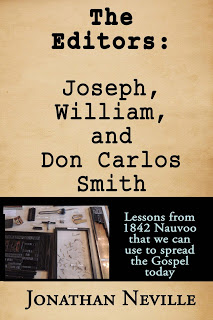
Even when we published Brought to Light, I had more material on the Times and Seasons that I couldn’t work in. I wrote The Editors: Joseph, William, and Don Carlos Smith to complete the trilogy.

The book offers even more detail about Joseph Smith’s role at the Times and Seasons. A lot of people have invested a lot of effort and time and money into the long-held assumption that Joseph was acting as editor. It’s a basic premise among the citation cartel. Tour companies rely on this premise to promote tours to Central America as visits to “Book of Mormon lands.” [See examples at the end of this blog.]

The assumption is not easy to discard, but the evidence of the error, IMO, is overwhelming. In The Editors, I list every known historical reference from 1842 having anything to do with Joseph and the Times and Seasons. I also examine some of the long-held assumptions about Joseph’s letter to Bernhisel (which he didn’t write and probably never even saw) and the Wentworth letter (which refutes the hemispheric theory of Book of Mormon geography).

The main thesis of this book is that Joseph Smith saw what happened with W.W. Phelps, Oliver Cowdery, John Whitmer, and Warren Cowdery. These four men had all been editors of Church newspapers. Even though the Lord called Phelps and Oliver by specific revelation, they along with John and Warren all left the Church, one way or another.

Oliver Cowdery candidly explained the intense pressure he felt as an editor, both in the sense of having to produce so much content and in the sense of his accountability toward God.

The first two newspapers–The Evening and the Morning Star and the Messenger and Advocate–ceased publication. When Joseph started up the next one–the Elders’ Journal–he put his brother Don Carlos in charge and listed his own name as Editor. There is no evidence that Joseph was anything more than a nominal editor; i.e., he was editor in name only.

But there was a good reason for Joseph to do this. By listing himself as editor and having his trusted brother doing the work, Joseph sought to avoid the problems he faced with the first four editors he used. Because of extremely difficult circumstances, the Elders’ Journal only published four issues–two in Kirtland and two in Missouri. The printing press was buried in Missouri when the Saints were forced to flee.

Later the printing press was retrieved and brought to Nauvoo, where Don Carlos started the Times and Seasons. After his death, his successor ran the paper for a few months before Joseph received a revelation that the Twelve should purchase and operate the newspaper. Joseph again became the nominal editor.

This time, instead of having Don Carlos as acting editor, I think he had his brother William serve as acting editor.

For a long time, people assumed John Taylor and Wilford Woodruff acted as editors, but they were involved with the printing shop and other activities. It was William who spent all his effort on publishing the newspapers, including the Wasp as well as the Times and Seasons. Joseph himself clarified that when he said John Taylor commenced his editorial career in November 1842–after Joseph had resigned as nominal editor and fired William from both papers.

I realize that for many people this is more detail than they need. But it didn’t make sense for me to sit on this information when so many people in so many ways continue to promote what I consider to be incorrect assumptions about Joseph’s role at the Times and Seasons.
__________________

Some examples of the “Book of Mormon” tours to Central America, all based on the erroneous assumption that Joseph Smith linked the Book of Mormon to Central America:

http://www.almaldstours.us/

http://lds-tours.com/

Bonus problem: John Lund, a long-time tour leader to Central America, wrote a well-known book about the Times and Seasons that relies on confirmation bias and circular reasoning to justify the Mesoamerican setting. You can see it here:

Source: Book of Mormon Wars

Moroni and America

Oliver Cowdery spent some time in his letters discussing Moroni and his mission. I’ve previously explained the reasons why I titled my book on geography Moroni’s America. Here’s another reminder of what Orson Hyde said about Moroni on July 4, 1854. This is in the Journal of Discourses, here.

After discussing the American Revolution, Elder Hyde related Moroni’s involvement with the country. Notice the part I emphasized in bold below.

In those early and perilous times, our men were few, and our resources limited. Poverty was among the most potent enemies we had to encounter; yet our arms were successful; and it may not be amiss to ask here, by whose power victory so often perched on our banner? It was by the agency of that same angel of God that appeared unto Joseph Smith, and revealed to him the history of the early inhabitants of this country, whose mounds, bones, and remains of towns, cities, and fortifications speak from the dust in the ears of the living with the voice of undeniable truth. This same angel presides over the destinies of America, and feels a lively interest in all our doings. He was in the camp of Washington; and, by an invisible hand, led on our fathers to conquest and victory; and all this to open and prepare the way for the Church and kingdom of God to be established on the western hemisphere, for the redemption of Israel and the salvation of the world.

This same angel was with Columbus, and gave him deep impressions, by dreams and by visions, respecting this New World. Trammeled by poverty and by an unpopular cause, yet his persevering and unyielding heart would not allow an obstacle in his way too great for him to overcome; and the angel of God helped him—was with him on the stormy deep, calmed the troubled elements, and guided his frail vessel to the desired haven. Under the guardianship of this same angel, or Prince of America, have the United States grown, increased, and flourished, like the sturdy oak by the rivers of water.

To what point have the American arms been directed since the Declaration of our National Independence, and proven unsuccessful? Not one!

The peculiar respect that high Heaven has for this country, on account of the promises made to the fathers, and on account of its being the land where the mustard seed of truth was planted and destined to grow in the last days, accounts for all this good fortune to our beloved America.

Source: Letter VII

Book summaries – Brought to Light

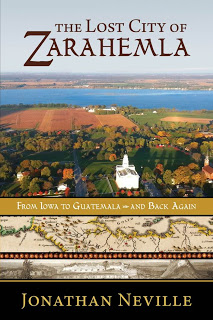
When I wrote The Lost City of Zarahemla, my publisher limited the page count on the ground the people don’t want long books. I had a lot of research left over, but I didn’t know if I’d ever use it for anything but my own interest.

Lost City attracted a lot of attention and discussion, pro and con.

Church history issues have become integrally connected with questions about Book of Mormon geography and historicity.

Some people strongly resisted the idea that Benjamin Winchester was involved with the anonymous articles about Central America that provided a justification for looking in Central America for evidence of the Book of Mormon. They had long assumed Joseph Smith wrote, edited, or at least approved of these articles, and therefore felt they had Joseph’s approval for their Mesoamerican theories of geography.

Think of it from the perspective of the Mesoamerican proponents who thought Joseph Smith approved of the two-Cumorahs theory that underlies the theory of a Mesoamerican setting.

Obviously, if Joseph didn’t write, edit, or even approve of these articles–worse, if he opposed them–then a fundamental premise for the Mesoamerican theory simply evaporates. Instead of having Joseph on their side, the Mesoamerican proponents find themselves opposing Joseph, or at least rejecting what he taught.

I wasn’t surprised to see strong opposition from the Mesoamerican advocates. Ironically, it’s their own dogma that cause the problem. They are the ones who insisted that Cumorah cannot be in New York because it is too far from Central America. Their Mesoamerican tail is wagging the dog of the New York Cumorah.
_______________

On the other hand, those who were concerned about the notion that Joseph Smith was confused, or changed his mind over time, or misled the Church about Cumorah, were relieved to see that these notions were based on faulty assumptions.

Those who believe what Joseph and Oliver taught about Cumorah were glad to see that the prevailing assumptions about Joseph Smith and the Times and Seasons were questionable at best (and, in my opinion, unjustified by the evidence).

Those who believe Joseph and Oliver knew what they were talking about, and that Joseph was consistent his entire life, find their beliefs vindicated, or at least corroborated, by this approach toward Church history.
_______________

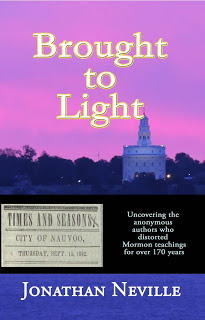
But Lost City was far from the last word on the subject. Brought to Light offers much more evidence to support the basic thesis of Lost City. Brought to Light goes beyond the anonymous articles about Central America to look at other material in the Times and Seasons.

In Brought to Light, I propose that Winchester wrote several other unattributed articles. In fact, I suggest that much of the material in lesson manuals, books and articles that has long been attributed to Joseph Smith in fact was not written by him.

This has implications for topics unrelated to the Book of Mormon geography, including the role of women in the Church.

Here is a table from the book that lists unattributed articles from the Times and Seasons that are found in the Joseph Smith manual:

Chapter(s) in manual
Editorial from Times and Seasons quoted in the lesson manual Teachings of the Presidents of the Church: Joseph Smith
2, 35
Baptism for the Dead<!–[if supportFields]> XE "Baptism for the Dead" <![endif]–><!–[if supportFields]><![endif]–>,” T&S, Apr. 15, 1842, p. 759; HC 4:595
7, 8, 16, 17
Baptism,” T&S, Sept. 1, 1842, pp. 903–5;
7, 9, 10, 13, 33
“Gift of the Holy Ghost,” T&S, June 15, 1842, p. 823; HC, 5:27
10, 23, 37
“To the Saints of God,” T&S, Oct. 15, 1842, p. 952
11, 16, 33
Try the Spirits<!–[if supportFields]> XE "Try the Spirits" <![endif]–><!–[if supportFields]><![endif]–>,” T&S, Apr. 1, 1842, pp. 744–45; HC, 4:574
11, 15, 23, 44
“The Temple,” T&S, May 2, 1842, p. 776; HC, 4:609
13, 15, 21, 23, 36
“The Government of God,” T&S, July 15, 1842, p. 857, 858; HC, 5:65
16
“Knowledge Is Power,” T&S, Aug. 15, 1842, pp. 889–90
27
“John C. Bennett,” T&S, Aug. 1, 1842, p. 868
38
“To Subscribers,” T&S, Feb. 15, 1842, p. 696
39
“Ladies’ Relief Society,” T&S, Apr. 1, 1842, p. 743; HC 4:567

I explain the book why I think others wrote these articles.
________________

Brought to Light contains a lot of detailed analysis that may be more than general audiences want, but those interested in Church history will find a lot of material that is not available elsewhere.

Source: Book of Mormon Wars

Someone is wrong on the Internet

Is it possible to resolve anything on the Internet?

Probably not.

Is it possible to reach a consensus on the Internet?

Almost surely not.

Then why write and read blogs?

For me, blogs are useful records of the things I’m working on, what I read, and my thoughts, a sort of easily accessible journal that, apparently, other people are interested in. So far, there have been about 150,000 hits on my blogs and hundreds of people read them every day, mostly from the U.S. but also from many other countries around the world.

Marketing experts know it takes many impressions to influence thinking and behavior. Most people are not going to change their minds even in the face of new information, but a few do. Impressions can accumulate until a tipping point can be reached. One blog post might make the difference, like the last snowflake that causes an avalanche.

There’s a clever post about the challenge of persuasion on another blog, here. Ardis Parshall writes:

“This classic xkcd webcomic (#386, Duty Calls) captures the common online absurdity of exerting great effort to prove to a stranger that he is wrong and you are right about something that doesn’t matter to anyone. I mean, who would do something like that?”

So is there a reason to blog other than journaling?

I think so.
_________________

As I’ve discussed many times, one of the biggest obstacles to reaching consensus in any field is lack of open communication and exchange of ideas. Whenever possible, people tend to prefer confirming their biases as opposed to changing their minds. This may be even more true of scholars, academics and educators than of the general public, for the obvious reason that the intellectuals have much more invested in their beliefs.

To confirm their biases, scholars, academics and educators tend to establish and perpetuate closed systems. A college campus, for example, is a closed system; faculty are hired based on shared academic assumptions and credentials, and students are admitted based on shared objectives and beliefs in the value of the established academic assumptions and credentials.

The LDS citation cartel is a prime example, of course, since the cartel’s concept of “peer review” is essentially “peer approval” by a small group of like-minded academics who resist intrusion (or even participation) by outsiders who challenge their shared assumptions.  

Because the academic citation cartel exists to confirm the shared biases of cartel members, the cartel is able to impose their assumptions and beliefs on others through the educational system. Their assumptions about Church history (i.e., that Joseph and Oliver were confused speculators who misled the Church about the New York Cumorah) and about Book of Mormon geography (i.e., that Mesoamerica is the only viable setting) have come to dominate LDS thought because the cartel members have successfully excluded alternative assumptions from BYU and CES. Consequently, everyone is taught the same assumptions, and they continue ad infinitum.

The Internet is one of the only ways to bypass the cartel and communicate new ideas. Cartel members understand this, which is why the citation cartel exists in the first place. They know that most members of the Church, when faced with a choice between the academics on one hand and Joseph and Oliver on the other, will choose Joseph and Oliver.

Given a choice, most members of the Church would reject the two-Cumorahs theory. For that reason, the citation cartel relegates the two-Cumorahs theory to isolated comments in academic writings and subliminal teaching such as the display on Temple Square and the images in the missionary editions of the Book of Mormon.

In Joseph Smith’s day, everyone knew there was one Cumorah and it was in New York.

In our day, LDS academics reject what Joseph and Oliver said, replacing it with the idea that there are two Cumorahs; Mormon’s Cumorah is in Mesoamerica, and Moroni’s Cumorah in New York.

_____________________

I doubt this post will be the snowflake that causes an avalanche, but hopefully it will add to the accumulation of ideas that weighs on the citation cartel. Eventually, I trust, a consensus about Church history and Book of Mormon geography will develop.

Source: Book of Mormon Concensus

The Mothers of Invention – 2D vs 3D

Although I’ve posted lately about the old arguments used by Mesoamerican advocates, I’m sure you’ll agree with me that their arguments are outdated, tired, and fundamentally irrational anyway. And yet, like an old video game that some people still play, these old arguments persist.

Another way to look at the question of Book of Mormon geography from a different perspective is to view it from  a longer-term, broader 3D perspective.*

The 2nd dimension approach is the worldview that is apparent to everyone, where the way things look on the surface are the way things really are. Even the image of the 3D Mario above is only 2D on this web page.

The 3rd dimension perspective involves a deeper analysis, looking beyond the surface at context, persuasion, and future implications. If Mario jumped off the screen and hopped around on the table, you’d understand him much better.

In the world of Book of Mormon geography, the 2D approach obsesses with things such as whether the River Sidon flows north or south, whether the text mentions snow, and whether farmers near Palmyra have found enough relevant artifacts lately. The 2D approach also focuses on “correspondences” with artwork and artifacts from Mesoamerica, seeking to find ways that the Book of Mormon text actually describes Central America, despite the absence of volcanoes, jungles, tapirs, jaguars, massive stone pyramids (or any stone buildings), and, of course, Mayans themselves. Mesoamerican proponents prefer the 2D approach because it is essentially semantic and can never be resolved, justifying ongoing research forever.

The 3D approach doesn’t ignore the surface issues but looks deeper at the implications of repudiating what Joseph and Oliver said about Cumorah, the plains of the Nephites, etc. The 3D approach considers the impact on faith of trying to persuade people that Joseph and Oliver were honest, accurate and correct about everything except this one point: their claim that it was a fact that Cumorah–the one and only real Cumorah of the final battles–was in New York. Essentially, the 3D approach considers what Joseph Fielding Smith said about the two-Cumorahs theory; i.e., that it would cause members of the Church to become confused and disturbed in their faith.

2D thinkers reject what President Smith said and refuse to even consider the evidence of the fulfillment of President Smith’s warnings. Because they have testimonies, and because they believe in the Mesoamerican theory, they don’t understand how anyone could lose his/her faith over the Mesoamerican theory. Most of them don’t realize they are in a situation where they can’t unsee Mesoamerica. Consequently, they can’t understand how anyone else can unsee Mesoamerica.

This is one reason why it is pointless to argue about Book of Mormon geography. No matter what you say, people with Mesomania can’t unsee Mesoamerica in the Book of Mormon. They’re too indoctrinated.

That’s why I recommend learning about relevant Church history and discussing that instead of Book of Mormon geography. Even 2D thinkers will, eventually, come to understand the 3D implications of Mesomania once they learn about and ponder Letter VII, the two sets of plates, and the actual authors of the anonymous 1842 Times and Seasons articles that led to Mesomania in the first place.

________________
* Scott Adams often writes about different perspectives, albeit not on LDS topics. I like the way he frames topics, as I’ve mentioned before. If you are interested in politics and haven’t read his blog or his books, you should, here.

Source: Book of Mormon Wars

Book summaries – The Lost City of Zarahemla

People have asked for summaries of my books, so I’ll start with The Lost City of Zarahemla.

I wrote this one more than two years ago. It was my first book about Church history, and it initially provoked considerable controversy. Now, I think my conclusions are generally accepted.

The book started when I wanted to answer this question, “Who wrote the anonymous articles in the Times and Seasons that linked the Book of Mormon to Central America?”

The Mesoamerican theory that many LDS scholars and educators continue to promote has always relied on these articles for support, based on the inference that Joseph Smith wrote them because he was the editor of the paper.

After researching the issue, I found lots of evidence that Joseph had nothing to do with these editorials and that Benjamin Winchester, probably with editorial input from W.W. Phelps and/or William Smith, wrote the anonymous editorials.

The book generated some fascinating opposition from the Mesoamerican advocates. They didn’t know I had more research that I couldn’t fit into this book (which I’ll discuss when I summarize Brought to Light and The Editors).

You can see why they opposed my conclusions. If it wasn’t Joseph Smith who wrote or edited (or at least approved of) these articles, then who did? And why? I offered answers in Lost City, but the answers undermined one of the fundamental premises for the Mesoamerican theory.

So far as I know, this was the first book to propose a specific alternative author for the anonymous articles. Previously, everyone simply assumed that Joseph Smith (or John Taylor) had written them.

I think now most historians who have looked into this issue agree with my general conclusions, although people may have various views about the relative contributions of Winchester, Phelps and William Smith. The main point–that Joseph Smith did not write or edit these anonymous editorials–is pretty well accepted now by those who have considered the historical record in detail.

Some Mesoamerican proponents have lately said they never relied on these articles in the first place, so it doesn’t matter that Joseph didn’t write or edit them. That’s revisionist history, of course, as anyone can see by simply reading the literature. For example, John Sorenson cites the anonymous articles on pages 2-3 of his seminal book, An Ancient American Setting for the Book of Mormon.

There are still a few Mesoamerican proponents who stick with the idea that Joseph Smith wrote (or edited) the anonymous articles. I’ve never seen a detailed analysis of the historical evidence that supports that theory; however, these proponents rely on a “stylometry” analysis published a few years ago that I discussed briefly in the book and will review here.
___________________

When I first inquired about the question of authorship, I was often referred to an article published by the Maxwell Institute here, titled “Joseph Smith, the Times and Seasons, and Central American Ruins.”

Here is the Abstract, with my notes in red:

[During the time the Latter-day Saints lived in Nauvoo, John Stephens and Frederick Catherwood published Incidents of Travel in Central America, an illustrated report of the first discovery of ancient ruins in Central America by explorers. These discoveries caused great excitement among the Saints, and subsequently five editorials appeared in the Times and Seasons commenting on what these meant for the church. Although the author of the editorials was not indicated, historians have wondered if Joseph Smith penned them since he was the newspaper’s editor at the time. [Mesoamerican advocates have always assumed he did, which is why they continue to cite these articles to support their theory.] We examined the historical evidence surrounding the editorials and conducted a detailed stylometric analysis of the texts, comparing the writing style in the editorials with the writing styles of Joseph Smith, John Taylor, and Wilford Woodruff—the only men involved with the newspaper during the time the editorials were published. [Actually, Woodruff handled the business matters of the printing shop, which printed the newspaper among other things. Taylor wrote some things for Joseph–Joseph needed lots of things written in his various civic and church capacities–but Taylor never said he wrote for the paper and Joseph said Taylor began his editorial career in November 1842. Several people worked at the newspaper, including a copy editor. William Smith edited and published the Wasp from the same office during this time.] Both the historical and stylometric evidence point toward Joseph Smith as the most likely author of the editorials. [There is zero historical evidence that Joseph wrote the editorials. The authors refuse to share their assumptions, database, and software for independent analysis of any legitimate “stylometric evidence” that exists.]  Even if he did not write them alone, he took full responsibility for the contents of the newspaper during his editorial tenure when he stated, “I alone stand for it.” [This statement was written in the Times and Seasons in March, months before the anonymous articles were written. There is no documentary evidence that Joseph Smith even wrote the statement in the first place. Other people wrote lots of things in his name, and even signed his signature at times.]
________________
The abstract alone includes logical and factual fallacies, but the article itself is even worse. IMO, it is basically an exercise in confirmation bias, using “black box” stylometry results. I won’t get into the details, but I wanted to collaborate with the author and revisit the “stylometry” analysis. Instead, the author wrote three long attack articles and refused to make his database, assumptions, and software available for replication. I would have been happy to accept the results of the stylometry had these factors been available for analysis and replication, and I think the author’s refusal to release the critical information says all anyone needs to know about the validity of the study.

Source: Book of Mormon Wars

The Mothers of Invention – your own Cumorah

How to invent your very own Cumorah

[adapted from a post on November 2016]
While necessity is the mother of invention, a desire to see the world may also work as a motivator to invent things. 
The text of the Book of Mormon is flexible enough to let you invent your own Hill Cumorah pretty much anywhere in the world.

If you like Eritrea, Sri Lanka, Malaysia, Chile, Peru, Panama, Guatemala, Yucatan, southern Mexico, Baja… Take your pick or add your own favorite.

No problem. No problem at all.

Of all the places I’ve visited, I’m thinking the south of France would be a fun place to put Cumorah. I could visit there often to do research. Other great places I’ve visited and would like to spend more time include Rio de Janeiro and the south island of New Zealand.

If you want to invent a Hill Cumorah in your favorite part of the world, you just need to:

1) ignore what the modern prophets and apostles have said* and

2) apply a flexible interpretation of the Book of Mormon text.

_________________
An awesome explanation for how to invent your own Cumorah is provided by our friends at FairMormon, here: 
This may be the single most preposterous article at FairMormon, and that’s saying a lot. If I had the time, I’d go through, line by line, and itemize the logical and factual fallacies of this piece. By now, readers of this blog can do that on their own anyway.
One classic rhetorical trick FairMormon uses frequently is on full display here. This is where you omit references that contradict your thesis, while purporting to discuss all the relevant information. Unsuspecting readers have no idea that they are reading a highly selective, misleading “analysis” of the issue.
For now, I’ll briefly comment just on the headings. Throughout, when I refer to Cumorah, I mean the Cumorah of Mormon 6:6, the scene of the final battles of the Nephites and Jaredites.

The Church has no official position on any New World location described in the Book of Mormon

Several Church leaders have declared that Cumorah is in New York, including members of the First Presidency speaking in General Conference, as I’ve documented on this blog. By outright repudiating these statements, the Mesoamerican proponents want their followers to believe that nothing stated in General Conference is an “official position” of the Church. According to this approach, “only new revelation following proper procedure, and being accepted by the Church as a whole,” constitutes an “official position.” Which leads one to wonder why we even have General Conference or any teaching other than the canonized scriptures. The Mesoamerican advocates don’t mention that not a single General Authority has ever stated, let alone implied, that Cumorah, is anywhere else but in New York. 

There is no clear indication that Joseph Smith ever applied the name “Cumorah” to the hill in New York

FairMormon skips over evidence such as Lucy Mack Smith’s history, in which Joseph referred to the hill as Cumorah even before he obtained the plates. The Mesoamerican advocates want us to believe that in D&C 128, which includes the phrase “Glad tidings from Cumorah,” Joseph was referring to a hill in Mesoamerica in the midst of his list of a series of events that took place in New York and Pennsylvania.

A late account from David Whitmer is the earliest possible association of the name with the New York hill

David Whitmer told several people, including Joseph F. Smith and Orson Pratt, about this event. I’ve explained before that Zina Young asked Edward Stevenson to ask David about it, apparently because she had heard about it in 1832 when David Whitmer and Hyrum Smith baptized her family. This is one of several examples of the effort by Mesoamerican advocates to discredit the Three Witnesses.

Joseph Smith never used the name “Cumorah” in his own writings when referring to the gold plates’ resting place

FairMormon forgets to tell readers that Joseph Smith’s personal writings contain very little information at all. For example, Joseph never wrote the words Moroni or Nephi or Bible. They also forget to tell readers about Letter VII here, which Joseph fully endorsed multiple times.

David Whitmer is not told that the hill from which Joseph received the record was called Cumorah, but this usage seems to have nevertheless become common within the Church

This is another attack on the credibility of David Whitmer. They forget to tell readers that Joseph said the messenger had the plates, and that Joseph gave the plates to the messenger before he left Harmony. They forget to explain why the messenger would be taking the plates to Cumorah when Joseph and Oliver were heading for Fayette to finish the translation. I’ve actually had Mesoamerican advocates tell me that this messenger was on his way to Mesoamerica when David, Oliver and Joseph met him on this occasion. 

The Book of Mormon text indicates that the Hill Cumorah in which the Nephite records were hidden is not the same location as the one where Moroni hid his plates

This is one of the funniest claims on the FairMormon website. Basically they’re claiming that Joseph and Oliver didn’t study the text closely enough to realize the Hill Cumorah cannot be in in New York. This is a classic example of how intellectuals can use sophistry to deny the obvious. Joseph and Oliver had personal experience with the Nephite repository in the New York hill. Orson Pratt explained that the repository was in a department of the hill separate from the stone box in which Moroni concealed the plates. Yet these intellectuals, as FairMormon claims, “conclude that they (i.e., Cumorah and the New York hill) could not be the same.”

Since the 1950s, opinion among Book of Mormon scholars has increasingly trended toward the realization that the Nephite Cumorah and the Hill in New York cannot be the same

Clever rhetoric here. These self-styled “scholars” have arrived at the “realization” that they were right all along. It’s no longer a theory in their minds; they have “realized” the “truth.” 

There are 13 geographical conditions required for the Book of Mormon Hill Cumorah

These “conditions” are the product of circular reasoning. They were concocted by the same guy who wrote the entry in Encyclopedia of Mormonism that was plagiarized for a phony fax from the office of the First Presidency which FairMormon and other members of the citation cartel cite as evidence of Church policy, while they also deny that statements made by actual members of the First Presidency in General Conference are not Church policy. 

Joseph Fielding Smith, before he became President of the Church, argued for a New York location as the scene of the final battle

Hmm. FairMormon doesn’t show readers what JFS actually wrote. Instead, they sanitize it for readers by summarizing it and then arguing against it. Here’s what he wrote: “Because of this theory some members of the Church have become confused and greatly disturbed in their faith in the Book of Mormon.” The first time he issued his warning about the two-Cumorahs theory, JFS was Church Historian and had been an apostle for 20 years. The second time he issued it, he was President of the Quorum of the Twelve. But to Mesoamerican scholars, he didn’t know what he was talking about and he was wrong. I think most members of the Church can see that President Smith’s warning has been vindicated. We see the evidence all around us in terms of lost testimonies and confused investigators. 

Joseph Fielding Smith acknowledged that this was his opinion, and that others were entitled to their own opinions regarding this subject

Any LDS who accepts the Articles of Faith must agree that others are entitled to their own opinions. No one has to believe anything. What FairMormon forgets to tell you is that their “analysis” of JFS’s views is based on a 40-year-old recollection by a student in Sidney Sperry’s class, recalling what Sperry said JFS said. FairMormon wants you to believe this compound hearsay instead of JFS’s written warnings.

No actual archaeological digs have been performed at the site to actually attempt to find artifacts

In this paragraph, FairMormon tells us that even if they find artifacts on Cumorah (and boxes full of artifacts have been found there), it doesn’t prove the site was Cumorah because war artifacts “can be found all over the country in a great many sites.” Another of my favorite FairMormon logical fallacies. 

The Book of Mormon does not state that the plates of Mormon were buried in the Hill Cumorah: All of the other records except the gold plates were buried there

By “plates of Mormon” they mean the plates Mormon gave Moroni. You can read the goofy “logic” in this paragraph, but of course the text never says Moroni didn’t bury the plates in the same hill where his father hid the Nephite plates in the repository. FairMormon forgets to tell readers that Moroni told Joseph Smith the record was “written and deposited” not far from his home near Palmyra.

Moroni wandered for 36 years before burying the plates of Mormon

Moroni returned to the Hill Cumorah to get the plates of Ether, and probably a second time to get the sermons and letters of his father. FairMormon wants readers to think “Moroni could easily have eventually come to modern New York state” from southern Mexico.

Ancient militaristic texts, including those of the Bible, frequently exaggerated the numbers involved in battle for their own propagandistic purposes

FairMormon wants readers to think Mormon wrote propaganda.

Brigham Young related a story about how the plates were returned to Moroni in a cave in the Hill Cumorah

FairMormon dismisses the statement by Brigham Young, which he related two months before his death so the events would not be forgotten. They also dismiss the statements of Heber C. Kimball, Wilford Woodruff, and others, who describe the respository as a room with a stone shelf, etc. 

The geologic unlikelihood of a cave existing within the drumlin in New York called “Hill Cumorah” suggests that the experience related by the various witnesses was most likely a vision

FairMormon wants people to believe that Joseph, Oliver, Don Carlos and others somehow shared a vision of a hill in Mesoamerica that they visited multiple times and spoke about on several occasions. FairMormon also wants readers to believe that Moroni could transport the plates to and from Mexico at will. You probably don’t believe that an LDS scholar would make such claims, so please read the FairMormon explanation and see for yourself.
_________________
I put together a video that shows how to manufacture a Hill Cumorah in Mexico. It’s based on one of my favorite blogs to follow. You can use the same techniques described on that blog to put Cumorah wherever you want.

https://youtu.be/zUZbgyu6-AI

I also put this one one of my DVDs for anyone interested.
__________________
*Note: You’ll notice in the video how important it is to start with step #1. Don’t skip step #1. This is the key to manufacturing your own Cumorah. If you make a mistake and pay attention to what the modern prophets and apostles have said, you pretty much have to stick with the Cumorah in western New York, a couple of miles south of Palmyra. That’s not nearly as fun as inventing your own Cumorah in southern Mexico or wherever else you want.

Source: Book of Mormon Wars