Zombie geography at BYU

Some ideas just won’t die. They’re zombies. They don’t know they’re dead, and they are mere shells of living beings, but they keep on coming.

The Mesoamerican theory of Book of Mormon geography is a zombie. It continues to prowl around BYU.

The textbook definition of a zombie is: a will-less and speechless human held to have died and been supernaturally reanimated.

In the world of software, a zombie is “A process or task which has terminated but was not removed from the list of processes, typically because it has child processes that have not yet terminated.”

The Mesoamerican theory is like zombie software. It is dead, but it has child processes that still live, like little zombies.
______________

Here are some of the reasons why the Mesoamerican theory died.

1. Its origin–the anonymous articles in the Times and Seasons, wrongly attributed to Joseph Smith–has been exposed as a historical mistake.

2. Thanks to Letter VII, few people even try to defend the two-Cumorahs theory any more. (The Mesoamerican theory claims the “real” Cumorah is in Mexico, so it was a mistake to give the hill in New York the name Cumorah.) Once members of the Church realize that accepting the Mesoamerican theory requires you to also believe that Joseph Smith and Oliver Cowdery were ignorant speculators who misled the Church, most members reject the Mesoamerican theory quickly.

3. The illusory “correspondences” between Mesoamerica and the text of the Book of Mormon are really just ordinary characteristics of most human civilizations that are not evidence of the purported link between Book of Mormon peoples and the Mayans.
______________

Although the Mesoamerican theory is dead, Mesomania lives in its children. Once we finish them off, we will be rid of the zombie geography. But to finish them off, we have to first identify them, starting with BYU connections.

1. BYU Studies, “the premier Mormon academic journal since 1959,” continues to promote the zombie Mesoamerican setting, right on its main page.
https://byustudies.byu.edu/
Go to the bottom of the page under “Popular Pages” and click on the first one, titled “Charting the Book of Mormon.” Scroll to section 13 and read the entries, including 13-161, here.

Presenting BYU’s zombie geography map of Mesoamerica!

2. Officially, BYU is supposed to be neutral about Book of Mormon geography. And that would be fine, in a vacuum. But for years, BYU promoted the Mesoamerican theory, including taking faculty to Mesoamerica on educational “Book of Mormon” trips. The zombie theory was widely taught for decades. To claim “neutrality” with this history would be like a strip mining company suddenly claiming “neutrality” after cutting all the trees and shearing the mountaintops. It’s not neutral when the damage is not remediated. The zombie children of the Mesoamerican theory are present throughout the University (on all the campuses). Besides, faculty are not really neutralHere is a discussion of an article by a BYU Professor who claimed BYU destroyed Ancient (Mesoamerican) Book of Mormon Studies:
http://bookofmormonwars.blogspot.com/2015/09/how-byu-destroyed-ancient-mesoamerican.html
Other current BYU Professors have written extensively about the zombie Mesoamerican setting for the Book of Mormon.

3. BYU students are taught to understand the geography of the Book of Mormon as presented by the abstract map I blogged about here: 
http://bookofmormonwars.blogspot.com/2017/04/update-on-abstract-maps.html

It is obviously designed to look like Central America, because it interprets the text according to the Mesoamerican theory. 

That map is not Central America!
Faculty have been told not to link the text to any real-world site. Instead, they came up with this “virtual reality” version. But it teaches the same thing as the two-Cumorahs theory; i.e., Cumorah is not in New York and Joseph and Oliver were ignorant speculators who misled the Church.  
4. Let’s say BYU finishes off the on-campus zombie geography somehow. Will that solve the problem? 

No.

The children of the zombie Mesoamerican theory live in the minds of most of the students who have been educated at BYU for decades. That’s why we see the Arnold Friberg Mesoamerican paintings everywhere. It’s why Mesomania is ubiquitous.

Whenever you see these books and paintings, you are looking at zombie Mesomania.


It’s up to each of us to help deal with the zombie geography of Mesoamerica.

Source: Book of Mormon Wars
If ye are not one

One oft-quoted scripture on the topic of consensus is this:

“I say unto you, be one; and if ye are not one ye are not mine.” D&C 38:27
I’ve heard this quoted many times to support the idea that people should agree on doctrinal matters, including interpretations of geography of the Book of Mormon and Church history. And that’s fine, provided the agreement is on something that is true.
But look at the first part of the verse:
“Behold, this I have given unto you as a parable, and it is even as I am. I say unto you, be one; and if ye are not one ye are not mine.”
What is the Lord referring to here?
Verse 26 is the parable, but it refers,in turn, to the preceding verses.
Verse 26: “For what man among you having twelve sons, and is no respecter of them, and they serve him obediently, and he saith unto the one: Be thou clothed in robes and sit thou here; and to the other: Be thou clothed in rags and sit thou there—and looketh upon his sons and saith I am just?”
In the preceding verses, the Lord explains that he created the Earth, that he has taken “the Zion of Enoch into mine own bosom,” and that “all flesh is corrupted before me, and the powers of darkness prevail upon the earth.” 
Then the Lord says, “And for your salvation I give unto you a commandment, for I have heard your prayers, and the poor have complained before me, and the rich have I made, and all flesh is mine, and I am no respecter of persons. And I have made the earth rich, and behold it is my footstool, wherefore, again I will stand upon it…. And let every man esteem his brother as himself, and practice virtue and holiness before me. And again I say unto you, let every man esteem his brother as himself.”
This principle is so important that the Lord repeats it twice, right before giving the parable of the unjust father.
In my view, Section 38 teaches about the basic Zion principle of equality; i.e., it is not just that some people are rich while others are poor. The Lord clarifies that he has made the rich; they may think they have “earned” it and therefore “deserve” it, but it is God who has given them the gifts and opportunities to become rich. 
A few months later, on June 15, 1831, the Lord explained further. 
“Wo unto you rich men, that will not give your substance to the poor, for your riches will canker your souls; and this shall be your lamentation in the day of visitation, and of judgment, and of indignation: The harvest is past, the summer is ended, and my soul is not saved!”
The parable of the unjust father who tells one son to be clothed in robes while the other must be clothed in rags applies to the Latter-day Saints who seek to establish Zion. 
The Lord has told us that he has made the rich, and he has told the rich that they must give their substance to the poor. Enabling some of his children to create wealth is the Lord’s way of providing for the poor. As D&C 104 puts it, “this is the way that I, the Lord, have decreed to provide for my saints, that the poor shall be exalted, in that the rich are made low.”
This is what D&C 38 means. 
And to the extent that we fall short of becoming one in terms of wealth, we are not His.

Source: Book of Mormon Concensus

Sharing posts

I’ve been asked how to share my posts on social media. I had forgotten about my twitter account, so it was a good reminder.

At the end of every post on this blog there is a sharing icon. It looks like this:

You just have to click on the icon for the social media you want to use. For example, if you want to share a post on twitter, click the twitter icon.

Here’s an example from my BeyondTheRivers twitter account:

https://twitter.com/RiversBeyond

You can retweet from BeyondTheRivers as well.

(For those new to the blog, “BeyondTheRivers” is an allusion to Isaiah 18:1, which explains how Nephi knew he’d have to sail around Africa to get to the promised land.)

Happy Tweeting!

Of course, you can also use the Facebook icon to share on Facebook, Printerest icon to share on Printerest, etc.

Source: Book of Mormon Wars

Book of Mormon Translation

I get a lot of questions about how Joseph Smith translated the Book of Mormon. I have a section on that topic in the Whatever Happened book.

Today I want to mention three points to consider.

1. Only the Title Page is a literal translation. 

Joseph Smith’s History, circa June – October 1839 [Draft 1], here, reads,

“I would mention here also in order to correct a misunderstanding, which has gone abroad concerning the title page of the Book of Mormon, that it is not a composition of mine or of any other man’s who has lived or does live in this generation, but that it is a literal translation taken from the last leaf of the plates, on the left hand side of the collection of plates, the language running same as the <all> Hebrew <wr[i]ting> language <in general>. And that no error can henceforth possibly exist I give here the Title so far as it is a translation.”

With some wording changes, the same passage appears in History, circa June 1839-circa 1841 [Draft 2], here.

“I wish also to mention here, that the Title Page of the Book of Mormon is a literal translation, taken from the very last leaf, on the left hand side of the collection or book of plates, which contained the record which has been translated; and not by any means the language of the whole running same as all Hebrew writing in general; and that, said Title Page is not by any means a modern composition either of mine or of any other man’s who has lived or does live in this generation. Therefore, in order to correct an error which generally exists concerning it, I give below that part of the Title Page of the English Version of the Book of Mormon, which is a genuine and literal translation of the Title Page of the Original Book of Mormon, as recorded on the plates.”

In History, circa 1841, fair copy, in the handwriting of Howard Coray, Joseph Smith’s history reads:

“I wish to mention here that the title page of the book of Mormon is a literal translation taken from the last leaf on the left hand side of the collection of plates which contained the record that has been translated. The language of the whole running the same as all Hebrew writings writings; and that said title page is not a modern composition. Therefore in order to correct an error which generally exists concerning it I give below that part of the title page which is a genuine and literal translation of the title page of the book of Mormon recorded on the plates.”

Those who have read Whatever Happened to the Golden Plates? know the significance of the phrase “Original Book of Mormon.” It was not in the 1839 draft, but it was in Draft 2. Howard Coray omitted it, but it appears in the Times and Seasons, Oct. 15, 1842, here.

“I wish also to mention here, that the title page of the Book of Mormon is a literal translation, taken from the very last leaf, on the left hand side of the collection or book of plates, which contained the record which has been translated; the language of the whole running the same as all Hebrew writing in general; and that, said title page is not by any means a modern composition either of mine or of any other man’s who has lived or does live in this generation. Therefore, in order to correct an error which generally exists concerning it, I give below that part of the title page of the English version of the Book of Mormon, which is a genuine and literal translation of the title page of the Original Book of Mormon, as recorded on the plates.”
_______________

This is significant for two reasons. First, it refutes the idea that Joseph merely read the words off the stone in the hat. He was making a “literal translation” from the plates themselves.

Second, it implies that the rest of the translation may not have been literal. I’ll discuss this more in upcoming posts.
_______________

2. Gospel Topics essay on Book of Mormon translation.

The essay, found here, is a good overview. Unfortunately, it starts off with the inaccurate quotation of Joseph Smith, which was actually Wilford Woodruff’s summary of a day’s teaching and not a direct quotation. I’m working on an annotated version of the essay.
_______________

3.. Conference in Logan.

In March 2017 there was a conference at Utah State (Logan, Utah) titled “New Perspectives on Joseph Smith and Translation.” I had a conflict so I couldn’t attend, but videos from the session are now available. Info is here: http://religionnews.com/2017/05/03/mormon-scholars-debate-joseph-smiths-role-in-translation/

I’ll have more to say on this soon, but I just wanted to give the information now.

Source: Book of Mormon Wars

the first question to ask

If you’re interested in Book of Mormon geography, the first question to ask is this:

Where is Cumorah?

The answer, of course, is in western New York, where Joseph Smith and Oliver Cowdery said it was. If someone tells you it’s somewhere else, or that there are “two Cumorahs,” you know they are repudiating Joseph Smith and Oliver Cowdery.

For me, there’s no point in considering geography theories that put Cumorah anywhere else but in New York. This also applies to the “abstract maps,” including those being taught at BYU.

You will find dozens, even hundreds, of different maps if you look online. You can assess them easily by seeing how they treat Cumorah.

One of the best known is the one at BYU Studies, here. https://byustudies.byu.edu/

Scroll to the bottom of the page. The first item under “Popular Pages” is “Charting the Book of Mormon.” Click on that.

You’ll find some useful material here, but there is also some misleading material. Scroll to

Section 13: Geography in the Book of Mormon

Here’s the direct link: https://byustudies.byu.edu/charts/13-149-ten-essential-features-book-mormon-geography

This entire section is a disaster, IMO, Look at this one, for example.

13-149 Ten Essential Features of Book of Mormon Geography

These “Essential Features” have little if anything to do with the text. They are pure Mesomania, an effort to persuade people that the text actually described Mesoamerica.

The first one says “A narrow neck (isthmus) separated the land northward from the land southward and was flanked by an east sea and a west sea.”

Of course, the text never uses the term isthmus. This is classic for Mesomania. The text doesn’t describe anything about Mesoamerica–no jungles, no volcanoes, no huge stone pyramids, and even no Mayans–so the Mesoamerican advocates have to change the wording in the text to make it work.

You can go through all of the items in Section 13, and you’ll see how they use this substitution technique throughout to justify their Mesoamerican theory.
________________

This is just one example of how far afield people can get when they ignore what Joseph and Oliver said about Cumorah in New York.

You’ll find plenty more. But you can avoid all of that by going to http://moronisamerica.com/

As always, I’m interested in anyone who can come up with a better explanation of Book of Mormon geography with Cumorah in New York.

Source: Book of Mormon Wars

Brother Scott’s Book of Mormon Witness Presentation

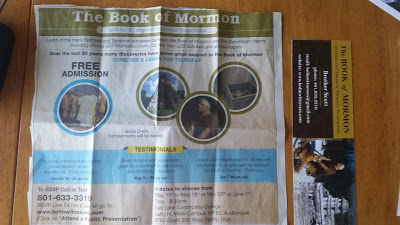
Yesterday a friend gave me a cutout from the newspaper:

You might want to attend, or not. You might want to tell your friends, or not. I’m just making you aware of what’s going on. (I blogged about this already here, complete with illustrations.)
“Brother Scott” is holding these events every Thursday from May 11-Jun 1 from 7-8:30 pm in Sandy. You can get the info from his web page here:
I applaud the effort to make the Book of Mormon better known. I found Brother Scott to be engaging and enthusiastic. Apparently he went on one of the infamous “Book of Mormon tours” to Central America and is on fire now.
Unfortunately–very unfortunately–Brother Scott is promoting the Mesoamerican setting with lots of classic Mesomania. He’s telling people Izapa Stela 5 is Lehi’s dream, that Joseph wrote the articles in the Times and Seasons, etc. 
Of course, he forgets to tell the audience about Letter VII, Zion’s camp, the numerous General Conference addresses, President Joseph Fielding Smith’s warning about the two-Cumorahs theory, and anything else that contradicts his theories.
Brother Scott didn’t want to hear what I have to say.
He’s actively soliciting invitations to come speak at firesides, as you can see here:
I’m sure he’ll have no problem getting invitations, and I’m also sure he’ll have no problem presenting his material in Church buildings because he’s promoting Mesoamerica. As long as you promote the two-Cumorahs theory, you’re good to go. You can even use the artwork on the walls of the Church buildings as illustrations. As well as the illustrations in the missionary edition of the Book of Mormon itself.
But if his audience thinks carefully about his presentation, or spends 5 minutes on the Internet, they’ll soon realize that he, like all good Mesoamerican advocates, is saying Joseph and Oliver were ignorant speculators who misled the Church about Cumorah being in New York, the plains of the Nephites being in Ohio, etc.
I think Brother Scott could do a lot of good if he would simply consider an alternative to Mesoamerica and focus on critical aspects of Church history, such as Letter VII.

Source: Book of Mormon Wars

"From a hill in Manchester Township"

Even when the Joseph Smith Papers editors quote Letter VII, they won’t identify the hill in New York as Cumorah. The reason, apparently, is that they favor the Mesoamerican setting which requires that Cumorah be located in Mexico.

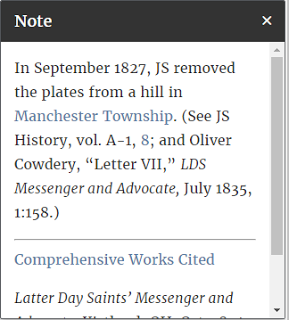
Here’s the latest example: footnote 5 to the Preface to Book of Mormon, circa August 1829. It reads:

“In September 1827, JS removed the plates from a hill in Manchester Township. (See JS History, vol. A-1, 8; and Oliver Cowdery, “Letter VII,” LDS Messenger and Advocate, July 1835, 1:158.)”

Here’s the link: 

http://www.josephsmithpapers.org/paper-summary/preface-to-book-of-mormon-circa-august-1829/2#8575720065777173346
______________

In Letter VII, Oliver Cowdery not only identified the Hill Cumorah as the hill where Joseph found the plates, but he also stated it was a fact that the final battles of the Nephites and Jaredites took place in the mile-wide valley to the west.

This makes it all the more striking that the note refers to “a hill” as though the generic hill had no name and was not a critical location in Church history and Book of Mormon geography.
______________

I came across this bizarre omission in footnote 5 because I was noticing something fascinating in this Preface. Joseph was explaining the lost 116 pages and the commandment he received from the Lord to “translate from the plates of Nephi” to replace what was lost. The Preface paraphrases parts of D&C 10 and quotes other parts but without quotation marks.

For example, D&C 10:41 says, “you shall translate the engravings which are on the plates of Nephi,” but the Preface says, “thou shalt translate from the plates of Nephi.”

In my view, both passages refute the popular narrative that Joseph kept the plates under a cloth the entire time, as depicted in the latest movies you can see on request on Temple Square. The Lord told Joseph to “translate the engravings” and “translate from the plates.” You can’t do either if the plates are under a cloth or somewhere else.

More to the point of this post, in the Preface Joseph mentions two sets of plates. First, he mentions the “plates of Lehi” from which Mormon abridged the “Book of Lehi” that was on the 116 pages. Second, he mentions the “plates of Nephi” which he, Joseph, translated. He doesn’t mention the plates containing the abridgment (the “Harmony” plates he originally obtained from Moroni’s stone box).

At the end of the Preface, Joseph writes, “I would also inform you that the plates of which hath been spoken, were found in the township of Manchester, Ontario county, New York.” This is where footnote 5 kicks in, with the “a hill” comment.

What I find significant here is that Joseph is explaining he used different plates–the plates of Nephi–to replace the Book of Lehi. He found it necessary to explain to readers of the Preface that these plates of Nephi “were found” in Manchester township.

Think about this a moment.

It was widely known at the time and in the area that Joseph got the original plates from the stone box in the Hill Cumorah. People tried to steal them from him. He had to move to Harmony to translate the original plates to get away from the would-be thieves. There was no need for Joseph to explain where the original plates came from–and he did not.

The Preface is an explanation for why Joseph translated a second set of plates–the plates of Nephi. He explains these plates were found in the township of Manchester, Ontario county, New York.

Notice he doesn’t say he found them.

Instead, he writes they “were found,” using the passive voice.

That’s important because it’s another indication that Joseph did not find the plates of Nephi. Instead, the divine messenger delivered these plates to Joseph after Joseph arrived in Fayette.

IOW, Joseph found the original plates–the ones containing the abridgments written by Mormon and Moroni–in the stone box on the Hill Cumorah, as directed by Moroni. These plates contained “the original Book of Mormon” as Joseph called it. He took these plates to Harmony and translated all of them, from the Book of Lehi through the Book of Moroni, including the “last leaf” which was the Title Page. Then he gave the plates to a divine messenger and left for Fayette with David Whitmer and Oliver Cowdery.

After Joseph arrived in Fayette, the messenger delivered the plates of Nephi. Joseph translated these as 1 Nephi through Words of Mormon. In this Preface, Joseph is telling readers that these separate plates were also found–albeit, not by him–in Manchester township. (The Hill Cumorah is in the Manchester township.)
_____________

It’s pretty cool to see how the Preface itself explains the two sets of plates. Now, if only we could get the Joseph Smith Papers to acknowledge that the Hill Cumorah–the only Hill Cumorah–is in New York, we could make some good progress.

Source: Letter VII

The CES letter

I’ve had several requests to address the CES letter. If you’re not familiar with that, it’s a letter written in 2013 by Jeremy Runnells, who explains the background on his web page here:

“In February 2012, Jeremy experienced a crisis of faith, which subsequently led to a faith transition in the summer of 2012. In the spring of 2013, Jeremy was approached and asked by a CES Director to share his concerns and questions about the LDS Church’s origins, history, and current practices. In response, Jeremy wrote what later became publicly known as Letter to a CES Director.”

Although the letter was originally written in 2013, the controversies it spawned continue. I’ve seen discussions about it as recent as within the last month. Often when I speak, people ask what I think because they know someone who has been influenced by the letter.

In my view, it’s not the CES letter that is the problem. Runnells raises good questions that I think many people have, whether they are active LDS, inactive LDS, former LDS, or never LDS (whether they are investigators or antagonistic to the Church).

The problem is the responses given by LDS apologists.

The responses are unsatisfactory for many–including me–because they focus on the Mesoamerican setting and some of the traditional interpretations of Church history that are based on historical mistakes.

The CES letter is a fairly comprehensive list of common objections to LDS claims about Church history, the Book of Mormon, the Book of Abraham, and various doctrines. Runnells is using it as a fundraiser at this point, but that’s irrelevant to the merits of the questions he raises.

There have been many responses to the CES letter. Here is a compilation of some:
http://debunking-cesletter.com/?page_id=3964

Two of the most prominent responses were provided by FairMormon and Dan Peterson. Runnells has addressed them here and here, respectively. I think Runnells has done a good job sorting through the sophistry of the citation cartel, but the gist of his objections is this: he raises subjective expectations and then is disappointed when reality doesn’t meet his expectations. I think his conclusions are understandable given his assumptions and expectations, and those assumptions and expectations are themselves understandable given what he’s been taught, but because what he has been taught is driven by Mesomania and related interpretations of Church history, the questions he raises have answers that have not been provided yet, so far as I can determine.

Readers of this blog know that I think FairMormon and the rest of the citation cartel are ineffective because of their obsession with the Mesoamerican setting (which I call Mesomania). Mesomania leads them to embrace and promote the two-Cumorahs theory, to distort the text of the Book of Mormon, to repudiate Joseph Smith and Oliver Cowdery, and to provide interpretations of Church history designed to justify their Mesomania that have the perverse effect of creating doubt out of what should be faith-sustaining statements and events. In each case, Mesomania undermines faith, just as Joseph Fielding Smith warned.
_____________

I don’t know how much interest there really is in yet another analysis of the CES letter. Those who are familiar with the issues, however, will understand the significance of a few of the main points I’ve been addressing on this blog and in my books. I’ll list them here. If people ask for more detail, I’ll address these points in future posts as time permits.

1. There is only one Cumorah and it really is in New York.

2. There were two departments in the hill Cumorah. One contained the stone and cement box that Moroni prepared for the plates and the breastplate. The other contained Mormon’s repository of Nephite records.

3. In North America, right where Joseph indicated, there is abundant evidence of civilizations that match the text of the Book of Mormon, and the text itself describes the North American setting.

4. Joseph translated two separate sets of plates. The plates he originally obtained from Moroni he translated in Harmony. The plates he translated in Fayette came from the repository in Cumorah. He actually translated the plates; they were not merely a talisman as some scholars claim today. (Related to this, he may have referred to the Bible in Fayette when he translated the Isaiah passages on the Fayette plates.)

5. Joseph never once linked the Book of Mormon to Central or South America.

6. Joseph was merely the nominal editor of the 1842 Times and Seasons and numerous articles have been incorrectly attributed to him.

7. The Mesoamerican and two-Cumorahs theories were based on a mistake in Church history.

Source: Book of Mormon Wars

Why LDS scholars still try to discredit Letter VII

Because the only alternative hypothesis to “Letter VII is speculation” is “I have been wrong about everything,” we can expect LDS scholars and educators who have long promoted the Mesoamerican and two-Cumorahs theories to continue trying to persuade people that Letter VII is speculation and it is incorrect.

[If you don’t know what Letter VII is, go here.]

This means these scholars and educators will continue trying to persuade people that when Oliver Cowdery wrote it was a fact that the final battles of the Jaredites and Nephites took place in New York, Oliver was merely speculating. They know that if there is one Cumorah and it is in New York, everything they have been teaching students for decades about Book of Mormon geography is false incorrect. Consequently, they want people to believe Oliver didn’t know what he was talking about and was wrong because they, the Mesomania scholars and educators, know more about Cumorah than Oliver did when he wrote Letter VII.

When you consider the claims of the Mesomania scholars and educators, remember that when he wrote Letter VII, Oliver was the Assistant President of the Church. Of course, he had recorded most of the Book of Mormon, interacted with angels, was the only witness besides Joseph Smith to critical events, and a few months later would, with Joseph, receive the Priesthood keys directly from the Savior, Moses, Elias, and Elijah.

These same Mesomania scholars and educators who claim to know more than Oliver Cowdery also want you to believe the Joseph Smith, who helped write Oliver’s letters and endorsed them multiple times, was also speculating. Worse, according to these scholars and educators, Joseph misled the Church for a hundred years until the scholars came to the rescue with their two-Cumorahs and Mesoamerican theories.

When you read what the Mesomania scholars and educators write and teach, be sure you understand their motivations. I have no doubt they want to build faith and share their knowledge, but unfortunately, they also have a strong interest in perpetuating the theories they’ve advanced for decades.
_______________

*I credit Scott Adams with framing a completely different issue this way here.

Source: Book of Mormon Wars

The crumbling of one fundamental assumption

The astronomer Halton Arp made a useful observation when he wrote, “It is interesting how the crumbling of one fundamental assumption can have reverberations throughout the whole underpinning of one’s science.”

In the context of Church history and Book of Mormon geography, the “crumbling of one fundamental assumption” has also had reverberations throughout the whole underpinning of long-held beliefs.

The fundamental assumption was that Joseph Smith linked the Book of Mormon to Central America. That assumption, based on mistakes in history, is crumbling in the face of detailed historical analysis. The entire Mesoamerican theory is crumbling along with it, as are the various rationalizations made by LDS scholars who promoted the Mesoamerican theory for so long.

Terry Givens has been one of the greatest proponents of the Mesoamerican theory. He wrote the Foreword to Mormon’s Codex, calling it “the high-water mark of scholarship on the Book of Mormon.”

In By the Hand of Mormon, Givens described the Stephens and Catherwood books about Central America. Then he wrote: “Joseph was quick to see how the Book of Mormon had arrived on the scene of this mystery with impeccable timing. Responding immediately to the Stephens account, Joseph wrote back to Bernhisel, thanking him for the “kind present” and ecstatically declaring that it “corresponds with & supports the testimony of the Book of Mormon” … Picking up the thread of Stephens’ remarks, he wrote (or sanctions) these remarks in a subsequent article.” Givens then cites the anonymous Times and Seasons articles before claiming “Joseph’s enthusiasm for the service that antiquities could render the cause of Book of Mormon historicity” in the context of Central America was the case for the establishment of a museum at Nauvoo.

In reality, the only enthusiasm Joseph expressed was about Cumorah in New York. He didn’t write the Bernhisel letter. He didn’t write or endorse the anonymous Times and Seasons articles. He never once made or approved of a link between the Book of Mormon and Central America.

Givens is far from the only LDS scholar who embraced the false assumptions about Mesoamerica, but he is one of the most prominent. He and like-minded LDS scholars have given us a series of cascading assumptions that have led to the conclusion that Joseph and Oliver didn’t know what they were talking about when the said Cumorah was in New York. This has led to all kinds of mischief, as I’ve discussed throughout this and other blogs, as well as books and articles.

Crumbling is one of many possible metaphors for what is happening. As the erroneous assumption crumbles, the entire foundation of the Mesoamerican theory will collapse. Along with it, the idea that Joseph and Oliver were ignorant speculators who misled the Church will dissipate. The idea that Brigham Young, Wilford Woodruff, and Heber C. Kimball misled the Church about the repository in the Hill Cumorah in New York will also dissipate. The various rationalizations given by the scholars for events in Church history that contradicted their Mesomania will be exposed for what they were. We’ll understand Church history better, and we’ll have a greater appreciation for the Book of Mormon as an actual history of actual people that took place in an actual, real-world setting that makes sense and is consistent with what Joseph and Oliver said all along.

We can be happy that this one fundamental assumption is finally crumbling.

Source: Book of Mormon Wars