Mesomania and the Magic World View (Magical Meso Tour edition)

A major impediment to reaching a consensus about the Book of Mormon is the magical world view employed by those who advocate a Mesoamerican setting.

I just returned from the Mormon History Association’s annual conference which was held in St. Louis. One of the speakers was D. Michael Quinn, who wrote the book Early Mormonism and the Magic World View. I’ve found the book very helpful in some respects and I’ve cited it, but it’s also problematic because of the unstated assumptions upon which the basic thesis relies.
But that’s not my topic today.
Instead, I’m going to discuss how the Mesoamerican theory relies on its own Magic World View. (I think of the search for a Mexican Cumorah as a Magical Mystery Tour, or, more precisely, the Magical Mesoamerican Tour.)
I’m not being facetious here, at least not entirely.
Here’s why.
To the extent I’m getting pushback on the two-sets of plates scenario, it’s from people who think the Lord intervened supernaturally, which is a euphemism for magically. For example, on Sunday I did a fireside in Nauvoo. One of the questions involved the plates. It was a great question. The individual opined that the Lord could have done anything he wanted with the plates; e.g., taken them to heaven, transported them anywhere, etc.
I replied that metaphysics doesn’t seem to have been in play when Mormon and Moroni created the abridgment and Moroni buried the plates in the stone box before he died. 
The magic world view can’t explain why Mormon and Moroni went to such trouble. The Lord could have created the plates out of thin air and put the stone box near where Joseph lived anywhere. No need to nudge the family to Palmyra, etc.
It’s axiomatic that the Lord could do whatever he wanted, in accordance with natural laws. But it’s also axiomatic that the Lord doesn’t intervene except when absolutely necessary, and even then obliquely. Any theory that relies on golden plates being taken to heaven or magically transported long distances needs to address the work and effort that Mormon and Moroni expended on compiling and preserving the plates.
_______________
I think (hope) there’s a consensus among all LDS that Joseph Smith obtained a set of plates from a box made by a mortal Moroni out of stone and cement.
Are we good with that?
If we read the accounts, the stone box contained a set of metal plates, a breastplate, and a set of spectacles or interpreters, all of which were resting on elevated stones.
If someone disagrees with that, please let me know by email ASAP. [I realize that the North Visitors Center depicts the sword of Laban and the Liahona in connection with the stone box, but that’s because the historians who consulted on the project conflated separate accounts and cannot explain those artifacts except by magical thinking about the stone box, as I’ll explain.]
In December 1827, Joseph took the plates (what he later called the “original Book of Mormon”) to Harmony, PA. There, he translated the book of Lehi with Martin Harris and probably Emma and her brother.
Are we good so far?
In June 1828, Harris lost the 116 pages of Lehi. Joseph didn’t resume translating until winter 1829, mainly with Oliver Cowdery as scribe. They translated all of the plates (except the sealed portion) by the end of May, 1829, because Joseph translated the title page, which was the last leaf of the collection of plates, and had it printed and sent to the federal court in New York as part of his copyright application so it arrived by June 11.
Here’s where some of the magical thinking has crept into the traditional narrative.
Many scholars have assumed that the original plates of Nephi were somehow included in the record Joseph got from Moroni. They know the title page doesn’t mention them. They know Joseph translated the title page before he translated the plates of Nephi. And they know the title page was the last leaf of the collection of plates.
But they surmise, based purely on speculation, that he somehow skipped over the plates of Nephi to translate the title page first.
[I should point out that many LDS scholars and educators, including historians, currently think Joseph didn’t even use the plates when he translated. They claim they were under a cloth the whole time, as the latest Church history movies depict. So far, none of them have explained how Joseph could say the title page was a literal translation of the last leaf of the plates. For these scholars, the entire translation was part of the magic world view. I think Joseph actually used the plates during the translation. It required him to study the characters and learn what they meant, but he also had to rely on the seer stones (the Nephite interpreters as well as his own) to confirm the sequence of words he formulated. Bottom line, I don’t think the plates were merely window dressing.]
Next, we know that before leaving Harmony, Joseph gave the plates to a divine messenger. He, David and Oliver met a messenger along the road to Fayette. The messenger had the plates and said he was going to Cumorah. 
If you have a Mesomania magic world view, you think David was lying or confused when he related this story multiple times. And yet, this was one of the Three Witnesses who had a reputation for honesty and accuracy (which is why he was chosen in the first place). Plus, there is reason to believe he related that story as early as 1832 (and probably sooner). 
If you take David at his word, then the messenger was taking the Harmony plates to Cumorah. 
Why?
The obvious answer is to return them to the repository of records (Mormon 6:6). I can’t think of another reason, and I don’t know anyone who has. Instead, the Meso magic world view simply denies the event occurred because it contradicts the world view of Mesomania.
And this is how it is depicted in the new Church film; i.e., it’s not depicted at all.
It think you get the point now. We know Joseph obtained the plates of Nephi (colloquially called the “small plates of Nephi”) when he was in Fayette. the question is how and when. I think the messenger brought them over from Cumorah. I’m interested in any alternative explanations that don’t involve the magical thinking that David was a liar/deceiver.
I’ll skip over other details to get to the main point about the repository in Cumorah. 
The Meso magic world view requires you to believe that there was no repository in the New York hill Cumorah. You have to believe either that (i) Brigham Young, Wilford Woodruff, Heber C. Kimball were also lying, or (ii) that it was a magic chamber that Joseph and Oliver visited at least three times even though it was actually in Mexico.
__________________
There’s plenty more to discuss, but for now, I hope you get the idea.
Letter VII and the two sets of plates are pragmatic, real-world explanations for the events in Church history that cannot be reconciled with the Meso and other non-New York Cumorah theories. The New York setting for Cumorah is uniquely capable of explaining these events without resorting to a magic world view.
IOW, Mesoamerica requires acceptance of the Magical Meso Tour, searching for Cumorah in Mexico, as well as the Mesomania magic world view.
 

Source: Book of Mormon Concensus
Letter VII and the New York Cumorah

I just returned from another trip to Nauvoo and once again, I was struck with the seriousness of the question of Letter VII.

Oliver Cowdery’s Letter VII, which Joseph Smith helped write and specifically endorsed at least three times, declares it is a fact that the Hill Cumorah in New York is the Hill Cumorah mentioned in the Book of Mormon (Mormon 6:6). 
During Joseph’s lifetime, most literate members of the Church knew about Letter VII. Not only was it published in the Kirtland Messenger and Advocate, but at Joseph’s direction it was reprinted in the 1841 Gospel Reflector in Philadelphia, the 1841 Times and Seasons in Nauvoo, and in a special pamphlet published in England in 1844. It was in this context that Joseph referred to Cumorah in D&C 128. 
When Joseph was alive, everyone knew Cumorah was in New York. It was never a question, and Oliver, as Assistant President of the Church, had declared it was a fact.
After Joseph’s death, Letter VII was published in the Millennial Star and the Improvement Era.
But it has never been published in the Ensign.

____________________
The New York setting for Cumorah has been consistently taught even in General Conference at least through the 1970s.


No alternative setting for Cumorah has ever been taught in General Conference.

Despite Letter VII, there remain many LDS scholars and educators who insist the “real” Cumorah is somewhere in southern Mexico. These people promote the “Mesoamerican” model of Book of Mormon geography, along with the so-called “Two Cumorahs” theory. They claim Joseph and Oliver were ignorant speculators who misled the Church about Cumorah being in New York, but now they, the scholars and educators, have figured out where Cumorah must be and for the last few decades, they have been working hard to persuade members of the Church that they are right and Joseph and Oliver were wrong.
In fact, one of the leading BYU scholars has disparaged those Church members who believe what Joseph and Oliver taught. He wrote, “There remain Latter-day Saints who insist that the final destruction of the Nephites took place in New York, but any such idea is manifestly absurd.” [John L. Sorenson, Mormon’s Codex, p. 688, emphasis added.]
Mormon’s Codex was published by Deseret Book and the Neal A. Maxwell Institute at BYU. The Foreword was written by Terryl Givens, who wrote “John Sorenson has again upped the ante with what will immediately serve as the high-water mark of scholarship on the Book of Mormon.” [p. xvi.]
Give Brother Sorenson credit for expressing what these LDS scholars and educators actually think of those members of the Church who accept what Oliver and Joseph taught about Cumorah being in New York.
The scholars’ disdainful approach extends beyond Letter VII and members of the Church who accept it. They scholars are also disdainful of Church leaders who agree with what Joseph and Oliver taught about Cumorah, including Joseph Fielding Smith, Marion G. Romney and Mark E. Peterson. 
Every time you see or hear someone promoting the Mesoamerican theory, you know they think that what Oliver wrote about Cumorah being in New York is “manifestly absurd.” They think that when Joseph endorsed Oliver’s writing, he was endorsing a false narrative that misled the Church.
I’m not saying anyone has to accept Letter VII. If you want to think it is “manifestly absurd” because LDS scholars and educators are telling you that, it’s fine with me. 

What I am saying is that every member of the Church today should be as familiar with Letter VII as were the members who lived during Joseph Smith’s lifetime.

If people choose to reject Letter VII in favor of the two-Cumorahs theory, fine. But I think it’s a big mistake to suppress the existence of Letter VII just because the dominant LDS scholars and educators disagree with hit.

Source: Letter VII

New Organization

I’m nearing 500 posts on this blog and I’ve addressed just about every question I’ve been asked, that has been raised in other blogs, and that I’ve thought of.

The problem is organization.

You can search for terms, of course, and many people do that. But with so many posts, you may get more search hits than you can reasonably manage.

I’m organizing the blog by pages. The first page shows the basic graphic for the two sets of plates, here: http://bookofmormonwars.blogspot.com/p/the-two-sets-of-plates-schematic.html

Soon I’ll have a page for FAQs (Frequently Asked Questions).

If there are questions you think I haven’t answered already, email them.

Source: Book of Mormon Wars

Perspectives, inside and outside

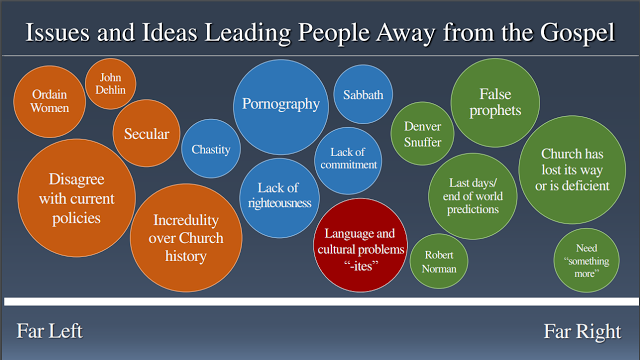
Some months ago a PowerPoint slide made the rounds of the Internet.

This graphic purports to be part of a presentation to LDS General Authorities on the topic of what issues and ideas lead people away from the Church (notice the slide says “Gospel” instead of “Church”), organized from “Far Left” to “Far Right.” I can’t vouch for its authenticity, of course, but it does reflect what I’ve seen and heard over many years, coming from the perspective of leaders and active members in the Church. I call this the “active LDS” perspective. 
A corresponding graphic was prepared and circulated also showing what purports to be the issues and ideas leading people away from the Church, but this one is from the perspective of people who are not active LDS (inactive, former members, nonmembers).

This one, too, reflects what I’ve seen and heard over many years, coming from those who are not active in the Church (whether nominally members or not) for whatever reason. I call this the “non-LDS perspective.”
I have lots of thoughts on each component. For example, the “non-LDS” chart cites “Church lies about its history,” but that’s an anachronistic objection now that we have access to original documents. I still hear people repeat the canard that Brigham Young changed Lucy Mack Smith’s biography of Joseph, or that the text of the Book of Mormon was changed x number of times, but we all have access to the original documents, so those objections seem silly, at best. 
Another one that stands out on the “non-LDS” chart is “Poor apologetics backfire.” I couldn’t agree more with this one, of course; I think the citation cartel has done some good, but far more harm because of their insistence on certain ideas, especially their two-Cumorahs theory that Joseph and Oliver were ignorant speculators who deceived the Church about Cumorah being in New York.
For now, on this blog, I want to point out something that stands out to me.
Notice that on the “non-LDS” chart, one of the largest circles is “Book of Mormon is not ancient.”
On the “active LDS” chart, the Book of Mormon isn’t even mentioned.
These are both accurate representations of the respective points of view, IMO. The “active LDS” chart doesn’t mention the Book of Mormon because active LDS don’t think (or admit) that Book of Mormon geography and historicity are important. They implicitly believe the book regardless. (Even that’s an overgeneralization, because many active LDS I know have problems with this topic. Some don’t even believe the Book of Mormon is an ancient document; they just don’t see this as a deal breaker for ongoing activity.) Active LDS don’t understand why someone who believes the Book of Mormon would entertain doubts about its authenticity. 
It’s essentially self-selection; i.e., if they did entertain doubts or questions, maybe they wouldn’t be active LDS.
From the outside (non-LDS) perspective, the historicity of the Book of Mormon is a fundamental issue. If, as they believe, the Book of Mormon is not ancient, then why should they believe it? Of course, this line of thinking leads to the corollary that Joseph was not a prophet, etc. 
In my view, the geography and historicity of the Book of Mormon are fundamental questions for everyone who reads the text. I think both have been well established by the North American setting. Some active LDS may set aside their questions in the interests of the greater good, meaning the other reasons for faith, but it seems unlikely that anyone who reads the Book of Mormon does not wonder, sooner or later, where it took place. 
It is for this reason that I’ve been writing this blog.
I think the traditional answers of the LDS scholars and educators who promote the Mesoamerican and two-Cumorahs theory directly undermine faith, for all the reasons I’ve discussed. These two graphics reflect that. 
I also think that if/when the LDS community converges on unity in supporting what Joseph and Oliver taught about Cumorah in New York, at a minimum, the problems of geography and historicity will diminish. Inactive, former, and prospective LDS will take another look at the Book of Mormon. In so doing, they will respond to the spiritual messages.
But I have to say, I don’t think the current generation of Mesoamerican promoters will change their minds, regardless of the evidence. It will take the cumulative experience of Church members over an unfortunately long period of time to change the so-called consensus that has led to the problems depicted in these two graphics. 

Source: Book of Mormon Wars

FairMormon helps anti-Mormons

For a reason I won’t get into right now, I’m going to revisit an ongoing and serious problem. FairMormon (https://www.fairmormon.org/) purports to be “the world’s largest database of faithful answers to critical questions.”

It may be the “largest database,” but since it misleads members of the Church, what good is a large database? A smaller, accurate database would be more effective.

FairMormon does some good work in many areas, but they also contribute to the confusion and loss of faith that we see happening in many cases because of their strict adherence to the Mesoamerican theory of Book of Mormon geography.

Take a look at this part of the “largest database of faithful answers.” FairMormon is a gift to anti-Mormon web pages in several respects, but especially when it comes to Book of Mormon geography.

https://www.fairmormon.org/answers/Book_of_Mormon/Geography/New_World/Hill_Cumorah#Question:_Where_is_the_Hill_Cumorah.3F

The first thing they do is say “The Church has no official position on any New World location described in the Book of Mormon.” To support this, they cite the phony fax from the “Office of the First Presidency,” here:
https://www.fairmormon.org/answers/Book_of_Mormon/Geography/Statements

I’ve previously shown here http://bookofmormonwars.blogspot.com/2016/11/how-to-create-some-doctrine.html that this “fax” is plagiarized from the entry in the Encyclopedia of Mormonism. That entry was written by David Palmer, who cites his own book to support the article. It’s classic citation cartel practice, and you’ll see more from Brother Palmer in this FairMormon article.
______________

As you read the FairMormon article on Cumorah, you’ll notice a few key points.

1. FairMormon never cites Letter VII because they don’t want members of the Church to know that Joseph and Oliver unequivocally identified the New York hill Cumorah as the site of the final battles of the Jaredites and Nephites. This is why you can’t trust FairMormon, and why so many members of the Church go to anti-Mormon web sites, which do explain Letter VII and how the LDS scholars and educators repudiate Joseph and Oliver to promote their Mesoamerican theories.

2. FairMormon claims David Whitmer, one of the 3 witnesses, was a liar (they use the euphemism to explain their rejection of his oft-repeated statement by saying “some historians question its accuracy”). This is the same approach that has led to the suppression of David Whitmer’s testimony in other media, as I’ve shown and will show again soon.

3. FairMormon refuses to quote modern prophets and apostles who have spoken about Cumorah being in New York and instead claim that “Since the 1950s, opinion among Book of Mormon scholars has increasingly trended toward the realization that the Nephite Cumorah and the Hill in New York cannot be the same.” FairMormon and many other LDS scholars and educators frequently claim the scholars know more than the prophets and apostles, so this is not unusual. Here, they quote Elder Dallin H. Oaks, as if he supports the two-Cumorahs theory!

4. FairMormon refuses to quote what President Joseph Fielding Smith said on at least two occasions. Referring to the two-Cumorahs theory that FairMormon promotes, President Smith said, “This modernistic theory of necessity, in order to be consistent, must place the waters of Ripliancum and the Hill Cumorah some place within the restricted territory of Central America, notwithstanding the teachings of the Church to the contrary for upwards of 100 years. Because of this theory some members of the Church have become confused and greatly disturbed in their faith in the Book of Mormon.” Instead of quoting President Smith, FairMormon quotes criticism of him by a Mesoamerican proponent, and then supports it with 40-year-old hearsay from a student in a class at BYU.

5. FairMormon quotes Brother Palmer’s “geographic conditions” for the Hill Cumorah that include the self-serving requirements for volcanoes and no cold or snow. The Mesoamerican theory depends on its own retranslation of the text anyway (i.e., horses are tapirs, towers are huge stone pyramids, etc.), but these “requirements” for Cumorah have led to the comical search for Cumorah in Southern Mexico that has consumed the time and effort of many people for over 100 years. Worse, these requirements rely on the premise that Joseph and Oliver were ignorant speculators who misled the Church.
_____________

You can read the rest of the article and see the other logical and factual fallacies, but I point out the five above to explain why, if you have people who want to know about the Church, or people who have questions about the Book of Mormon, you should not send them to FairMormon.

Source: Book of Mormon Wars

Unless it is exactly like themselves

On October 22, 1829, Joseph Smith wrote a letter to Oliver Cowdery from Harmony, Pa.

“Respected Sir I would in form you that I arrived at home on sunday morning the 4th after having a prosperous Journey, and found all well the people are all friendly to <us> except a few who are in opposition to ev[e]ry thing unless it is some thing that is exactly like themselves.” (original spelling)

Over the last couple of years as I’ve been involved with questions about the Book of Mormon historicity and geography, as well as Church history, I’ve noticed two main themes.

The historians generally want to get the history right. They don’t have an agenda other than accuracy. Naturally, many of them were taught a particular point of view about Church history, and these traditions endure, as I’ve shown in the Joseph Smith Papers, the Church history museum, and other places. But for the most part, historians are dedicated to accuracy. They embrace all evidence and seek to reconcile it all, as much as possible.

That’s definitely not what I’ve experienced with the Mesoamerican proponents.

This group, typified by the “Book of Mormon Archaeological Forum” which owns Book of Mormon Central, by their own admission, has the goal “to increase understanding of the Book of Mormon as an ancient Mesoamerican codex.” They are not just uninterested in evidence that contradicts their goal; they actively oppose it.

As Joseph expressed it, they “are in opposition to everything unless it is some thing that is exactly like themselves.”

Consequently, the pursuit of consensus about Church history has a high likelihood of success. People dedicated to accuracy and consideration of all relevant material should be able to reach a consensus about the facts, at a minimum, and hopefully about the most reasonable inferences as well.

Obviously, there are critics of the Church who claim to know all the facts and yet infer different motivations, thereby reaching different conclusions, but to the extent these inferences are spelled out, people can make informed choices. In my experience, few of the critics have all the facts. They find enough to support their doubts and stop seeking. I’d be interested in any critics who know all the facts about the two sets of plates and reach different conclusions, for example.

With respect to Book of Mormon geography, however, we have the most prominent group of LDS scholars and educators whose main goal is “to increase understanding of the Book of Mormon as an ancient Mesoamerican codex.” (This goal appears to be shared by Mesomania Meridian Magazine, Mesomania BYU Studies, The Mesomania Mormon Interpreter, the Mesomania Maxwell Institute, and other such publications.)

Of course, one could say that Moroni’s America is dedicated to “increase understanding of the Book of Mormon as a history of North America,” but I don’t think the two situations are parallel.

First, I accepted the Mesoamerican material for decades before new information helped change my mind. A person who has never changed his/her mind ought to wonder why other once like-minded people have.

Second, I did not start out with the goal of presenting a “North American” setting. I started with the goal of understanding what Joseph and Oliver taught, and then seeing if the text described what they claimed. That goal could have led me to a setting of New York state or all of the Western Hemisphere, and anything in between. In fact, it could have led to a Mesoamerican setting.

But it didn’t.

This shows the fundamental difference between my approach and that of the Mesoamerica proponents. I start with what Joseph and Oliver said and see if the text can be interpreted to support their claims. Then I look at anthropology, geography, archaeology, geology, etc. Everything seems to fit quite nicely.

The Mesoamerican approach (as well as the Baja, Chile, Peru, Malaysia, and other non-New York Cumorah approaches) start with interpreting the text and then seeking a place where it fits. In my view, this is not just unwise. It is nonsensical. The text is vague enough to support any number of possible settings. Perhaps an infinite number, but surely a number in excess of 100.

That’s why the Lord told us where Cumorah was.

This all boils down to the reality that until members of the Church reach a consensus on Cumorah, we will never reach a consensus on the rest of the Book of Mormon geography.

Conclusion: Let’s reach a consensus on Church history, which is doable.

Then let’s reach a consensus about Cumorah, which should be doable.

Then, let’s all work together to see how the New York Cumorah fits.

Source: Book of Mormon Concensus

A fair chance

Accepting and living the gospel can be a challenge, so I continue to wonder why we make it harder for investigators (and members) than it needs to be.

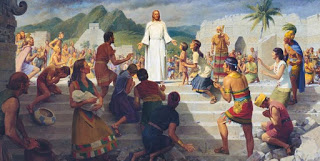
The Mesoamerican and two-Cumorahs theories are ubiquitous in the Church, thanks to the Arnold Friberg paintings and Christ Visiting the Americas featured in meetinghouses, temples, and the missionary and foreign-language editions of the Book of Mormon itself.

It’s not just the illustrations. These theories have been taught at BYU (all campuses) and throughout CES (Church Educational System) for decades. They have been featured in the Ensign, New Era, Friend, and Liahona. They are in all the visitors centers, etc. They are the “consensus” among LDS scholars even today.

Look at what these theories ask investigators (and members) to believe.

1. Joseph Smith was a prophet who translated the Book of Mormon by the power of God.
2. The Book of Mormon is an actual history of real people.
3. We don’t know where the Book of Mormon took place, but we do know that Joseph Smith was an ignorant speculator who misled the Church when he and Oliver taught that Cumorah was in New York.

I realize that sounds harsh, but that’s the reality of what is going on right now. 

As long as this continues, I don’t think investigators (and members who have questions) have a fair chance to evaluate the Book of Mormon, Joseph as a prophet, and everything else that flows from there.
_________________

A basic gospel principle recognizes that people are free to choose. But freedom to choose is premised on meaningful alternatives. Imperfect alternatives are one problem inherent in mortality, but what if none of the alternatives available to you are viable?

Let’s say you’re diabetic and the only food source available to you is a candy store. Does it really make any difference which candy you choose?

What if you grow up in a society that presents choices that are mostly “evil” in terms of the gospel, but some are less evil than others? As a society degenerates to the point where all choices are evil, maybe free agency becomes an illusion and you end up with a Noah’s flood scenario.
_______________

Now, think of the choices available to an investigator.

Choice 1. You can stick with one of the many beliefs put forward by the world, all of which contradict Mormonism–including the beliefs you grew up with.

Choice 2. You can consider Mormonism.

Let’s say you’re one of a tiny percentage of Earth’s inhabitants who chooses Choice 2.

If you’re already Christian, you accept the general idea of God and Jesus Christ as taught in the Bible. So far, so good.

But if you’re Christian, you probably have trouble with the idea of Joseph Smith as a modern prophet. And if you’re not Christian, you have the same trouble.

The missionaries ask you to read the Book of Mormon to find out if it’s true. If it is, they say, then Joseph was a prophet and all is right in the world of Mormonism.

The first thing you do is open the book and see the illustrations. You recognize the Mayan motifs and ask the missionaries where the Book of Mormon people lived.

“Central America,” one companion says. “We don’t know,” the other says. Or, if the investigators are lucky, one missionary will say “North America, with Cumorah in New York.”

The confusion is apparent to the investigator even before he/she starts reading.

Worse, the more the investigator learns, the more he/she comes to recognize the basic inconsistency of what the missionaries expect him/her to believe. 

Investigator: “If Joseph was a prophet, why would he mislead everyone about Cumorah being in New York?”

Mesoamerican promoter: “He didn’t.”

Investigator: “But I saw this article about Letter VII online and–“

Mesoamerican promoter: “You’re not supposed to read that.”

Investigator: “But it’s right here, Look.” (pulling it up online)

Mesoamerican promoter. “Okay, since you insist, I admit it’s true that Oliver Cowdery explicitly said Cumorah was in New York in his Letter VII. It’s also true that Joseph helped write the letter and fully endorsed it on multiple occasions. But later Oliver left the Church. Joseph changed his mind and said the Book of Mormon took place in Central America.”

Investigator: “He did? Where?”

Mesoamerican promoter: “In a series of anonymous letters in the Times and Seasons. But don’t read those, either, because Joseph identified Quirigua as Zarahemla, which obviously can’t be correct, so Joseph simply didn’t know what he was talking about.”

Investigator: “I thought you said he was a prophet.”

Mesoamerican promoter: “He said he was only a prophet when he spoke as a prophet. When he spoke about Cumorah, he obviously was not a prophet.”

Investigator: “That sounds… doesn’t that seem to bring everything he said into question?”

Mesoamerican promoter: “No. Joseph was a prophet about everything except about things our scholars disagree about. Our scholars have a consensus that the Book of Mormon took place in Mesoamerica. That’s why you see the illustrations in the book we gave you. That’s why they’re hanging up at the chapel. You don’t need to worry about a thing. When Joseph Smith was wrong about something, our scholars have corrected him.”

Investigator: “I see… Thanks for your time, but I won’t be needing this.”
(hands the Book of Mormon back).

Source: Book of Mormon Wars

Serious obstacle to consensus-Translations of the Book of Mormon obscure meaning

One obstacle to consensus is changing the text of the Book of Mormon itself. 

I’ve referred to the “Sorenson” translation before, when Brother Sorenson and like-minded people use terms that aren’t actually in the text. The best known example is replacing the phrase “head of Sidon” with “headwaters of Sidon.” Another is the phrase, “narrow strip of mountainous wilderness.” Mountainous does not appear in the text.

When I recently translated the pocket edition of Moroni’s America into French, I discovered something I hadn’t noticed before.

The translation of the Book of Mormon into French uses the Sorenson translation.

Wherever the text uses a variation of the phrase “head of the river Sidon,” the translation first converts the English into “source of the river Sidon” and then translates it that way.

Look at Alma 22:27. “the borders of the wilderness which was on the north by the land of Zarahemla, through the borders of Manti, by the head of the river Sidon, running from the east towards the west.”

In French: “les régions frontières du désert qui était au nord près du pays de Zarahemla, à travers les régions frontières de Manti, près de la source du fleuve Sidon, allant de l’est vers l’ouest.”

This is not a literal translation!

Instead, it’s an interpretation.

The literal translation of the French back into English would be: near the source of the river Sidon.

Of course, that’s the Sorenson translation, meaning, that’s the translation that Mesoamerican advocates wish Joseph Smith had used, and the one they prefer. They think Joseph should have written “headwaters” instead of “head” of Sidon.

I’ve discussed this Sidon several times on this blog. You can find the posts by searching for “head of Sidon.” Here is one example:

http://bookofmormonwars.blogspot.com/2015/12/head-of-sidon-still.html

The Mesoamerican activists need the Sidon river to flow northward because the only two rivers in Mesoamerica that they can possibly identify as Sidon both flow northward. Therefore, they reason, “head of Sidon” means “headwaters of Sidon,” which means “source of Sidon.”

The Mesoamerican activists have successfully educated people throughout the Church about the Sorenson translation (i.e., headwaters of Sidon), and the translator used Sorenson’s translation, not Joseph Smith’s, when he/she translated the Book of Mormon into French.

A literal translation into French would be: À la tête de la rivière Sidon.

The same thing has been done in the translations into other languages.

I’m sure the translators think “head of the river” is too vague to translate, so they put it in words that convey a specific meaning; i.e., they changed the text to read the “source of the river.” 

Joseph knew the word source. He used it here, in 2 Nephi 25:26: “And we talk of Christ, we rejoice in Christ, we preach of Christ, we prophesy of Christ, and we write according to our prophecies, that our children may know to what source they may look for a remission of their sins.”

Had the Nephite text referred to the source of the river Sidon, Joseph could have used that word. I think he would have used that word. He would have dictated “source of Sidon.”

Instead, he chose the phrase “head of Sidon.”

The Mesoamerican activists think Joseph translated this incorrectly. They think he should have dictated “headwaters” or “source.” They can’t change the original text (fortunately), but they can change the foreign language texts by influencing the translators.

Consequently, unless you read English, you will think Joseph translated the plates using the term “source” in connection with the River Sidon. 

But he did no such thing.
____________________

A related problem is the small neck of land, the narrow neck of land, the narrow neck, the narrow pass, and the narrow passage. In English, each of these is a distinct term. But in French, they are conflated into one term, the way the Sorenson translation does.

Alma 50:34 – there they did head them, by the narrow pass which led by the sea into the land northward, yea, by the sea, on the west and on the east.

French – là ils les devancèrent, près du passage étroit qui menait près de la mer jusque dans le pays situé du côté du nord, oui, près de la mer, à l’ouest et à l’est.

Mormon 2:29 – And the Lamanites did give unto us the land northward, yea, even to the narrow passage which led into the land southward. 

French – Et les Lamanites nous donnèrent le pays situé du côté du nord, oui, jusqu’au passage étroit qui menait au pays situé du côté du sud.

Notice how in French, both are translated as passages, even though the term passe is the French translation of the English pass

Alma 63:5 – launched it forth into the west sea, by the narrow neck which led into the land northward.

French – et le lança dans la mer de l’ouest, près de la langue étroite qui menait au pays situé du côté du nord.

Ether 10:20 – And they built a great city by the narrow neck of land, by the place where the sea divides the land.

French – Et ils construisirent une grande ville près de la langue étroite de terre, près de l’endroit où la mer divise le pays.

Both of these are translated as a “narrow tongue,” not as a “narrow neck.”

Alma 22:32 – the land of Nephi and the land of Zarahemla were nearly surrounded by water, there being a small neck of land between the land northward and the land southward.

French – le pays de Néphi et le pays de Zarahemla étaient presque entourés d’eau, une étroite bande de terre existant entre le pays situé du côté du nord et le pays situé du côté du sud.

Notice here that the French does not say a “small” neck of land, but a “narrow strip of earth.” This seems to refer back to verse 27, another narrow strip, but it also links it to the previous narrow places.

Alma 22:27 – by a narrow strip of wilderness, which ran from the sea east even to the sea west, 

French – par une étroite bande de désert, qui allait de la mer de l’est jusqu’à la mer de l’ouest,

The French translation uses “désert” for wilderness (which means desert in English) instead of a more accurate translation, “région sauvage.”

Source: Book of Mormon Concensus

Current state of the consensus

I continue to think it would be possible to reach a consensus about Book of Mormon geography if everyone sat down and discussed the issues openly.

But that isn’t happening.

The proponents of Mesoamerica don’t even want Church members to know about the North American setting. This is easy to understand.
_____________

As it stands today, there are two basic groups.

Group A thinks Cumorah is somewhere other than in New York. Adherents think Joseph and Oliver were wrong when they identified the hill in New York as Cumorah. They think scholarship can identify the Hill Cumorah and other sites.

Group B thinks Cumorah is in New York, based on what Oliver Cowdery wrote in Letter VII. Adherents think Joseph and Oliver knew Cumorah was in New York because they had visited the repository of Nephite records in the hill, because of the two sets of plates, because Moroni identified it as Cumorah, etc.
_____________

I don’t think the choice between these two views is even close. Most members of the Church, when presented with the choice, choose Joseph and Oliver over the scholars.

This explains why the scholars and educators who promote the Mesoamerican setting refuse to present their theory alongside the North American setting. The only way their theories endure is by excluding the North American setting from their publications, conferences, web pages, and classrooms.

Instead, you’ll read 2D arguments about which way the river Sidon flows, which “correspondences” are closer to which interpretation of the text, etc.

But you won’t read the 3D argument about accepting or rejecting Joseph Smith and Oliver Cowdery.
_____________

The current status of the consensus is this: people who accept what Joseph and Oliver said about Cumorah accept the North American setting, while people who think Joseph and Oliver didn’t know what they were talking about accept another setting (Mesoamerica, Baja, Panama, Chile, Peru, Malaysia, etc.).

IOW, the status hasn’t changed much.

Except that thousands of people are changing their minds about the setting, switching from Mesoamerica to North America.

Source: Book of Mormon Concensus