Conference tomorrow (Sat, July 8 2017)
I’m speaking about Church history and my soon-to-be-released book titled Why Mormons Need the Book of Mormon.
Here’s the info.
Source: Book of Mormon Wars
"Moroni's America" – The North American Setting for the Book of Mormon
The Book of Mormon in North America
"Moroni's America" – The North American Setting for the Book of Mormon
The Book of Mormon in North America
"Moroni's America" – The North American Setting for the Book of Mormon
The Book of Mormon in North America
I’m speaking about Church history and my soon-to-be-released book titled Why Mormons Need the Book of Mormon.
Here’s the info.
Source: Book of Mormon Wars
The First Presidency taught Elder Parley P. Pratt (1807–57) when he was a newly called member of the Quorum of the Twelve Apostles: “You have enlisted in a cause that requires your whole attention; … become a polished shaft. … You must endure much toil, much labor, and many privations to become perfectly polished. … Your Heavenly Father requires it; the field is His; the work is His; and He will … cheer you … and buoy you up.”1
Footnote 1 is “Autobiography of Parley P. Pratt, ed. Parley P. Pratt Jr. (1979), 120.
The original source for this passage is Minutes and Blessings, 21 February 1835, found in the Joseph Smith papers here: http://www.josephsmithpapers.org/paper-summary/minutes-and-blessings-21-february-1835/2
The passage follows this explanation: “The following charge was then given Elder P. P. Pratt by President O. Cowdery.”
This charge, given by Oliver Cowdery, was done on behalf of the First Presidency. This is why President Eyring tells us that “the First Presidency taught” Elder Pratt, even though it was Oliver who did the instructing.
At the conclusion of Oliver’s charge, the minutes record this:
“Elder Pratt gave his hand to President O. Cowdery and said he had received ordination and should fulfil the ministry according to the grace given him. To which the President replied, Go forth and Angels shall bear thee up and thou shalt come forth at the last day bringing many with thee.”
Can there be any doubt that Oliver Cowdery acted with the authority of the First Presidency?
That same month, February 1835, the Messenger and Advocate published Oliver Cowdery’s letter IV. A few months later, in July 1835, Oliver published Letter VII.
Because it contradicts their theories (the two-Cumorahs and Mesoamerican theories), many LDS scholars and educators still try to persuade members of the Church that Letter VII is false. They actually want you to believe that Oliver Cowdery, who was the Assistant President of the Church at the time, acted with the authority of the First Presidency in all matters except for certain passages of this one letter.
Think about that for a moment.
_____________
The Mesoamerican activists want you to believe that Oliver (and Joseph Smith, who helped write these letters and endorsed them multiple times) were ignorant speculators who misled the Church. This is especially ironic because Oliver started Letter VII by pointing out that “any tune can be played upon the bible.” As he explained, “What is here meant to be conveyed, I suppose, is, that proof can be adduced from that volume, to support as many different systems as men please to choose.”
It was specifically to avoid that problem that Oliver wrote with clarity and precision about the early history of the Church. He noted that “men, in previous generations, have, with polluted hands and corrupt hearts, taken from the sacred oracles many precious items which were plain of comprehension, for the main purpose of building themselves up in the trifling things of this world.”
It seems possible, if not likely, that Oliver anticipated a future time when even members of the Church would question basic facts about Church history that were well known in his day. Perhaps it was for that reason that he emphasized the fact that the hill in New York, where Joseph found the plates, was in reality the Hill Cumorah of the Book of Mormon. Here’s what he wrote:
“At about one mile west rises another ridge of less height, running parallel with the former, leaving a beautiful vale between. The soil is of the first quality for the country, and under a state of cultivation, which gives a prospect at once imposing, when one reflects on the fact, that here, between these hills, the entire power and national strength of both the Jaredites and Nephites were destroyed.
“By turning to the 529th and 530th pages of the book of Mormon you will read Mormon’s account of the last great struggle of his people, as they were encamped round this hill Cumorah. (It is printed Camorah, which is an error.) In this valley fell the remaining strength and pride of a once powerful people, the Nephites-once so highly favored of the Lord, but at that time in darkness, doomed to suffer extermination by the hand of their barbarous and uncivilized brethren. From the top of this hill, Mormon, with a few others, after the battle, gazed with horror upon the mangled remains of those who, the day before, were filled with anxiety, hope, or doubt. A few had fled to the South, who were hunted down by the victorious party, and all who would not deny the Savior and his religion, were put to death. Mormon himself, according to the record of his son Moroni, was also slain.
“But a long time previous to this national disaster it appears from his own account, he foresaw approaching destruction. In fact, if he perused the records of his fathers, which were in his possession, he could have learned that such would be the case. Alma, who lived before the coming of the Messiah, prophesies this. He however, by divine appointment, abridged from those records, in his own style and language, a short account of the more important and prominent items, from the days of Lehi to his own time, after which he deposited, as he says, on the 529th page, all the records in this same hill, Cumorah, and after gave his small record to his son Moroni, who, as appears from the same, finished, after witnessing the extinction of his people as a nation.”
_________________
The Mesoamerican advocates want you to disbelieve what Oliver wrote here because it directly contradicts their own theories.
But isn’t their approach exactly what Oliver was seeking to refute?
The Mesoamerican activists are “playing their own tune” on the writings of Oliver Cowdery, specifically repudiating what he so clearly and unambiguously declared.
Remember that whenever you read about Book of Mormon geography in BYU Studies, FairMormon, the Intepreter, Book of Mormon Central, Meridian Magazine, or any other member of the citation cartel.
Source: Letter VII
No surprise, there is a contrary view that the earlier, different measurements were erroneous.
Regardless of which side is correct about the speed of light, the phrase “intellectual phase locking” can extend beyond the consensus about the speed of light.
Obviously, on this blog I’m referring to the Mesoamerican theory of Book of Mormon geography. A critical mass of LDS intellectuals (scholars and educators) have reached a “majority consensus” of opinion that the Book of Mormon took place in Central America (specifically, Mesoamerica).
It’s not difficult to trace the history of Mesomania intellectual phase locking. I’ve already done that.
Once established, the phase locking continues through the educational process. Pretty much every student who has gone through BYU or any CES program in the last few decades–I speak from personal experience–has been locked into the same intellectual phase regarding the Mesoamerican/two-Cumorahs theory.
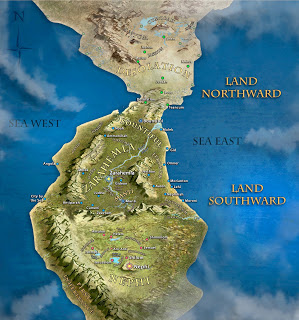
It is currently being perpetrated at BYU where students are required to study the Book of Mormon by referring to an “abstract map” that places Cumorah in a mythical location on a mythical map, akin to a Hobbit’s map of Middle Earth.
This is supposed to replace the previous “intellectual phase locking” that focused on Mesoamerica, specifically the Sorenson map (which is still found on the splash page of BYU Studies.)
Of course, it’s merely an iteration of the two-Cumorahs, Mesoamerican theory, rotated 90 degrees. That’s exactly what you’d expect when the creators adopted the Mesomania interpretations of the text.
Which would be funny if it wasn’t being established as the “official” or at least “officially approved” version of Book of Mormon geography.
Unless something changes, quickly, the process of intellectual phase locking will establish this map as the de facto Book of Mormon geography that LDS people everywhere will learn.
IOW, LDS students will be taught that the Book of Mormon took place in a fantasy, video-game-like world.
How effective do you think that will be?
Source: Book of Mormon Wars
And yet, “most” LDS scholars and educators outright reject it.
Why?
Because it directly refutes their opinions about Book of Mormon geography.
In fact, if you’re a new reader on this blog, you may have never heard of Letter VII. Especially if you were educated at BYU or in CES.
In Letter VII, Oliver Cowdery and Joseph Smith claimed it was a fact that the final battles of the Nephites and Jaredites took place in western New York.
But our LDS scholars and educators insist Letter VII is false because the New York hill is not the real Cumorah and that these battles took place in Mesoamerica (or Baja, Panama, Chile, etc.). This “two-Cumorahs” theory dominates the Church, despite the nominal “neutrality” position.
That’s why the Arnold Friberg paintings are in the missionary editions of the Book of Mormon. That’s why Mayan motifs are found throughout Church media. That’s why the North Visitors Center on Temple Square teaches that the real Cumorah was in Mesoamerica.
According to our LDS scholars and educators who promote the Mesoamerican theory, Joseph and Oliver were ignorant speculators who misled the Church about the New York Cumorah.
Now, is it “contentious” for me to make these observations?
__________________________
On the topic of contention, there’s a nice article on lds.org right now from Elder Larry R. Lawrence. You can see it here.
He writes,
“3. Contention
“Satan is the father of contention. He delights in seeing good people argue. When there is contention in your home or workplace, immediately stop whatever you are doing and seek to make peace. It doesn’t matter who started it.”
I completely agree with this. But we have to read it in the context of the rest of the article. Elder Lawrence’s first point teaches how to resist temptation; i.e., he points out that Jesus “ordered Satan to leave.” Resisting temptation consists of contending against temptation. His second point teaches us about lies and deception; i.e., the “dirty little secret that he doesn’t want you to know is that sin is addictive.” Satan also uses the logical fallacy of argument by consensus; i.e., “Everyone else is doing it.” His fourth point teaches us about “fighting discouragement.”
Not only is there is nothing inherently wrong with resisting, fighting and contending; these concepts are central to the purposes of life. To some degree they are implicated in every choice we make. If we don’t contend against the adversary–if we make peace with his efforts–we’ll become like him because then we’re contending with the Spirit of the Lord. Conversely, if we don’t contend with the Lord–if we make peace with his efforts–we’ll become like him because then we’re contending with the adversary.
The decision of whom we accept is also a decision about whom we contend with.
Obviously, Elder Lawrence is not counseling against contention per se; he’s warning against contention that arises from fault-finding and lies, especially when accompanied by anger.
_______________
From time to time I hear or read contentious comments about Book of Mormon geography. Some of the best come from BMAF.org, which owns Book of Mormon Central, which promotes the Mesoamerican theory exclusively.
While I think the ideal solution for everyone is to reach a consensus, at least about the New York setting for Cumorah, I have no problem with people believing whatever they want. While I think it’s healthy to discuss different ideas, I don’t see any reason to contend about the subject–except where advocates of any position seek to suppress information.
As I’ve said many times, my main priority is help people make decisions that are fully informed. I don’t care if people agree with me or not; I just explain what evidence there is and how I interpret it.
In my view, the best approach would be full disclosure. Let everyone–every member of the Church, every investigator, every former member–have access to a comprehensive comparison of the various theories of Book of Mormon geography.
But advocates of non-New York Cumorahs don’t want that.
My entire purpose in writing books, blogs and articles, and in speaking, is to avoid contention and make peace by giving people as much information as I can so they can make informed decisions.
For example, I’ve provided a simple decision tree for people to use to help them decide which geography makes sense to them. You can see it here:
http://bookofmormonconsensus.blogspot.com/2017/02/cumorah-decision-tree-for-book-of.html
I’m perfectly fine with whatever conclusions people reach after going through the analysis.
But the prevailing approach among Mesoamerican activists is to suppress information and prevent people from being able to make fully informed choices. This is why BYU Studies, the Interpreter, Book of Mormon Central, BMAF, FairMormon and the rest of the citation cartel will never give readers access to a fair comparison of the different theories.
I strongly disagree with the approach of the citation cartel precisely because it leads to contention.
Am I being contentious when I point this out? Some apparently think so. But in my view, it’s the opposite of contention to encourage full disclosure and fully informed choices.
In the interest of full disclosure, I also posted a chart of relevant facts with which people can agree or disagree. It’s here:
http://bookofmormonconsensus.blogspot.com/2016/08/agree-agree-to-disagree-by-topic.html
So far as I know, it remains the most comprehensive and fair collection of relevant facts. If anyone knows of a better one, let me know.
_______________
For too long, LDS scholars and educators who promote the Mesoamerican setting have suppressed Letter VII and its context. They don’t want people to even know about it. Then, when people do find out about Letter VII, these advocates don’t want people to believe it.
I’ve discussed their reasoning here:
http://www.lettervii.com/2017/01/why-some-people-reject-letter-vii.html
If people choose to reject Letter VII, that’s fine with me. At least, once they’ve read it, they are making informed decisions.
_______________
For me, the question of Book of Mormon geography boils down to one central question:
Is Cumorah in New York, as Joseph Smith and Oliver Cowdery taught?
1. If it is, then we can discuss where the rest of the events took place, using the New York Cumorah as a pin in the map. This can range from New York state to the entire western hemisphere.
2. If it is not (if Cumorah is not in New York) then IMO it doesn’t really matter where it is. Once you accept the premise of the two-Cumorahs theory–i.e., that Joseph and Oliver were ignorant speculators who deceived the Church–does it really make a difference what you believe about what they said?
As I’ve said all along, if people want to reject Letter VII, that’s fine with me. But let’s not prevent people from even knowing about Letter VII.
_______________
Source: Book of Mormon Concensus
You can find the article and book online here: https://rsc.byu.edu/archived/book-mormon-authorship-new-light-ancient-origins/9-credibility-book-mormon-translators
I highly recommend the article, which explains why Joseph Smith and Oliver Cowdery deserve to be believed. It concludes with this:
A secular society hardly recognizes that decisions can be made in terms of future accountability. But the Prophet reveals this perspective in adjusting a conflict with the intense comment, “I would be willing to be weighed in the scale of truth today in this matter, and risk it in the day of judgment.” [61] The Prophet and Cowdery kept journals with periodic and profound introspection. Thus Cowdery’s editorial farewell rings true in saying that he had well counted the cost of trying to “persuade others to believe as myself,” and he willingly faced the “judgment seat of Christ,” who would see “the integrity of my heart.” [62] The names of Joseph Smith and Oliver Cowdery led the rest in certifying the truth of the events and teachings of the 1835 Doctrine and Covenants, the first book to name the messengers restoring both the Book of Mormon and the two priesthoods. [63] The preface, stamped with Oliver Cowdery’s phraseology, expresses their solemn view of eternal responsibility: “We do not present this little volume with any other expectation than that we are to be called to answer to every principle advanced, in that day when the secrets of all hearts will be revealed, and the reward of every man’s labor be given him.”
_____________
But there is some tremendous irony here. First, the article doesn’t mention Oliver’s 8 letters about Church history, including Letter VII. Was that an intentional omission, an oversight, or an intervention by an editor who rejects Letter VII and its implications?
Second, the book containing this article was edited by Noel Reynolds, who, I’m informed, is a staunch Mesoamerican proponent who insists Cumorah is not in New York. IOW, he believes Joseph and Oliver were ignorant speculators who misled the Church about the New York Cumorah.
In my ongoing effort to understand why LDS scholars and educators reject Letter VII, this article demonstrates the major problem of the Mesomaniacs who want us to believe Joseph and Oliver were credible and reliable about literally everything except Letter VII.
Source: Letter VII
Too bad they don’t look at Book of Mormon Central (BOMC).
If you click on one of the articles in BOMC’s “archive” you will also get a “More like this” sidebar with suggestions for more reading. No matter what resource you select, you will be directed to articles that support the main objective of BOMC, as expressed by its owner, BMAF:
“Our goals are (1) to increase understanding of the Book of Mormon as an ancient Mesoamerican codex.”
IOW, the goal of BOMC is to convince members of the Church that Joseph Smith and Oliver Cowdery were ignorant speculators who misled the Church about the location of Cumorah in New York.
It’s not an easy task, this effort to undermine the credibility and reliability of Joseph and Oliver (and David Whitmer). Most LDS accept these men as reliable, credible, rational people who simply reported the facts about their experiences. But not BOMC.
To make the Mesoamerican setting work, BOMC and the rest of the citation cartel must frame these men as ignorant and confused so that they, the BOMC scholars, can come to the rescue with their more sophisticated education and explain that Joseph and Oliver and David (and Brigham Young, John Taylor, Wilford Woodruff, Joseph Fielding Smith, Marion G. Romney, Mark E. Peterson, etc.) were ignorant speculators who misled the Church.
BOMC is trying to convince members of the Church that every prophet and apostle of the latter-days, starting with Joseph Smith, who has discussed Cumorah in General Conference or other official avenues, has been an ignorant speculator who misled the Church.
This is why their “archive” contains only material that promotes the Mesoamerican theory.
You can search BOMC all you want and you will find no material about the New York Cumorah, apart from a single source, which is my first edition of the short Letter VII book. You can still see it here: https://archive.bookofmormoncentral.org/content/letter-vii-oliver-cowdery%E2%80%99s-message-world-about-hill-cumorah
I give BOMC credit for uploading that reference in the first place, and for not removing it. Yet.
However, I have ceased working with BOMC because they put up attack articles without even acknowledging that I’ve responded, let alone putting up my actual responses.
They continue to suppress ideas and facts that contradict their main goal of establishing the Mesoamerican setting.
IMO, they are doing tremendous harm to the Church and to the effort to sweep the Earth with the Book of Mormon.
And if the EU cared, they would no doubt fine BOMC for the same reason they fined Google.
__________________
Here’s a fun example.
Look at this BYU Studies article on Zelph.
https://archive.bookofmormoncentral.org/content/zelph-story
It contains the old canard that Joseph Smith changed his mind over time regarding Book of Mormon geography, based on the false assumption that Joseph read the Stephens books and commented about them in the Times and Seasons. The “More like this” sidebar refers readers to this classic:
https://archive.bookofmormoncentral.org/content/what-significance-zelph-study-book-mormon-geography
The author here claims that the Zelph incident cannot “provide conclusive evidence for anything” because so many people recorded their subjective experiences. If we had only Wilford Woodruff’s account (as is the case for many important events in Church history), we would take it as the entire truth about the event. (That’s how we ended up with the false quotation in the Introduction to the Book of Mormon.)
But because others recorded the Zelph incident, giving greater context, we’re now supposed to think that Joseph’s revelation about Zelph is meaningless.
To make sure you get the message, BOMC guides readers to even more ridiculous articles in the “More like this” sidebar:
More like this
The Zelph Story
John Bernhisel’s Gift to a Prophet: Incidents of Travel in Central America and the Book of Mormon
KnoWhy #130- Why Did Mormon Give So Many Details About Geography? (Alma 22:32)
The Treason of the Geographers: Mythical “Mesoamerican” Conspiracy and the Book of Mormon
Review of Deciphering the Geography of the Book of Mormon and An Ancient American Setting for the Book of Mormon
I’ve addressed these articles in detail, but BOMC won’t tell you that.
Plus, they omit from their “Archive” what I consider the best article about Zelph ever published by BYU-affiliated organizations:
http://emp.byui.edu/marrottr/341folder/zelph%20revisited%20cannon.html
Needless to say, BOMC will never publish anything on Zelph that supports a theory that contradicts their Mesomania. They want members of the Church (and investigators) to believe Joseph Smith was an ignorant speculator who misled the Church about the New York Cumorah and therefore expected scholars (i.e., BOMC) to determine where the Book of Mormon took place.
__________________
When you realize what BOMC is doing, how shamelessly they are promoting their Mesomania dogma, it’s actually pretty funny.
Except it’s also tragic for those who want to know the truth.
Source: About Central America
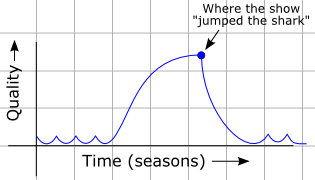
In their latest issue, 56:2, they’ve “jumped the shark”* with their Mesomania.
The issue includes a book review of Jerry Grover’s book, “Geology of the Book of Mormon.” I’ve commented on this book in the past. Jerry’s a great guy, and his book is interesting and well reasoned, but it’s nothing but confirmation bias. It’s entirely based on the premise of volcanoes, which we all know are never once mentioned in the text.
Here’s the Mesomania logic:
1. The Book of Mormon took place in Mesoamerica.
2. Mesoamerica has lots of volcanoes that are a significant part of the Mayan lifestyle and culture.
3. Therefore, the destruction in 3 Nephi must have been caused by volcanoes.
The logical fallacies here are easy to identify for those not suffering from Mesomania. The most obvious one is this: the Book of Mormon never mentions volcanoes!
Not only are volcanoes never mentioned in the text, but the supposed impact of volcanoes happened exactly once over 1,000 years in a land supposedly dominated by volcanoes. It’s an absurd proposition, of course. For an explanation of volcanoes in that region, go here. Then there is the matter of earthquakes, which occur I think twice in the Book of Mormon. Go to any earthquake map and you’ll see that in Mesoamerica, earthquakes are a frequent occurrence. The real Book of Mormon lands should have serious earthquakes only rarely–and no volcanoes.
Because Mesomaniacs start their thinking with a premise that contradicts what Joseph and Oliver clearly taught–i.e., that Cumorah is in New York–what do we expect other than logical fallacies?
___________________
Here is the summary of the book review, with my comments in red. You can download the entire book review as a pdf here.
The summary is bad enough, but the rest of the article is even worse. Here are some bonus passages from the full article:
Using the geology of Mesoamerica, he tests some of the more popular geographic models, such as Sorenson’s, to see if the geography matches the geologic settings that would have been necessary to cause the events described within the Book of Mormon. As I pointed out already, this article and Jerry’s book are purely bias confirmation.
Grover shows, clearly, that the geology of the Great Lakes region does meet the requirements of certain events, such as the mist of darkness (3 Ne. 8:19–22). This is a classic straw man argument. I don’t know of anyone except Aston who promotes a “Great Lakes region” argument for the Book of Mormon the way the Mesomania scholars characterize it, such as FairMormon, here. [BTW, that article uses information that FairMormon knows is false, but they refuse to correct it because the falsehood corroborates their theory but the truth does not.] Not only is this a straw man argument (attacking a fiction created by the Mesomania scholars), but it’s a red herring because it distracts from the reality that Mesomaniacs don’t want people to know about. Google “New Madrid earthquake” and you’ll see that everything described in 3 Nephi has actually occurred along the Mississippi River, including the mist of darkness, within recorded history. Here’s the USGS site on the topic.]
Various geologic scenarios are presented and evaluated in a step-by-step progression, beginning with a volcano-only event and then progressing to the possibility of multiple events, such as a volcanic
eruption and a major earthquake acting concurrently. All of the “various geologic scenarios” involve volcanoes! And yet, as I pointed out, the specific items described in 3 Nephi have occurred in the Mississippi River valley without any volcanic action–just as the text describes them. The “volcano requirement” is pure fiction, concocted to exclude alternatives to the Mesoamerican setting. How do they explain Mormon’s failure to even mention volcanoes? They don’t, but they use the typical methodology of inferring whatever isn’t in the text that they need to support their theory. This is what I call the “Sorenson translation” and the entire two-Cumorahs/Mesomania theory depends on it.
I went into the book with a rather critical eye, which, I think, made me sensitive to some of the imperfections, but by the time I reached chapter 12, “Best Fits for Locations and Events,” I found myself intrigued by Grover’s interpretations. [This is one of my favorite passages. Mesomaniacs always claim they apply a “critical eye,” yet never once does the reviewer question the underlying premise (that the Book of Mormon took place in Mesoamerica) nor the obvious problem that the text never mentions volcanoes. Instead, his “critical eye” notices things such as typos, a lack of uniformity in figures, and a bibliography that is “not as extensive as I would have liked” because Jerry didn’t cite two of the author’s own articles–one of which is titled “Volcanic Destruction in the Book of Mormon.” That’s what passes for criticism when one is “reviewing” a book that confirms one’s biases.]
__________________
If Meso BYU Studies was interested in a serious book review, maybe it would have someone who doesn’t already agree with the major premise–someone whose criticism would include more than complaints that his own articles weren’t cited–do the review.
But it never will.
This book review is consistent with the overall editorial stance of the journal. Like the rest of the citation cartel, BYU Studies will never publish a side-by-side comparison of alternative Book of Mormon geography theories as described by their respective proponents, let alone an honest critique of Mesomania and the associated bias-driven articles that permeate what passes for LDS scholarship in this area.
___________________
*Jumping the shark is described this way: “Jumping the Shark is the moment when an established long-running series changes in a significant manner in an attempt to stay fresh. Ironically, that moment makes the viewers realize that the show’s finally run out of ideas. It’s reached its peak, it’ll never be the same again, and from now on it’s all downhill.”
Source: Book of Mormon Wars
I think it’s the opposite of “controversial” to review and support what Joseph Smith, Oliver Cowdery, David Whitmer, Brigham Young, Anthony Ivins, Marion G. Romney, Mark E. Peterson, and others have taught about Cumorah.
My approach to Church history is to consider all the accounts, assume people were generally honest (although highly subjective) and then seek to understand and reconcile inconsistencies. I continually invite comment and refinement. I don’t claim I’m right about anything; I only explain what makes sense to me and why alternative interpretations don’t make sense to me. I change my mind whenever someone offers a better explanation. (That’s the process I used to reject the Mesoamerican theory after having accepted it for decades.)
It’s funny that this is considered “controversial” when many of the prevailing traditions are, or should be, the ones considered controversial.
To me, what should be controversial is the common practice among some LDS scholars and educators to reject any historical accounts, scriptures, or statements of modern prophets and apostles that contradict their theories about the Mesoamerican setting. It’s the tail wagging the dog, and it’s on display throughout LDS academia, media, and artwork.
Even worse is the ongoing effort by the citation cartel to suppress information and opinions that differ from the Mesoamerican/two-Cumorahs theories.
Specifically, here are some things I consider controversial:
1. The ongoing effort by many LDS scholars and educators to suppress and reject Letter VII by insisting that Joseph and Oliver were ignorant speculators who misled the Church. This group includes everyone who advocates a so-called “two-Cumorahs” theory, an “abstract map” of the Book of Mormon, and/or a Mesoamerican, Baja, Panama, Chile, or any other theory that puts Cumorah somewhere other than western New York.
If you’re a student at BYU, for example, you are taught an “abstract map” of the Book of Mormon that declares Cumorah is not in New York, which in turn teaches that Joseph and Oliver were ignorant speculators who misled the Church. It’s difficult for me to imagine a more controversial teaching, yet every BYU student is required to learn this.
2. The ongoing effort by some LDS scholars and educators to claim Brigham Young either made stuff up or was recounting a bizarre vision when he related what Oliver Cowdery said about the repository in the New York hill Cumorah, Others besides BY also mentioned it, but just two months before he died, BY spoke about this because he didn’t want the knowledge to be lost or forgotten. Yet thanks to the efforts of Mesomania scholars and educators, few members of the Church have ever heard about this.
3. The ongoing effort by some LDS scholars and educators to impose imaginary “requirements” on the text and to find “correspondences” between Mesoamerican culture and history on one side, and what they think the Book of Mormon text should say on the other. These imaginary “requirements” include such things as volcanoes, which are never even mentioned in the text but, according to the Mesomania scholars and educators, must be found any proposed Book of Mormon setting. The “correspondences” are illusory, IMO, because they are features of most human societies. Many of them are based on the spurious “Sorenson” translations summarized by horse = tapir and narrow neck of mountainous wilderness.
___________________
My approach to the scriptures has been to understand the text of the scriptures (BoM, D&C, PofGP, Bible) from the perspective of those who wrote them. For example, the idea that the “narrow neck” would be Panama (or, worse, the Isthmus of Tehuantepec) is purely a modern construct, based on modern maps of the entire western hemisphere.
If it wasn’t such a serious problem, I would find it funny to have people determining, by “consensus,” what a “narrow neck of land” must mean–especially when the only real consensus among these scholars and educators is that Joseph and Oliver didn’t know what they were talking about. This is how the Nicene creed was developed.
____________________
The next time someone tells you that Letter VII, the two sets of plates, the New York Cumorah, and/or the North American setting of the Book of Mormon are “controversial” topics, ask them about the three I listed above.
And that’s just for starters.
🙂
Source: Book of Mormon Wars
![]() |
| G. Washington, “President of America” |
People keep asking about the concept that Lehi’s descendants inhabited all of North America and South America. Some early members of the Church thought this, but Joseph Smith never taught it. Still, it makes sense when we realize that people intermarried and migrated extensively after the Nephite civilization was destroyed in western New York.
A lot of the confusion comes from statements such as this one from Wilford Woodruff’s journal, dated April 1844:
“Conference met at 10 oclok April 8th. President J Smith arose and said it is impossible to continue the subject that I spoke upon yesterday in consequence of the weekness of my lungs. Yet I have a proclamation to make to the Elders. You know the Lord has led the Church untill the present time. I have now a great proclamation for the Elders to teach the Church here after which is in relation to Zion. The whole of North and South America is Zion. The mountain of the Lords House is in the centre of North & South America.“
Mesoamerican activists actually cite this as evidence that the Book of Mormon took place in Central America.
Others read the rest of the journal entry and get a better idea of what was intended.
“When the House is done, Baptism font erected and finished & the worthy are washed, anointed, endowed & ordained kings & priests, which must be done in this life, when the place is prepared you must go through all the ordinances of the house of the Lord so that you who have any dead friends must go through all the ordinances for them the same as for yourselves; then the Elders are to go through all America & build up Churches until all Zion is built up, but not to commence to do this untill the Temple is built up here and the Elders endowed. Then go forth & accomplish the work & build up stakes in all North and South America. Their will be some place ordained for the redeeming of the dead. I think this place will be the one, so their will be gathering fast enough here.”
In modern times, we interpret this to mean the continents of North America and South America, but that’s now how it was meant in 1844.
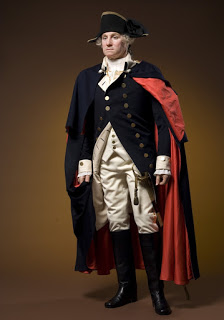
About a year later, in June 1845, Woodruff was back in England. He visited the exhibition of Madame Tussaud and Sons. One of the exhibits that most impressed him was this:
“George Washington dressed as the President of America taken from A bust executed from Life. This personage bespoke as much dignity as any member of the Group.”
Woodruff used the term “America” interchangeably with the United States, or the United States of America. He referred to it as America three times as often as he did the United States. Like his contemporaries, he was concerned about the division between the northern states and the southern states. For example, he made this comment in Volume 2 of his journal:
“After General Harison was elected President of the United States A body of citizens suspended a line across the road in which the President was to walk. This line contained or supported 27 flags one for each of the states. As General Harrison was passing under thes colors the line parted in the centre. One half fell into the street towards the north & the other half towards the south as much as to say the states would be divided.”
_________________
When we think about Joseph Smith’s statement from the April 1844 conference, he was referring to the Nauvoo temple, which was built “in the centre of North and South America” if we’re referring to the United States of America. It’s nearly as central as possible in a literal sense, given the unknown extent of the western territories.
When Joseph said the Elders were to go through “all America” “& build up stakes in all North and South America,” he was referring to the United States, as we can see not only from the ordinary use of the term “America” at the time, but also from the reality of what actually happened. The Elders were already in Europe. They didn’t go to South America until much later. But it was important for the members to know they would build the Church in both North and South America. They were not going to focus just on the northern states, where most of them had come from.
It’s always important to read historical documents in the context of the times in which they were written.
___________________
The question remains, how could there be descendants of Lehi throughout the western hemisphere if the events of the Book of Mormon took place in North America (using modern terminology).
The quick answer: the Nephite civilization was destroyed in western New York, after years of battles all the way from Zarahemla in Iowa, across the midwest (Bountiful) eastward to New York. Later, after the Book of Mormon record was concluded and Moroni buried the plates, people from the Mayan civilization migrated northward and occupied what is now the Southeastern U.S. and the Mississippi River valleys. After a few hundred years, they left and returned to their homeland in Central America. This explains how Lehi’s blood, however diluted, made its way throughout what today is known as Latin America.
Source: Book of Mormon Wars
This is why I like to simplify the issue..
One way is the binary decision about Cumorah; i.e., is there only one Cumorah in NY, or is the “real” Cumorah (Mormon 6:6) located somewhere else?
That’s a simple question.
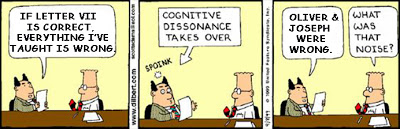
And it has a simple answer, which this modified cartoon explains:
_________________
Another simplification is distinguishing between 2D and 3D debates.
The never-ending debates about interpreting the text (where is the narrow neck of land, where is the snow, etc.) are 2D (two-dimensional) because they are purely surface issues that cannot be resolved from the text itself. That’s why there are dozens (or hundreds) of proposed maps.
The 3D (three-dimensional) debate is whether we can trust Joseph Smith and Oliver Cowdery as reliable, credible people when they wrote Letter VII.
As the cartoon illustrates, it’s a simple question.
1. If Letter VII is correct, the Mesoamerican setting doesn’t work and is wrong.
2. If Letter VII is wrong, then Joseph and Oliver were ignorant speculators who misled the Church (until LDS intellectuals figured out that Cumorah was actually somewhere in southern Mexico).
I think it should be easy to reach a consensus on this point, at least. In fact, I think most LDS who know about Letter VII and read it find it persuasive. The only exceptions are those who have a stake in the Mesoamerican theory, and therefore have a level of cognitive dissonance that is so high, Letter VII and its historical context is not sufficient to persuade them.
Maybe what we’re really seeing now is two separate sets of consensus being formed.
1. Everyday LDS are reaching a consensus that Letter VII is accurate, with all that entails.
2. Some intellectual LDS are sticking with their consensus that Letter VII is false, with all that entails.
The split between the two is becoming more stark all the time.
Source: Book of Mormon Concensus